
In short
"If spiritual
practices are to yield their fruits without fail, they should
be observed with a full awareness of their purpose".
~ Ramana Maharshi, Sri Ramana Darsanam
The steps of spiritual ladder - in short.(1)
Step One - Law of Force.
Man uses physical/intellectual/material force to acquire as many objects as possible that he loves and in which he seeks happiness. In doing so, he performs unrighteous acts by gaining objects at the expense of the weaker ones.
This is the zero level, in fact still beyond the spiritual path. It drags on for many incarnations.
Since there are always more objects desired than possessed, and unrighteous acts result in rebirth in weak bodies unable to satisfy their lusts, such a person eventually matures and learns that unrighteous acts weaken, and in order to have a better effect he must follow the Dharma - the path of right deeds/behaviour.
In this way, he moves to a higher stage.
Step Two - Righteous deeds: the path of karma.
Man, by performing proper righteous deeds, tries to achieve Liberation. He continues to love objects and seeks happiness in them. That is how many more incarnations pass again.
However, the sack of desires has no bottom; the more objects man acquires the more he desires them, without ever being able to achieve fulfillment. Unable to quench the fire of desires with deeds, this man eventually matures and learns that karma does not give Liberation because it is unconscious and that only God is Consciousness - so in order to achieve more at less cost, he must turn to God/Gods by worshipping them.
In this way, he moves to a higher stage.
Step Three - Worshipping various Gods/Goddesses or divine beings with love of objects.
A person accepts the existence of an all-powerful Being superior to himself, begins to believe in and worship him. At this stage, he believes in many Gods [many names and forms of God] or divine beings (angels of various levels, saints, divine mothers, various aspects of God, etc.) and worships them. He still loves the objects of this and other worlds and seeks happiness in them, while God [Gods, divine beings] is supposed to help him acquire them. This is the stage on which most devotees of various religions find themselves. This is again how many incarnations pass.
However, since there are too many objects, and such a man is unable to worship all the names and forms of God equally properly, problems arise in his life and he comes to the conclusion that he is doing something wrong. In this way, he matures and learns that there is only one God, whom he worships in the form of different names and forms - because up to now he has worshipped different names of God (aspects, divine beings, etc.) his devotion has been scattered and weak. To correct this, he must worship only one God.
In this way he moves to a higher stage.
Step Four - Worshiping one God with love of objects.
Man already has only one God, but through him he still seeks satisfaction of his needs and desires; what he loves are the objects meant to satisfy him in one world or another, and God is the helper in all this. His mind, which until now was divided among many Gods or many aspects of God/divine beings, is now focused on one, which makes it stronger and more effective.
At this stage, a person can see the worshiped God in personal form. People at lower levels encountering such a God-seer are inclined to uncritically assume that he has realized God, when in fact he has not even attained love for God yet, but still has love for the objects of this and other worlds. At this level, many lose the right path and their progress is significantly retarded - seeing the figure of the beloved God fulfilling their desires, they are charmed by this and are themselves inclined to believe wrongly that they have realized God.
--------------------------------------------------------------------------------------------------------------
This is where miraculous powers appear - so-called siddhis [kalpita](2) (which can actually also manifest at an earlier level) - but these are ego-based powers that have the power to seduce, blind and bind. If one succumbs to their charms, one can become stuck for a long time. Such siddhis are considered an obstacle and a trap on the spiritual path.
--------------------------------------------------------------------------------------------------------------
Although God appears in personal form before such a zealous devotee fulfilling his desires, he deliberately does not fulfill them all, because the devotee is still unable to distinguish between what is truly good and what is bad. As part of his divine game, God refuses to fulfill some of his devotee's wishes or fulfills them in such a way that various troubles ensue. In this way, through successive incarnations, he teaches him lessons of spiritual maturity.
Eventually such a man matures and comes to the conclusion that asking God for objects was not right, and that by asking for them through so many incarnations - the one who all-knowing, all-loving and all-powerful Supreme and knows what he needs without asking - by this very act of asking he has only offended Him. He reaches the point where he begins to love God for God himself and not for the objects of this or other worlds.
In this way he goes to a higher stage again.
--------------------------------------------------------------------------------------------------------------
Here is an important caesura: after passing the fourth stage, man ceases to seek his happiness in objects with the help of God and is now seeking God only for himself acquiring a disposition to surrender his ego.
At this stage the nature of the teachings changes: until the fourth step they sanctioned the ego and its making happy, from the fifth step they begin to talk about the necessity of ego annihilation. --------------------------------------------------------------------------------------------------------------
Step Five - Worshiping one God with love of God.
Man no longer loves objects and seeks them - he seeks and loves God alone. He stops asking God for objects, he asks for God alone. Thus develop in him strong dispassion [vairagya] and strong love of God [deiva bhakti ] - two wings [vairagya and deiva bhakti] grow in him on which he continues to glide to the goal.
God, who previously fulfilled man's trivial requests, now asked earnestly for only himself, responds to this request and ... disappears! Up to now he has allowed his name and form [nama-rupa] to be worshipped, but since these are unreal aspects of him, now, seeing man's readiness for something more, he wants to give him the real himself - so God withdraws his name and form from the eyes of the worshipper. The dark night falls.
This man, who has hitherto considered the form of God to be his actual nature, thinks that his beloved God has abandoned him and is suffering in the agony of separation. This great pain, however, is only due to his lack of true knowledge of the real aspects of God: Existence-Consciousness-Happiness [sat-chit-ananda]. In order for him to know these aspects God must now give him a lesson of true knowledge.
In this man, until now, the conviction was strong that he was a staunch believer and his devotion to God was great, and God loves him. On the ground of these feelings, his ego was growing. In order for him to move on, God must now burn out his ego. To do this, he needs a helper - someone who has himself been born out of the body on Earth and has realized the state of God, to whom he sends the adept to learn. Such someone is called Sat-Guru (Satguru, Sadguru].
In this way, the man goes to a higher stage.
Step Six - Love for the Guru.
The Supreme, knowing how difficult it is to make a man realize God if he himself is not born on Earth from a mother as a human being accepting all the limitations of the human body, in his grace appears in the world in a human body as an incarnation of God along with the Master-disciple relationship inscribed in this incarnation in order to guide mature followers to the final rung of the spiritual ladder. This relationship makes the disciple, upon meeting his Guru, immediately burn with great love for him, confident that in the Guru he has found an embodied God who fulfills his real needs, unlike the earlier image of God fulfilling his various trivial desires.
However, since only the ego-loss conditioned realization of one's oneness with the Self, which is the true nature of God [sat-ćit-ananda], and merging with it without leaving the slightest trace of individuality, is true God-seeing and God-realization, the task of such a Sat-Guru is to bring about the destruction of the ego in the disciple so that the disciple abandons even the outward form of his Guru [nama-rupa] and realizes the Self [sat-chit-ananda, his true nature] within himself.
The Sat-Guru provides him with a direct path for this and teaches him to follow it. Its essence is based on grasping the direct connection to God within oneself and advancing along it. At this level the disciple must cling directly to God, he must not rely on anything indirect; his ego can only be destroyed by the real God, not any image or form of God. At this stage, God's mighty grace acts directly and in its full power, burning away the disciple's hidden inclinations and bestowing a foretaste of divine happiness [real, not imagined]. Thus he proceeds to the higher, final stage.
--------------------------------------------------------------------------------------------------------------
At this step siddhi [akalpita, different from the earlier ones called kalpita] may once again appear, but this time they are of a different nature - they appear without desire for them being a side effect of the practice performed, they are based on the Self and not the ego, they manifest by the power of the Self, they do not delude, bind or blind. The adept feels no passion for them, treating them on a par with any other skill such as walking, hearing, etc.
--------------------------------------------------------------------------------------------------------------
Step Seven - Love of Self and Liberation [Moksha].
By practising sharply, to the limit of his ability, powerful direct practice, combined with surrender to God, the disciple exposes himself to the direct grace of God - this grace slowly burns out the hidden tendencies in him and eventually destroys them completely. In this way, God completes his spiritual path and bestows the realization of the state of perfect, pure love experienced as the imperishable state of Love of the Self, which is God.
Man achieves Liberation - the highest human possibility and value. His ego is never reborn again, and he continues to live in the body as a Jivanmukta - Liberated while alive, living in perfect happiness-love-bliss-peace-joy, in a state called the "fourth state" [turiya] (or turiyatita - the transcendental state), transcending and different from the three commonly known states (waking, dreaming, deep sleep). It is the leaving of the wheel of mundane existence [samsara] and the completion of man's spiritual path.
Such a man is a great treasure for humanity carrying it all upward. Unfortunately, he is also a great rarity. Currently, no such realized sage living in a body on Earth is widely known (he may live without revealing himself to the wider public). Anyhaw we don't know about him.
--------------------------------------------------------------------------------------------------------------
One who has attained the Self [atma-swarupa-siddha] in the described way is one who has simultaneously attained all other siddhis, because this one [attainment of the Self] is the highest siddhi, above all the others. Just as all planets are in space whether manifesting or not, so all siddhi are in the one who has realized the Self. They may or may not manifest in his presence - this is meaningless and is not an indicator of the state of Liberation. One should not judge whether one is a realized sage or not by the manifestation of siddhis or not. One who judges on the basis of siddhi is like a six-year-old child learning the multiplication table, whose Nobel Prize-winning father, when asked, flawlessly recites the multiplication table to the child, to which the child states: "Wow, my dad knows the multiplication table! He really deserved the Nobel Prize!".
The most valuable of the powers manifested by realized sages and felt by others is the ability to transmit in Silence the experience of the happiness of the Self. It is a unique power, inherent only to realized sages or very advanced practitioners at the sixth level, but beyond the reach of ordinary siddhas of earlier stages. Such power manifested in the presence of Ramana Maharshi.
--------------------------------------------------------------------------------------------------------------
Note: The spiritual teachings found in our website - especially in their practical, overarching dimension - are suitable for adepts from the fifth stage upward, especially those moving from the sixth to the seventh stage, but to a lesser extent for those in the first through fourth stages.
Anyone at any stage can, of course, derive from Ramana Maharshi's instructions, but putting them into practice from the practical side [that is, the proper practice of Atma-vichara] will be made much more difficult or even impossible at the earlier stages.
However, even in such a situation, there is a wicket open on the path of Ramana Maharshi: earnest, persistent and correct work in the preliminary phase of the practice taught by Sri Ramana will allow one to purify the mind and move upward faster than on other, circuitous paths, developing a doposition for the proper practice and giving correct direction at the same time, which together will eventually give one the ability to perform the proper practice and experience the Self.
How long it will take is an individual matter.
Ramana Maharshi himself said once [Upadesa Undiyar] about his path that it is "a path for all", and another time [Upadesa Manjari] that it is "only for ripe souls".
And this and this is true.
______________
(1) Based on " The Path of Sri Ramana Part II" by Sadhu Om.
(2) We write about siddhis [kalpita] here and draw attention to them not because they are supposed to be of any importance on the path of Sri Ramana, but because there is a widespread belief that they are an indicator of a man's spiritual greatness; as you can see, this is incorrect.
----------------------------------------------------------------------------------------------------
The direct path - in short.
1. You exist. You are. This is the only indisputable fact.
You can question everything else, but not that you exist, because to try to question anything, you must first exist.
Your existence/being is self-aware - no one has to confirm or make you aware that you exist
This existence/being did not come to you from outside - you existed before you were given a name and taught anything.
Your existence/being is permanent and natural - everything else is acquired, can come and go.
2. This existence/being manifests itself as "I" or "I am."
This feeling is with you always; even in the deepest darkness, when all senses are turned off, the "I am" remains intact.
3. However, what you currently experience as "I" or "I am" takes the form of "I am this or that" and is not pure "I" but "I" mixed with the sense of being a body (mind) and various adjuncts (attributes or veils).
These adjuncts are, for example: thoughts, feelings, sensations, moods, inclinations, habits, desires, fears, attachments, identifications,etc.
This impure sense of "I" is called personality, ego, personal "I", false "I", body-consciousness knot.
This ego is constantly grasping for more adjuncts (mental objects), which nourishes and strengthens it.
This ego veils your true "I".
This is the primary and only real reason for experiencing lack of happiness (including: sufferings, fears, feelings of lack, desires, anger, feelings of meaninglessness, etc.), all the others are secondary and disappear if you remove the first one.
This personal "I" as a whole is a creation that has no real existence; if one searches for what is real in it - it disappears, and what remains is the true "I", which alone is real.
4. In this personal "I" are combined two components: the sense of "I" or "I am" and the adjuncts (identifications/attachments/attributes/veils).
These two components are fundamentally different one from the other.
The sense of "I" is connected to the true "I", the adjuncts are not.
Adjuncts have the nature of external objects, the sense of "I" has in reality the nature of the Self.
The sense of "I" is connected to reality, while adjuncts are unreal in nature.
5. That which is the true "I" in you is the Self, Pure Consciousness.
It is the source from which your personal "I" arises and to which it is connected by a sense of "I".
6. In order to stop experiencing lack of happiness, you must purify your "I" of all identifications/adjuncts and, maintaining this state, return to the Source in order to immerse and melt/merge the "I" into the Source from which it emerged.
From "I am this or that," the "this or that" must disappear.
In order to get there, you must follow the path that leads through the "I" and only through the "I," because only the "I" is connected to the Source.
If you try to take with you on this path any adjunct to the "I" you will fail and will not reach the Source.
7. To accomplish this, you must do some work. This work is called spiritual practice.
The path of the practice leads through the "I", because only the "I" is connected to the Source and in reality has its nature.
If the practice did not have the nature of the Self, it could not lead to the Self.
If the means leading to the goal is not of the same nature as the goal, it will not lead to it.
Therefore, mental practices (e.g., affirmations, imagery, visions, etc.) cannot take you outside the mental realm.
No practices that accept the personal "I" as real will take you beyond the dominion of the personal "I".
The direct path does not lead by confronting anything but only by holding on to the sense of "I am" with the exclusion of everything outside of it.
8. The practice is to turn attention away from the objects and, at the same time, turn it to the subject, that is:
a) purifying the "I" from all adjuncts (or, in other words, distinguishing "I" from "non-I", subject from objects) and directing and focusing all attention on the "I" or "I am" with the intention of discovering the truth about the "I".
b) keeping all attention on the "I" or "I am" thus purified.
The method of practice offered to the world by Ramana Maharshi is called Atma-vichara (Self-enquiry, Self-attention, Self-abidance, Self-attentiveness, "Who am I?"). Sri Ramana called it the direct path for all.
Atma-vichara is a non-confrontational method - it doesn't involve confronting anything but just holding on to the sense of "I am" with the exclusion of everything else.
9. As a result of this practice, the personal "I" as such ceases to exist. You continue to exist as the true "I".
The false identification with the body (mind) and all adjuncts are permanently removed, and your sense of "I" immerses/merges into the Source (Self, God, Love).
The snake ceases to be a snake, it turns out to be the rope it always was.
As a result of this practice, all the ties by which the adjuncts were bound in your "I" are permanently broken and cannot be restored, because their root - the body-consciousness knot - is removed.
10. Now you are pure existence/being. This existence/being is your natural state.
In this state you are the unveiled true I, the Self, Pure Consciousness, Love, Reality, Sat-Ćit-Ananda.
This is the state of full happiness.
This is the state of Liberation.
This is Moksha.
This is Mukti.
This is the Self-realization.
This is the natural state.
This is the severance of the bonds of karma.
It is the state of absence of suffering, fear, misery, etc.
By longing for happiness, you are actually longing for this state, and it is only for lack of true knowledge that you try to replace its lack with pleasures, amusements or the accumulation of wealth of this or other worlds.
11. This existence is the same existence that was at the beginning.
What was real at the beginning is real now, only the unreal adjuncts and misidentification have disappeared.
You exist, as you have always existed.
Now, however, it is a pure existence, devoid of false identification.
Nothing new has been added to your existence - in this sense, it can be said that there is no path to walk, no work to be done, no achievement, and no realization - everything is and always has already been realized.
However, they were - through the discovery of their lack of real existence - removed all the projected unreal veils/adjuncts on the Self along with the misidentification, or in other words false realization of the unreal was removed - in this sense, one can speak of a demanding path to walk, practice and work to be done, and the realization of the Self (Liberation, breaking the bonds).
12. Gradually and slowly.
As a rule, the whole process is gradual and slow, with the last step - breaking the body-consciousness knot and karma ties - taking the blink of an eye and being irreversible.
----------------------------------------------------------------------------------------------------
The direct path of Sri Ramana - even more briefly.
1. You exist. You are. This is the only undeniable fact.
You can question everything else, but not that you exist, because to try to question anything, you must first exist.
Your existence/being is self-aware - no one has to confirm or make you aware that you exist
This existence/being did not come to you from outside - you existed before you were given a name and taught anything.
Your existence/being is permanent and natural - everything else is acquired, can come and go.
This existence/being manifests as "I" or "I am."
This feeling is with you always; even in the deepest darkness, when all senses are turned off, the "I am" remains intact.
Through this feeling [awareness] of "I am" you are directly connected to the Source [God, the Self]; "I" ["I am"] is the only trope leading to this Source - those who want to get there should grasp and follow it.
2. However, what a man experiences on a daily basis as "I" or "I am" takes the form of "I am this or that" and is not pure "I", but "I" mixed with the sense of being a body (mind) and various adjuncts (attributes or veils).
These adjuncts are, for example: thoughts, feelings, sensations, moods, inclinations, habits, desires, fears, attachments, identifications,etc.
Such mixed with adjuncts "I am" is not suitable to be a thread leading to the Source, however proper spiritual practice is able to restore this ability by purifying it.
This impure sense of "I" is called personality, ego, personal "I"/self, false "I"/self, etc.
This false self/"I" [ego], which we take for our real self, is a breeding ground for unhappiness and it veils the true "I" [Self], which is happiness itself.
Such a situation is called the forgetfulness of our true nature [pramada(3)] and is a great misfortune for man.
Ultimately, the goal of spirituality is the reversal of this process and our return to the Source, the Self, our true nature (although on indirect paths there may be no mention of this at all).
For this to happen, a combination of two elements is necessary: human effort and the grace of the Supreme.
3. In this personal self, two components are combined: the sense of "I" or "I am" and adjuncts/identifications/attachments/attributes/veils. These must be separated.
These two components are fundamentally different: the sense of "I" ["I am"] is connected to Reality, whereas the adjuncts are unreal in nature.
With the power of effort-demanding spiritual practice [atma-sadhana], from the "I am this body" and the tangle of adjuncts/objects, one must isolate the pure "I am" [the preliminary stage of practice], grasp and hold on to it, in order to proceed slowly along its track to the Source [the proper stage of practice].
4. Thoughts constitute the mind, the mind constitutes the personality, the personality veils the Self [true "I"].
In every arising thought there is an "I am" [aham-writti] and all the other components [objects, adjuncts]; from this thicket it is possible to pick out and capture the mere "I am" that has the connection to the Source, letting go of all the other components as spam that does not have this connection.
5. To accomplish this, it is necessary to direct attention [consciousness] in such a way that it stops clinging to thoughts [objects, adjuncts] and at the same time completely diverts to the thinking subject, "I" ["I am"], and then keeps full attention on it (without inattention, pramada*).
The Atma-vichara [Self-enquiry] method given by Ramana Maharishi serves this purpose.
6. When the pure-sattvic mind, purified of all objects/adjuncts, holds attentively to the "I" alone, the I-thought, the root of the thoughts [mind], disappears revealing the true "I" [Self] alone, called here "I am I" [I-I] or aham-sphurana.
In order to achieve this, earnest, steadfast, persistent, dedicated and correctly performed Atma-vichara practice is required.
7. This is the state of directly clinging to the Source [Self], directly drawing from it and directly experiencing the happiness of the Self unavailable in this world and far superior to what the world has to offer.
This state, in which there is not even the slightest trace of the I-thought, is called Silence [mouna] or the state of pure existence [pure being] and is the most powerful, wonderful and excellent spiritual practice [tapas], as defined by Bhagavan in the 30th verse of Upadesa Undiyar.
8. This state is also called "abiding in the Self" [Self-abidance, Self-attention] and is the essence of Sri Ramana's path in general and Atma-vichara practice in particular.
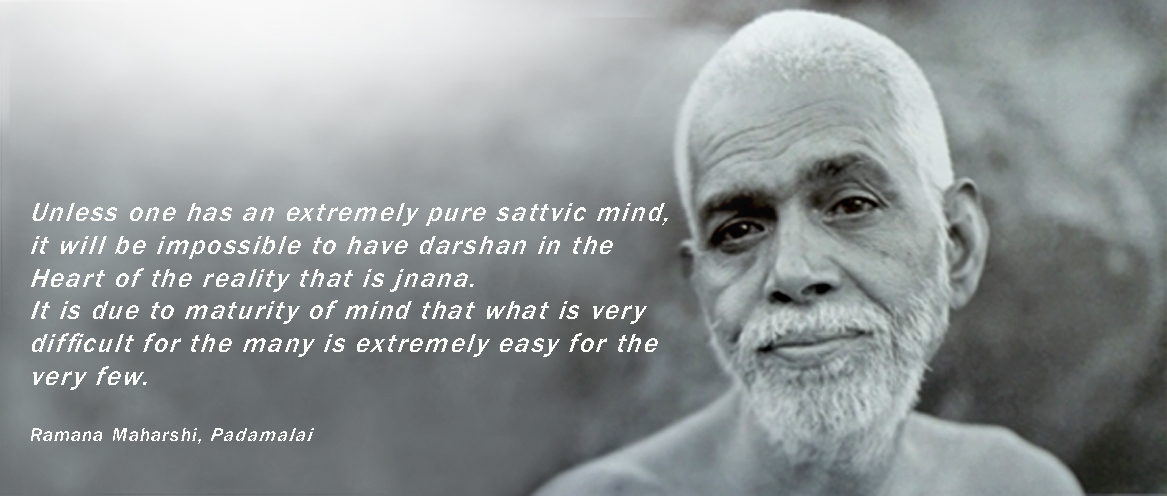
There are no words to describe the significance of this. Bhagavan once said [Padamalai]: "That bliss that grows in the field of mouna is not attained and experienced in any other field".
9. It is at the same time a direct and complete surrender of oneself to God (surrendered is "I" and "my", ahamkara and mamakara) and an acceptance of his grace without the rest.
(From the very beginning it is required to place all one's burdens at the feet of God/Guru/Self as an integral, intertwined with Atma-vichara element of the path of Sri Ramana).
In this state, without further man's effort, the Supreme Grace destroys the accumulated driving cogs of the wheel of suffering and misery [hidden tendencies, sanskaras and vasanas] in the karmic deposit, which are indestructible in any other way (they are not destroyed by death, they are carried over to subsequent incarnations).
10. At the stage of spiritual practice [tapas], entering and leaving the state of Self-abidance - as a result of the working of the latent tendencies expelling from it - takes place many times.
At the beginning it lasts a very short time, as practice progresses it gets longer, and the ease of entering and maintaining it increases. Hidden tendencies are destroyed slowly and gradually, and the whole process takes a long time.
Eventually it develops into a permanent state of being in the Self [Self-abidance].
11. When this state is firmly established in an instant moment the remaining tendencies, the bonds of karma and the body-consciousness knot [chit-jada-granthi] are finally broken and man, like a river flowing into the ocean, merges into one with the Source reaching the highest state of swarupa, one's true nature, Existence-Consciousness-Bliss [Sat-Chit-Ananda].
Such a one no longer experiences the happiness of the Self, he is the happiness of the Self. This is the state of fullness to which each of us, in our deepest depths, longs and strives (most often unaware of what we long for and strive for).
12. This is called Liberation while alive [Jivanmukti] (the body does not suffer any harm as a result of this process) or the Self-realization.
It is a permanent and eternal state (it does not change, it does not fluctuate, there is no more going in and out of it), and it is not terminated by the death of the body.
---------------
Summary:
God, to ensure that we have no difficulty in finding him, is present as close to us as possible: in the "I am" sense. He is present in everyone without exception not as something different from us, but shining uninterruptedly in the form of pure "I am" consciousness. Through it, he bestows his grace on all and everyone constantly and abundantly.
In order to take advantage of this grace so that with its help we can break out of the terrifying wheel of misery and suffering and live in a state of permanent and perfect bliss-happiness [our true nature], it is necessary to perform by our own efforts what lies within our capabilities - i.e., to turn away from charming objects and turn to "I am", - and then, without further effort on our part, to let grace perform what lies beyond our capabilities.
This way, the [seemingly] impossible becomes possible.
Sri Ramana Maharshi's path is based on this.
It has four major dominants:
a) This path is based on holding on to the "I am" alone, which is the only thing that is directly connected to the Source, so it is the direct path - everything else is indirect.
b) This path is based on holding on to the "I am" alone, which is the emanation of the Supreme's grace present in us, therefore it is the path of grace - grace alone performs what is impossible for man to accomplish.
c) This path is based on holding on to the "I am" alone, which already at the stage of performing the practice gives a pre-taste of the happiness of the Self, so it is the path of experience - those who follow it experience what it is all about in practice, they do not have to rely only on faith and promises.
d) This path is based on holding on to the "I am" alone, which is equal [proper stage] to being in a state of pure existence, which is the essence of true devotion [as defined in the 9th verse of Upadesa Undiyar], therefore it is the path of supreme devotion [self-surrender].
It is thus the direct path , the path of experience, the path of devotion [surrender] and the path of grace - all in one.
Such are the beauty and uniqueness of the path of Sri Ramana Maharshi.
This is also the path-shortcut, to be completed and accomplished in one lifetime.
The alternative(3A) are circuitous, indirect paths extending through many incarnations, at the end of which - to paraphrase Bhagavan - everyone must come to "I am" anyway.
------------------------------
(3) Pramada means both forgetfulness of the Self in a general sense and slackness in Self-attention in a specific sense.
(3A) It is commonly said that Ramana Maharshi gave a choice of two equivalent paths: bhakti and vichara. This is true at the beginning, later on these two paths intertwine with each other, to merge into one still later. We elaborate on this topic on our website.