
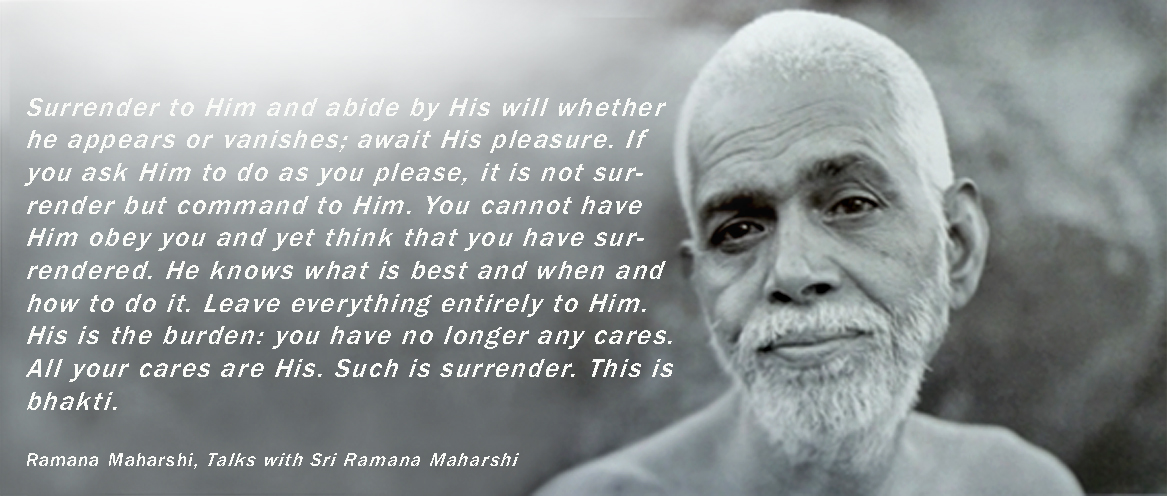
Miłość/oddanie [bhakti marga]
"It is very rare to get full faith in One [God or Guru].
If such a faith blossoms in the heart [due to past
merits], do protect and nourish it, since it is similar
to a new-born baby, without spoiling it by giving
room to any doubts or suspicion, just as, if one
possessed the Kamadenu, one would bring it up with
great care and love".
~ Ramana Maharshi, Guru Vachaka Kovai
(The Kamadenu is a divine cow which will give one whatever one desires).
As a result of the effect of undefinable, miraculous power, the souls [jivas] appear to be separated from their source.
Just as it is in the nature of water to continually flow downward to eventually reach the lowest place on earth - the ocean, so it is in the nature of the jiva to continually strive for its source - the Supreme. Making various efforts in the form of thought, speech and action, and not finding solace for long in the objects of this and other worlds, it very slowly makes its way towards its home.
The water, however, does not flow directly into the ocean - it fills all the depressions of the land it encounters on its way, stays in them for a shorter or longer time, flows from one place to another lower and lower according to the topography of the terrain. It evaporates and returns to earth again in raindrops. It doesn't even know where it ultimately goes. Similarly, souls engage in various activities according to their inclinations and character without a clear understanding of the ultimate goal of their efforts.
The jivas cannot stop their longing and cease their pursuit of happiness, for this is their nature. In order to realize it, they engage in the fulfillment of their immediate desires; however, whether they know it or not, their every effort is directed toward reaching their source, the Supreme [Brahman]. And just as water goes through a long and winding journey before it reaches the ocean, evaporating many times to transform into clouds and fall back to earth again, so too the soul goes through countless different incarnations before it reaches its home.
The soul's inherent love of happiness, depending on the degree of purity, takes on different strength - in its highest stage of love it is called Para Bhakti and is a direct experience of the Supreme, as the Supreme is nothing but an endless ocean of love and happiness. In this state, the jiva loses his soul nature and “regains” the nature of Brahman - eternal, effortless, undisturbed peace and happiness.
But before the jiva reaches its ultimate goal - Sat-Chit-Ananda, the vastness of never waning perfect happiness - no trivial pleasure can quench in it the desire for happiness and stop the efforts made to acquire it.
When these efforts are made deliberately, subject to control and regulation they become sadhana - the conscious spiritual practice of pursuing the Supreme. The loftiest and best effort a person can make in this life is such spiritual sadhana.
If a drop of water flowing down from the mountains finds its way into a mighty river flowing directly into the ocean, it will reach its destination smoothly and quickly, without turbulence or delay. The realized sages [Jnanis] who appear on earth from time to time are like a divine river - if the soul finds itself in their embrace it will reach its destination quickly and without unnecessary perturbation. The paths marked out by these divine rivers - the realized sages - are true spiritual sadhana, and each of them purifies the devotees who let themselves be swept along by its current.
The most powerful and closest to us current of the Ganges, the divine river of our time, is Bhagavan Sri Ramana Maharshi. To give oneself wholeheartedly and completely to living according to Sri Ramana's principals means to swim effortlessly with the current of devotion through the waters of the divine Ganges. Changing, distorting and interpreting his teachings to suit our purposes is swimming across the river, using its current to reach not the ocean, but some goal of our own on one of its banks.
It is said that there are two rivers flowing into the ocean of Existence [Sat]: the river of Wisdom [Jnana] or Consciousness [Chit], the flow of which is called the path of wisdom, knowledge or jnana [jnana marga or vichara marga] and the river of Happiness [Ananda or Priya], the flow of which is called the path of love, devotion or surrender [bhakti marga]. In other words, there are two paths to the source, i.e. realization of the Self, Brahman, God, the Supreme, Sat-Chit-Ananda [Existence-Consciousness-Happiness]: the path of wisdom [Chit or Jnana] or the path of love [Ananda]. This subsite describes the path of love - bhakti marga
What is bhakti? Bhakti is devotion. Bhakti is love. Love is like the waters of the Ganges. The waters of the Ganges are holy by nature. However, the same holy water is considered superior or inferior depending on the purity of the vessel it is in. Similarly, love or bhakti is divided into different degrees depending on the different levels of purity of the jivas minds. In this way, the bhakti present in different jivas can be divided into six different degrees or five successive standards/grades.
----------------------------------------------------------------------------------------------------
However, since the desired objects are always more than the objects already possessed, even the strongest of these people is unable to achieve fulfillment, so he tries to strengthen his body and mind to acquire more and more. However, by the power of the law of karma, as a result of his selfish actions causing harm to the weaker, which accumulate in the form of transgressions [sins], he is reborn in a physically weak body with a weak mind full of desires - which he is unable to satisfy; consequently, he suffers more and more.
In such a state he goes to a sage who gives him instructions called the Vedas, thus enrolling him in a bhakti school. This school has five standards, but one teacher. That teacher is the Vedas - the record of the teachings of realized sages.
The man says: Swami, my body and intellect are so weak, and the number of objects in the universe is so great, that in no way can I obtain them and satisfy my desires. Is there any better and faster way?
The sage answers: yes, it is. First, know the reason for your weakness. Everything of this world is God's creation and belongs to Him. For everything you take you must pay a price. You can't use your power to seize goods without paying the price, because this is a wicked act or otherwise a sin. The price you must pay is Dharma - righteous actions. Because you have not respected the laws of Dharma until now, your actions have weakened you. If you perform your actions knowing and applying Dharma, your actions will be righteous
----------------------------------------------------------------------------------------------------
"Karma giving fruit,
Karma Kanda is a very large part of the Vedas; because so many people are influenced by the mistaken belief that sense objects bring happiness, the Vedas take pity on them just as a mother takes pity on a not-so-wise child, giving them what they desire, even though happiness is not actually to be found in objects. A person who follows the given principles rejoices in acquiring objects of desire in this and subsequent incarnations and even in other worlds, but the more of these objects he acquires the fire of his desires burns with greater flame. Thus, after countless incarnations, he comes to the conclusion that the fruits he reaps by means of performing karma are limited; so he asks the question once again, aren't there better and quicker ways to achieve benefits than working through karma? Such a conclusion means that he has successfully completed the first standard of the bhakti school.
With this question he goes to the sage and says: Swami, the recommended actions have no end, I feel that I have neither the time nor the energy to perform them all, and that even if I perform them, they will not give me fulfillment. Are there any better and faster ways than working through karma?
----------------------------------------------------------------------------------------------------
Realizing the futility of his own efforts, this man accepts the existence of an all-powerful Being superior to himself, begins to believe in and worship him; his ego has already been surrendered to the point where he is able to earn humility toward God and bow his head toward him in search of his favor. This is the next stage of this man's development; he is thus promoted to the second standard of the bhakti school.
The vast majority of people who are nowadays called believers or devotees are in their second standard of bhakti school. These people are convinced that their love for God is immeasurable, but their love or bhakti is directed solely toward the objects of this or other worlds, and God is only a helper to help acquire them. Such love is still vishaya bhakti, while the means to gain objects is, in this standard, worshiping God under various forms and names.
In the case of monotheistic religions, worshipping different divine persons, divine mothers, different aspects of God, helping in different circumstances saints, angels, etc. works from the point of view presented here similarly to worshipping many Gods in polytheistic religions.
People studying at this level say: I made such and such a pilgrimage, God gave me wealth in return; I took a holy bath, God offered me a wonderful wife as a reward; I recite holy prayers every day, God ended all conflicts in my family in return; I attend the temple regularly, I got wise and good children as a reward, and so on.
As the number of desires increases, this man spends more and more time worshipping God, so his love for the names and forms of God increases. In this way, he spends successive recalcitrant incarnations in the second standard of the bhakti school.
However, the objects to be acquired are innumerably many, the bag of desires has no bottom, and man is forced to devote a lot of time every day to the duties of work, family and home - so how much of it is left for worshiping God? Besides, God has many names and forms, which are difficult to adore equally strongly; man naturally chooses one of them and begins to worship him in the main. When problems arise in his life as a result of past deeds, he begins to wonder where he went wrong and which God [aspect of God] he did not properly worship. At some point, he realizes that he is unable to gain fulfillment by worshiping the forms and names of God.
He therefore goes once again to the sage and says: Swami, I have worshipped the numerous names and forms of God according to your instructions. However, I have neither the time nor the ability to worship them all equally and satisfy them so that my heart is satisfied. Because of this, I have had to neglect some of them and have gotten into trouble. If I don't worship them all perfectly, my desires will not be satisfied, right? I am lost, so I am passing along the question, is there an easier and faster way to achieve fulfillment?
----------------------------------------------------------------------------------------------------
"If one has so much
earnestness and love, one can rouse God-consciousness
even in a stone".
After a moment's reflection, the man confesses that Shiva was the God whose worship he devoted most of his time to, neglecting others in the meantime. The sage replies: May Shiva, then, be your beloved God. Shiva is the Supreme. At all times, he was the one whom you worshipped under various forms and names, and he was the only one who fulfilled your desires. Your attention was divided among many Gods, so you could not direct it entirely to Shiva and worship him fully. From now on, his is the one to ask for whatever you desire - money, wife, children, success, wisdom, etc., he is the wish-fulfilling tree [kalpataru] who will give you whatever you desire. Now worship becomes simple: adore one God to satisfy your heart, be happy and let your wishes come true.
The man is now in the third standard of the bhakti school. However, the third standard consists of two substandards:
IIIA - where disciples practice worshiping one God with love for objects [vishaya bhakti].
IIIB - where disciples practice worshiping one God with love for God [deiva bhakti].
Our man is in three A standard, for through God he still seeks satisfaction of his needs and desires; what he loves are the objects meant to satisfy him, and God is only a helper in this. His mind, which until now was divided into many Gods or many aspects of God, is now focused on one, which makes it stronger and more effective. The task of spiritual disciplines is to focus the mind, which is scattered in all directions, on one thought. When the belief grows in this person that: “God takes care of all the needs in my life, what would I have to worry about”, he automatically frees himself from hundreds of thousands of unnecessary thoughts.
But that is not all. At this stage, a person clings so strongly to only one God and worships him in the form of one form and name so intensely that this God begins to appear to him in a particular form and name. Although his bhakti is driven by love of objects, under the influence of the intensity of worship combined with the fulfillment of desires, this man is able to see the worshiped God in the form of a person.
This is the case of many saints to whom God appeared in various forms. Arunagirinathar prayed so fervently that Subrahmanya appeared to him in person in the presence of many people, including the king. In response to the three-year-old Sambandha's fervent prayers, Shiva and Parvati appeared to him, feeding him divine milk. Whenever Sundaramoorti needed anything - money, a wife, a house, food - he would call upon Shiva and the latter would place it before him. Nam Dev was able to play, eat and live in the presence of Vithoba from his childhood years. Ramakrishna lived with Goddess Kali the way a son lives with his mother. Many other people experienced such phenomena of the presence of a personal God in their lives. In the West it was St. Teresa of the Child Jesus, who was constantly in the company of the little Jesus.
--------------------------------------------------------------------------------------------------------------
Note: Although in this thread we talk - following Sadhu Om - about visions as something relatively valuable on certain steps of the spiritual ladder, we stipulate that in a general sense we are very skeptical of them, and as far as Sri Ramana's path is concerned we are strongly against them.
Bhagavan Ramana's direct path begins above their level. We sincerely discourage all serious adepts attempting to walk it from peering in that direction. To do so would be to take a step backwards and step into quicksand, trap-laden terrain that is teeming with hungry alligators who have the deceptive power to appear as beautiful swans.
--------------------------------------------------------------------------------------------------------------
Although God appears in personal form in front of such a zealous follower fulfilling his desires, he intentionally does not fulfill them all, because this follower still cannot distinguish and does not know what is good and what is bad. Moreover, God does not allow his ego to grow bigger and bigger in arrogance as a result of thinking: “My beloved God is there to provide me with everything I desire”. For this reason, God, as part of His divine game [Lila], refuses to fulfill some of His devotee's wishes or fulfills them in such a way that various troubles ensue. Such events also occurred in the lives of the aforementioned saints.
There are many whose further progress on the spiritual path is greatly delayed at this stage, as they lose the right path here; seeing the figure of their beloved God fulfilling their desires, they are enchanted by this phenomenon. Moreover, crowds of people gather around them in awe and admiration, and they respond to their admiration by distributing holy vibhuti, kumkum or otherwise manifesting various miraculous powers [siddhis]. Unfortunately, succumbing to the charm of siddhi is on the spiritual path a sign of decline.
If a person's ego has been surrendered sufficiently to comprehend that “God, who is so generous to me, is equally generous to others; helping me, helps others as well”, then he will avoid such a downfall. Only the ego, which is not at all eager to surrender, but instead very eager to grow and strengthen itself, will easily succumb to the charms of siddhis by becoming the servant of poor flattery and applause, thus losing sight of the proper purpose of human life.
When others come to see such a God-seer they unreservedly accept the belief that he has realized God, when in fact he has not yet attained love for God [deiva bhakti], but still has love for the objects of this and other worlds [vishaya bhakti], so he has not yet even been promoted to III B standard of the bhakti school. Among the crowds who come are people of wealth, scientists, scholars, artists or people of high social status. In turn, he leads them just as the blind lead the blind! The spiritual adept should be wary of this trap!
----------------------------------------------------------------------------------------------------
"Complete surrender does require that you
have no desire of your own, that God’s desire alone is your
desire and that you have no desire of your own".
Finally, the man comes to the following reflection: What a miracle! Whenever I turn to God, He appears in front of me. Whatever I ask for, I get. Even my mother and father didn't love me like this. How can I repay him? What does he want from me? Nothing! How little I love the one who loves me without any obligation, expectation and for no particular reason. God loves me so much! However, there is a lot of love in me for sensual objects. Is this gratitude? I am ashamed of myself! I really don't love him one thousandth as much as he loves me. I only bother him and ask him for so many things. Is this what love for the beloved God should look like? Unfortunately not, shame on me! This is only love for objects, not for God. I am a jiva who can't even take a breath without his grace. My wealth was given to me by him, I enjoy health only because of his grace, also my intelligence is a gift of his grace. After all, it is by means of all this that I worship him, and yet I say “I worship God, so I expect fruits”. Is this all right? What a despicable person I am.
Now I know that he even knows my future needs and is ready to meet them long before I even think of them. This means that he takes care of me and bestows grace even before I take care of myself and ask him for something. He is All-knowing, knowing what I need and when I need it; he is also All-powerful, meeting everyone's needs similarly. He knows our needs and satisfies them because He is All-loving omnipotence. So why and what should I ask him for? By informing him of my needs, I degrade the All-knowing to not-knowing; by complaining about difficulties and asking for rescue, I degrade the All-powerful to powerlessness; and by expecting the fruits of worship, I use it as currency to buy love from All-love. Therefore, I only offend him three times - this is what all that I do is! Such is my gratefulness! Is this love for God [deiva bhakti]? Certainly not! I will no longer ask Him for any thing. Now I will ask Him only for HIM alone - the one whose gracious hands lift and carry me when I fall. From today, HE is my only need, and I'll tell Him about it right away
A small child holds in his hand a piece of bread that he got from his mother and tries to feed it to her. Up to this point, all of this man's worship had the nature of a little child demanding food; it was not love for God, but love for objects of this or other worlds. It was like tearing off a piece of a finger from a statue of God and offering it back to him. Unaware of the love his parents have for him, the child demands this and that again and again. When he grows up, however, he begins to understand that his parents provide him with everything he needs now and even in the future, and that he does not need to continue asking for everything like a small child. This man's ability to discern has now become so mature that he decides no longer to ask for any sensory objects, because he has gained the true knowledge that God is All-knowing, All-powerful and All-love.
God, who gradually purified the feeling of love in this man from animal love for objects to the present state of love for God, who also gradually freed him from selfishness through proper discrimination and desirelessness and made him already comprehend better what God's true love is, then appears in front of his follower and asks: “My beloved, what do you desire? What is your need that you call upon me with such great agitation? What has happened?”. The man replies: “Lord, forgive me my mistake of loving objects instead of loving You, perfect love itself”.
By experiencing the many pleasures associated with the gifts received from God, this man now learns that the fire of desire cannot be extinguished with objects. Thus he attains perfect dispassion [vairagya]. Through the gift of discrimination, he receives the understanding that one should love the giver and not the gifts received from him. Thus pure love for God [deiva bhakti] appears in him. From now on he has two wings on which he glides to his goal: perfect dispassion and pure love of God.
----------------------------------------------------------------------------------------------------
"Heart of mine, I will offer you some beneficial advice. If an irrepressible urge in a heart that has sunk fully and firmly in the Lord arises, acting on that urge becomes service to God. However, desist from performing any action as your own since this will only be the mischievous movement of jiva-bodha [individual consciousness]".
Why does God now stop appearing to the follower? Did the one asking “Give me yourself” know what God really is? No, only God knows that! Man thought God was the form and name he worshiped, so he asked to get only that form and name forever. However, at this level, God no longer allows himself to be led around by the nose of the follower by giving him what he wants. God wants to offer him what he really is.
Of the five aspects of God Sat-Chit-Ananda-nama-rupa [Existence-Consciousness- Happiness/Bliss-name-form], the first three are real and the last two are unreal. So far, this man has enjoyed only the unreal aspects of the Supreme i.e. nama-rupa [name and form]. The moment the form, along with the name, has disappeared, this man, who until now considered it “the real nature of God”, thinks that his beloved God has left him and is suffering in the agony of separation. This great pain, however, is only due to the lack of true knowledge of the real aspects of God: Existence-Consciousness-Happiness/Bliss.
Knowing that his current despair of separation from God is due to his love for God, and that it is at the same time the result of his lack of true knowledge of who God really is, and that the only cure for this disease is to give him true knowledge, God withdraws from the face of this man his unreal aspects: name and form.
The man is now suffering a nightmare of measureless longing.
"The state of absorption in the Self, where the ego is destroyed, is
alone the clear state of glorious devotion to Lord Siva".
The realization of one's oneness with the Self, which is the true nature of God, and sinking into it without leaving the slightest trace of individuality, is true seeing and realizing God. Therefore, God now wants to give His beloved follower this state. In what way? If someone wants to catch a wild elephant in the forest he will not accomplish this any other way than by taking with him a tamed elephant, at the sight of which the wild elephant will not run away; he must show him someone of his species so that the elephant will be enticed. Similarly, the Supreme, knowing how difficult it is to make man realize God if he himself is not born on earth from a mother as a human being accepting all the limitations of the human body, he in his grace appears in the world in a human body as an incarnation of God along with the Master-disciple relationship [Guru-sisya] inscribed in that incarnation..
Just as the man in our story represents all of humanity and the Vedas represent the teacher, the Guru in this story is Bhagavan Sri Ramana Maharshi.
The Guru is now teaching this man another lesson, for which we can take the story of Namdev as an example.
Namdev was a devotee of Lord Vittal, who in his worship came to a point when his beloved Lord began to refuse to appear in front of him him, calling him an unbaked claypot. Namdev then said: “Am I not your ardent follower? Why are you doing this to me? Why are you insulting me? Don't you love me anymore?”, to which Vittal replied: “You are making the mistake of thinking ‘I am a fervent follower of God, my worship is great, God loves me,’ because on the ground of these thoughts your ego grows and flourishes. Because I was obliged to respond to you with love for love, I could not correct your mistake. For this reason, I am now forced to treat you differently. Don't parents send their children to others to be taught by those others? So I, too, must now send you to the Guru to teach you humility and true knowledge. So far, you are undoubtedly an unbaked claypot, so you must go to the Guru so that he will bake you".
„Can't be, is there anyone greater than you called a Guru?”.
„Yes. Baking of the clay pot i.e. acquiring humility and true knowledge cannot be done by me. I am like a mother and father to you. In turn, this can only be done by the Guru. The right Guru lives in a dilapidated temple deep in the forest, go to him now”.
As Namdev felt ashamed and wanted very much to attain realization, so he went deep into the forest, found a dilapidated temple and saw an old man lying there, keeping his feet folded on Shivalingam. Seeing this sacrilegious act, Namdev stepped back in the doorway and thought: “My Lord Vittal said that this old man is a Guru and is supposed to teach me true knowledge, when meanwhile he doesn't even seem to know the basic rule that no one is to put their feet on Shivalingam”. He went inside the temple, and the old man said: “Come nearer, did Vittal send you?”.
Hearing this, Namdev was astonished a little, but he replied back abruptly: “Swami, it seems that you have knowledge of the past, present and future. How is it possible, then, that you don't even know that it is forbidden to place your feet on Shivalingam?”.
No matter how great one's devotion is, a mind devoid of humility is immature to meet the Guru and reap the true fruits of that meeting. Many times we have seen in the presence of Sri Ramana how someone arrives at the ashram and begins to instruct Bhagavan along with his entourage. This is how the immature mind reacts to the presence of the Guru. It will even try to find faults in his daily activities, reprove him and correct his actions, as Namdev did. Since it is the Supreme who clothes himself in the body of a human being by incarnating as a Guru who has no mind, he is therefore not moved by the criticism or ecstatic worship of his followers.
In the same way the old man reacted to Namdev's words, “Really my child? Are my feet really lying on the lingam? You see, I'm so old that I can't even see where my feet are. Besides, I have no feeling in them, I can't move them, so please take them and put them in a place where there is no lingam”. Namdev, thinking that the Guru had accepted his rebuke, grasped the old man's legs and put them over to the place where there was no lingam. But lo and behold, a miracle happened - the lingam immediately sprouted under his feet! No matter where Namdev placed the old man's legs, the lingam always sprouted under his feet. Since Namdev's mind was mature in all aspects except humility, he only needed the light touch of the philosopher's stone [sparsa vedi]; since he could not find any unholy place to put the Guru's feet on it, he concluded that the only unholy place was his head. Thus, reaching the pinnacle of humility, he placed the Guru's feet on his head. In this way Namdev became Shivalingam i.e. he realized the non-dual Truth, the Shiva-Self.
It is worth noting here that when Namdev placed the Guru's feet anywhere other than himself (second and third persons), the knowledge of the non-dual Truth did not arise in him; it only happened when he turned his attention to himself (first person), the Self, by placing his feet on his head. This confirms the truth that until a person turns his attention to his own Self, the knowledge that everything is Brahman cannot be perfect and true; it is only a mere imagination.
Namdev returned home. After a few days, his beloved Lord Vittal appeared in front of him and asked: “Why don't you call on me anymore?”. Namdev replied: “Oh Lord, are you still testing me? Where am I? After all, only You exist? So how can I be anywhere or anytime not with You?”. To which Vittal replied: “Well, now this clay pot is baked!”.
Let's now return to our man. He is already in standard three B of the bhakti school, and suddenly the personal God has stopped appearing to him, so he despairs and laments calling on Him. Seeing this, one of his friends says: “You are weeping for your beloved God. Don't you know that the sages say that without the Guru you can not obtain God? Listen, in Tirruvannamalai at the foot of the sacred hill Arunachali lives Ramana, whom many recognize as a realized sage, the embodiment of love - why don't you go to him and beg him to return your beloved God to you?”.
“Really? Then I'm going there” - says our man. So he arrives at Tirruvannamalai, goes to the ashram and there meets his beloved God in the form of a man to whom he feels an immediate overwhelming attraction. However, this attraction is not due to a prior acquaintance with him, but to an unbroken link with him maintained over many incarnations.
A conversation is now taking place between the disciple and the Guru:
Disciple: I worshiped God and received his darshan. He appeared in front of me whenever I called upon Him. I was a fool and only asked him for various objects until the day when by his grace I realized my foolishness. From then on, I loved only him and let him love me so that I no longer desired any things in any world. I wanted only him. However, when I prayed like this one day he disappeared and did not appear again, no matter how fervently I asked. I beg you to bless me graciously so that I can keep him forever. I have heard that the eternal God, Reality, can only be attained by the grace of the Guru; here I am, help me.
Guru: What? Your God has disappeared? If he is an eternal Reality, how could he disappear? And if the form you saw disappeared, could it be an eternal Reality?
Disciple: Oh Bhagavan, I am telling the truth. He really appeared in front of me and really disappeared.
Guru: Yes, what you say is correct. His appearance was as real as his disappearance. However, appearance and disappearance are not in the nature of Truth. What comes must go. If something has appeared or come, it means that it was not here before and that it will not be here later. How, then, can a thing that appears and disappears and exists only for a certain stretch of time be the eternal God unlimited by time or space? You are asking me to help you realize the always existing Reality. So you must make a good distinction and come to the right conclusion about what is this Reality and what is not. Only then will my help be valuable. It is senseless to help you to regain this appearing and disappearing form again. You must define and tell me what you really want. I can even give you hints to help you with that.
Disciple: Help please. So what is the definition of Reality?
Guru: Eternal – unchanging – self-shining. That which exists [is] in all places and at all times without appearing or disappearing is Reality; that which never changes form, grows or decays is Reality; that which shines brightly on its own without the help of any other thing is Reality. This alone is the SAT. Now find that which meets all these three conditions.
Disciple: Definitely, the entire universe that I see is bound by time and space, subject to change and liable to destruction. If so, then everything in the entire universe - including the sun, moon and stars - is unreal. Even my beloved God, who appears and disappears, does not meet the conditions of the definition of Reality, Sat. So how and where do I find a thing that meets these criteria?
Guru: Why don't you check to see if the one who is looking for a thing that satisfies these criteria doesn't satisfy these definitions himself?
Disciple: I, too, was born, grew, will grow old and disappear one day. I also do not meet these criteria.
Guru: What does it mean that you were born? Were you born, or was this body born? Isn't it the body that was born, grew, grew old, will die and disappear? Are you the body?
Disciple: But...my body will die!
Guru: If the body that dies is your possession, then it is what you possess, right? In that case, who is its possessor?
Disciple: Well, yes, I, the possessor must be different from this body. I, who am able to think and know the body and other things, I am definitely something different other than this body.
Guru: What does that mean? Again: are you a thinking mind? Isn't the mind a form woven from your thoughts?
Disciple: Yes, my mind thinks; but are these thoughts the mind?
Guru: Remove all thoughts and see for yourself. There is no such thing as mind. The very form of mind is thoughts alone.
Student: When there is no thought, there is nothing. When there is nothing, where is Reality?
Guru: Are you, who are knower of your thoughts, the mind, not other than the mind? Is not the mind which is known by you, your possession? If so, find out who and what you, the possessor of the mind, are.
Disciple: When there is no mind there is nothing to be known; but only to be aware that there is no thought.
Guru: Were you not aware of the movement of thought before? In the same way, aren't you now aware of the their subsidence too?
Disciple: Yes, even the thoughtless, the darkness...it's like knowing nothingness.
Guru: Don't both of these states - the state with thoughts and the state without thoughts - appear and disappear? Do they therefore meet the criteria of Reality? Find out whether you who know “this is manyness and this is nothingness” are satisfying the definition of Reality or not. See, your body was once young, but now its form has changed. The content of your mind has also changed. However, even at the very midst of these body and mind changes, aren't you the same one who remains unchanged until now? Has this “YOU” undergone any change?
Disciple: No, I am the same “I”. I am not an other. Wow, did this “I” exist before this body was born? Will it exist after its death? Who am I?
Guru: Why are you running your thoughts so far ahead? What was happening in deep sleep? Were you there, or were you not there?
Disciple: I, who am neither body nor mind, must have been there in deep sleep. But I was not aware of my existence in that state!
Guru: What were you not aware of there? You were not aware of just your body, mind and the world. Was your existence itself not experienced by you? Accepting your existence in deep sleep is at the same time knowing yourself also, because existence and knowledge are not different; they are one and the same. When you wake up, don't you reveal that you remember your nature in deep sleep when you say, “I slept well, I didn't dream anything”? Isn't such a statement upon awakening an expression of your knowledge of your own existence in deep sleep? Don`t these two experiences: “I slept well” and ‘I didn't dream anything’ reveal that you have knowledge/awareness of your existence in that state?
The present waking state, full of thoughts - body, mind and world - represents “manyness” [sakala-vyakta], while the dream state devoid of body, mind and world represents “nothingness” [kevala-avyakta]; thus, now and here you can scrutinize the nature of birth and death. Since you are already able to understand that you exist as other than body and mind in the dream and waking states, you should also be able to understand that you must exist as other than body and mind in the present life as well as before birth and after death.
Moreover, in order to know the world, you need aids such as light, senses and mind other than yourself - but did you need anything other than yourself in the state of deep sleep to be aware of your existence? Nothing! To know your existence you don't need any aids. So now investigate into yourself to find out if you meet the criteria for Reality.
Disciple: Yes, I must admit, I am coming to the conclusion that I am Reality. But then who was my beloved God, who gave me what I wanted all these years and whom I loved so much? Who is he? Was his compassion for me and my sincere devotion to him all false feelings and all in vain? Please be gracious and explain this issue to me as well.
Guru: If there were any thing called “love” other than you, that thing would undermine the oneness of Reality. Therefore, YOU are LOVE. If YOU were not love, could love be any other existing thing? The knowing of your Self [Sat] is always spontaneously ever present because you yourself are Knowledge/Consciousness [Chit]. Similarly, no feeling of love in you cannot be but you, because you are Love [Ananda] itself.
Disciple: I don't understand this. A moment ago you graciously explained to me how I constantly experience that I am Knowledge/Consciousness itself. Could you now just as graciously explain to me how I constantly experience that I am Love also?
Guru: Just as a little analysis helped to make you realize that you have the experience that YOU [Sat] are Knowledge/Consciousness [Chit] itself, a little analysis will prove that YOU [Sat] have the experience that you are also LOVE [Ananda].
Disciple: How shall I proceed?
Guru: Because of love for whom or what did you come here? Isn't it because of love for your beloved God? Why do you love him? Isn't it because he gave you everything you wanted? Suppose he gave everything to others but not to you, would you then come here?
Disciple: It could have been so, but now I already love my God just for the sake of his love only. Is this also selfishness?
Guru: You are now praying to him as if you have already gotten rid of your selfishness by not asking him to give you anything, but to just appear in front of you and stay with you. Let's assume that you have just learned that from now on he will give darshan to everyone else, but he has decided that he will never appear before you again. Will you still love him? This means that you are really loving (having devotion for) “your” Self, i.e. the target towards which you expect your beloved God's love to be directed. For this reason, the Vedas declare “It is for the sake of the Self [Atman] that everything is dear to us...”. So Self is the dearest of all.
Disciple: How strange this is! After deep reflection, I have to admit that all my love, including love for my beloved God, is self-centered. All is well. Just how then to account for such a disinterested love shown towards me by my beloved God?
Guru: Although he wanted nothing from you, towards whom was his love directed? Wasn't it towards you? You were the only target at which God and you alone aimed their love. Is it not clear, then, that the perfect form of LOVE is YOU alone? Just as you previously grasped that you are the Knowledge/Consciousness that knows your existence, you should now grasp that the spontaneous form of Love (both yours and your beloved God's) is YOU alone. So it turns out that YOU [Sat-Chit] are also Ananda, or in other words, the knowing YOU as Sat-Chit is also the attainment of supreme happiness/bliss - Ananda. Even obtaining for ever your beloved God in His true Sat-Chit-Ananda aspects, having discarded the unreal aspects of name and form, is THIS alone. This is what it is all about. Know IT; experience IT and be IT.
The man now goes home and reflects deeply on the received instruction of the non-dual truth [Adwaita upadesa]: “Who but my beloved God could be my Guru who directed me towards the Supreme Reality? It must undoubtedly have been my beloved God, who has shown me so much care and love all these years. But now I see that much more than my beloved God, who gave me various things whenever I asked for them, it is Sad-Guru who, by guiding me along the true path and giving me true good is the one Supreme Truth that I should obtain. Didn't I ask my beloved God to make him my only need? It seems that this request has just been fulfilled. His incarnation as my Sad-Guru is the only way He could give Himself to me. Truly my Sad-Guru, who lives as I do and is present day and night, and does not appear and disappear as Shiva did before, is the only one who is my beloved God! To be with him is the one treasure I have so earnestly asked for! What am I still doing here!
Guru bhakti has now blossomed in this man - he leaves everything and returns to his Guru, never to leave him again. Thus, when his love for his beloved God had matured into love for the Guru [guru bhakti], the man was promoted to the fourth standard of the bhakti school.
Guru bhakti [in the four standard] is the climax of dual love [dwaita bhakti]; no other form of dual love excels it.
When such Guru bhakti blossoms in a one's heart, he is on his pilgrimage towards the Supreme in a situation similar to a drop of water that has fallen into the mighty Ganges. The encounter of the true Guru and the exploding of true Guru bhakti within oneself only takes place in the fourth standard of bhakti school, when a man's love is already purified. At this point, the man realizes that being in the company of the Guru is the same getting his beloved God and being with him; thus, all of his earlier desire to meet as before God and be with him fades away. Thanks to the gift of discrimination [viveka], which has enabled him to eliminate all desire for worldly and heavenly objects, this man now sits at the feet of his Guru rejoicing the bliss of being fully satisfied in the presence of the Guru [the state of viveka-ananda].
Since Guru bhakti is the highest dimension of dualistic love let's now look at how it is seen in the different standards of the bhakti school.
In the first standard, for a person taking his first steps, the Vedas were the teacher, so he considered them his guru, and love for them was in his understanding the Guru bhakti. There are many scholars and pandits who have mastered proficiently a certain portion of Karma Kanda's innumerable recommendations. It is from them that humanity can receive the relevant instructions, and therefore each of them is a guru at this level and in his own branch of Karma Kanda. There are many teachers in the world teaching multitudes of people various ritualistic actions and performing certain deeds. So in standard one there are many gurus and each has many disciples. They are beginner gurus and beginner disciples no matter how zealously they might assert that their guru is the authentic Sad-Guru. The difference between Guru bhakti in standard one and Guru bhakti in standard four is as vast as the difference between a valley and a majestic mountain.
The number of gurus in the second standard of the bhakti school is just as great as in the first; they are supposed to help satisfy the many disciples attending it with their desire for objects [vishaya bhakti], by worshipping God in the form of different names and forms [aspects]. These people also call their love for their gurus “guru bhakti”, claiming: “Only and exclusively my guru is the Mahatma, the one who has seen God. He is God incarnate. He is God in flesh and blood! He is the Maharshi - come to him and all your aims will be fulfilled!”.
Don't we meet people, not only unlearned but even with academic degrees and high social position, who are flocking around so many such gurus, saying, “In such and such a city lives the great Mahatma, who achieved greatness by worshipping the goddess Lakshmi. Go to him and you will get wealth and fame”. “In our village there is a great Swami who has visions of the goddess Parvatya. He gives us prasad that fulfills all our desires”. “In a temple nearby lives a saint through whom Lord Subrahmanya speaks. He gives out holy ash [vibhuti], and if you receive it, miracles will happen”, etc. So, too, in the second standard, our teacher, Vedas, gives lessons with the help of many assistants.
Since a disciple in three A standard thanks to his one-pointed love, is able to enjoy the association with his beloved God, there is no longer any need for him to go to anyone, not even the teacher of the Vedas, who promoted him to this standard, because now that teacher is his beloved God, whom he sees and who fulfills his desires for objects. Visiting numerous second-standard gurus or worshipping the various names and forms of God is no longer in his nature and will not help him in any way, although second-standard adepts will claim otherwise and urge him to do so.
Sometimes it happens that a disciple who meets the qualifications for the fourth standard, in whom pure Guru bhakti is alive, who loves only God and has complete dispassion for the objects of this and other worlds, will be advised by second standard disciples to visit their “great gurus”. Under such circumstances, the Supreme Grace will cause that disciple to quickly leave the company of such gurus for his own good.
When the Buddha was wandering in the forest searching for the Truth, he met briefly with gurus of the first and second standards, but quickly abandoned them, finding their help to be in vain. For similar reasons, Ramakrishna had to end his discipleship with Bhairavi Brahmani.
It is clear that in the flame of the burning fire of longing for True Knowledge [Jnana] that arises in an aspirant in III B standard, the help of the gurus of standard I and II is completely worthless. Sometimes such gurus may accuse an aspirant who leaves them, no longer interested in their teachings with full speed heading for the gates of the higher level, of lack of devotion, disloyalty and ingratitude toward the guru [guru-drohi]. However, this best of aspirants heads straight for his goal without looking at these words. In the flood of desire for the Supreme Truth, he finds in himself neither the time nor the desire to regret or repent for the years wasted in the company of these gurus, nor does he feel either contempt or regret for them - he simply goes ahead forgetting them!
Some people, seeing such a situation of wasted time and disappointment for disciples of standard IV who end up with gurus of lower standards, may advise them: “The master-disciple relationship [Guru-sishya] is not necessary. The old belief that the Guru gives realization is outdated”. Note, one should be careful about giving the instruction that the Guru is completely unnecessary. The only truth behind such a statement is this: very mature disciples of the IV standard of the bhakti school do not need to go to standard I and standard II gurus; for by grace in time they will meet their Sad-Guru. Besides, don't people who give such advice to mature aspirants play the role of the instructing Guru themselves?
Sometimes, too, disciples who have love for worldly objects, qualifying for standards I, II and III A of our school, may find themselves in the presence of the true Sad-Guru, waiting for the mature adepts of standard IV. Although, due to good prarabdha karma, they happen to come in the presence of such great Sad-Guru, who is ever shining as the Supreme Brahman in a human body, they will simply take him as a tool for fulfilling their love for worldly objects, and therefore their love for him cannot be called Guru bhakti.
Not only will they ask only for the fulfillment of their worldly desires, but they will also expect Sad-Guru to give them initiation into the rituals, mantras, japas and other methods of worship appropriate for I-IIIA standards. Although Sad-Guru came into the world solely to teach devotion to the Self [Swatma bhakti], the highest and most refined of all loves, to those who are IV standard of our school, sometimes, driven by compassion for those who pray for worldly objects, such a Sad-Guru comes down to their level by recommending certain rituals (to those in standard I), mantras (to those in standard II) or japas or prayers (to those in standard III) - according to their requests, inclinations and abilities.
Just as a mother gives different food to infants and different food to adult family members, Sad-Guru helps those who have come to him solely to receive earthly or heavenly goods. Such instruction given by Sad-Guru instead of by ordinary pandits and Vedic scholars to disciples of standards I-IIIA is an incredible privilege for these people. Unfortunately, it is the habit of those who come to Sad-Guru and are below the level of III B to view the instructions given to them regarding mantras, japas, chakras, rituals, etc., as the main, essential teaching of Sad-Guru and to propagate them as such. However, it is the Sad-Guru's teachings relevant to them and only to them, tailored to their level and ability. It is the responsibility of Class IV students to find out what the main/real Sad-Guru teaching is and to practice it.
None of the gurus of standards I-IIIA have realized the Self [Atma-Jnana]. Therefore, they have the sense of reality towards the names and forms of the world, they expect to achieve their happiness in it and in the next worlds, and they also want to be known and appreciated i.e. they want to be glorified by people as the greatest of all gurus. They expect their disciples to always be satisfied, loyal and obedient to them. They do not like their disciples to progress further by abandoning dualistic love and turning it into non-dualistic love [Swatma bhakti] to rejoice in non-dual happiness [Atma-ananda]; as they themselves have not attained realization, they are therefore envious of it. However, since the true Guru is none other than the Supreme Brahman, he does not allow the disciple to stop at dualistic love for him. He points out to him in various ways that he cannot be satisfied with the present state of present quietness until he attains the spontaneous non-dual Self [Sahajatma-Anubhava].
----------------------------------------------------------------------------------------------------
"For me, seeking is only for the true jnana swarupa. For me, singing is only of your glory, heavily laden with grace. For me, quarrelling is only with the filthy sense objects of the world. For me, what is abandoned is merely the delusion of wordly desires".
Guru: Have you attained your beloved God?”.
Disciple: Yes Lord! You are my beloved God!
Guru: So what was this great boon you asked your beloved God for?
Disciple: Having a clear understanding, I can say today that the only boon I asked for was Himself, I did not want anything else.
Guru: Has this request been fulfilled?
Disciple: Yes, what I asked for is you my Lord, you who are now standing in front of me. So I have what I asked for!
Guru: What is standing in front of you? Did you ask for it - questions the Guru pointing out to his body.
Disciple: This is really you, my Sad-Guru, whom I have been longing for so much.
Guru: I am this? Do you believe that I am this body? If so, in what would this form be better than the one in which your beloved God previously appeared to you? That form appeared and disappeared in a moment. This one similarly: it appeared, will live for some time after which it will die and disappear. Isn't that so? So in what is this form superior to that one? If the goal of your desires was to obtain this form, then sooner or later your fulfillment will prove futile. So at least now you should decide - as you were instructed before - what is your true aim.
Disciple: You have revealed to me the great Truth that “I am the Supreme Thing”. My beloved God did not! Since it was you, and not he, who taught me the highest truths I feel that your love towards me caring for my true need is greater than the love of my beloved God, who gave me only what I asked for. You and the Truth you showed me are one and the same - this is my final conclusion.
Guru: If I am That, does it profit you? Praising me as Guru, God, or the Supreme Truth is your whole purpose, nothing else? If I am the Supreme Truth, then what about you? Who are you then? Is not your attaining me, the Supreme Truth, the same as your knowing that yourself are the Supreme Truth?
Disciple: Isn't holding on to the divine feet of my Sad-Guru the only way to attain the Supreme State of Truth? - what saying the disciple falls at the feet of his Guru and takes hold of them.
Guru: Are these your Guru's feet” - asked the Guru pointing out to his body. Is this your Sad-Guru? Again and again you make the same mistake. Here, within you is your Sad-Guru - said the Guru pointing out his finger at the disciple. The always shining Self-awareness, experienced directly as ‘I-I’ within you, is the real feet of your Sad-Guru. This Sad-Guru is the one you are to cling to. Only he will lead you to the ultimate goal.
Disciple: Only through your words, which came to me from outside, I learned this great Truth. My Lord, let me be blessed by prostrating to you [namaskaram], worship you and ask receive your prasad.
Guru [Guru Vachaka Kovai]: "The true form of prostration (Namaskaram) to the Guru is to remain in the Supreme Silence where, the sense of differentiation, Master-disciple, God-man, cannot rise through the delusion born of the ignorant ego".
[Guru Vachaka Kovai]: "The dissolving of the ice - the ego sense ‘I am the body’ into the ocean – the Guru-Awareness – that is the same as the oneness of Self-Awareness, is the true worship of the Guru".
[Guru Vachaka Kovai]: "Though one worships with all kinds of items one’s Guru, who is none else than Shiva in human form, merging into Him who is the Life of one’s life and thus losing one’s individuality, is the true worship of the Guru".
[Guru Vachaka Kovai]: “After submitting oneself – the ego, as a prey to the Guru who is the source of the Silence of Perfection, experiencing what remains in the heart - Awareness, is receiving the consecrated food (prasad) from the Guru”.
Disciple: If so, then I should forget even you, my Guru, and dive within to know my Self. This doesn't seem to be proper!
Guru: What do you call your Guru? As long as you think you are the body, you mistakenly take the body as your Guru. This is quite contrary to what it really is; this attitude contradicts what the Guru really taught you. That alone is improper.
He alone truly knows me who knows me as I myself know me.
Only the Self is the Supreme Thing. Above it there is nothing greater.
Disciple: I know that the form of my Guru is the same as the form of my Self and the form of my beloved God. It is a rare privilege to have such a Guru before me! How would I abandon him?
Guru: The guru is both outside you and within you. The guru on the outside creates favorable surroundings for you to dive within and know your true nature, he pushes you towards it from the outside. The guru within pulls you from within and keeps you in the heart not allowing you to go outside.
Disciple: If so, I feel it is wrong to cling to you, the external form of my Guru.
Guru: Yes, this is wrong! Doesn't the outer form appear to disappear later? So it is not unchanging. The Guru is the Self. Realization or otherwise the attainment of the Self is the attainment of the Guru and God. On the other hand, as long as you see the Guru or God as different from yourself, you cannot realize/know the Self, which is a perfect oneness. As long as there is a sense of separation, fear is bound to be there. If you want to be free from fear - that is, to be in a state of fearlessness - stay in the state of otherlessness, the state of Self. But this does not mean that your Guru is no longer there. When you dive within and establish yourself in your heart you will know that your Self is the true nature of your Sad-Guru. Only in this state are you always with your Guru. Your love of the Self [Swatma bhakti], i.e., the merging of you (your ego) into the Self, is indeed your true love for the Guru [Guru bhakti].
All your present love called Guru bhakti towards the external form of the Guru is only a divided, flawed, partial love. It is nothing but a defective state of love.
Disciple: Then is my present love for you not real?
Guru: The love that springs upon other things can never be full [poora]. When love is full, the defect in the form of the movement of springing upon other things does not arise. The fullness of unbroken and all-pervading Love is “Not with an other”, it is non-dual. Only one who has such love - “Not with an other” - has the Full Love [Sampoorna bhakti].
Disciple: Is this love “Not with an other” [Ananya Bhakti] greater than the love I have towards you and greater than your divine love towards me?
Guru: Yes! Self-Love is the best and the greatest. Only Self-Love is the perfect love. The ultimate state of perfect, pure love is experienced as the unbroken Self-abidance. A state lower than this is by no means the Supreme Love [Para bhakti] or the fullness of Love [Sampoorna bhakti]; that Love is the Self, that Love is Shiva.
Disciple: How is this possible? Beg you, explain me.
Guru: Isn't the Self, the first person, an inmutable and unchanging Consciousness? Are you not that Awareness? This can be proven even without going to the experience of realizing the Supreme Self. Even now it is not unknown thing to you. It is with you in your daily experiences. The first person as you experience it now is the “I am this body” consciousness, the ego - right? See. You take a flower in your hand or embrace a child and express love towards them. These objects are a second person, alien to you. You certainly have more love in you for yourself (your body, which you consider to be yourself) than for them. However, you don't take your hand, finger or leg - which you love more than the other person's objects - and cuddle them saying “Oh, my beloved fingers! Oh, my beloved hands, I love you so much, etc.”. No. But you express your love for a child, a flower or a dog in this way. Although you certainly love your body, which for you is the first person, more than any other object, you don't show love in such a fancy way towards your hands or feet. Why? Because love toward the first person is complete and perfect and doesn't need any actions or movement of the feeling to express itself.
When love abides as itself, it is full and perfect love. When love takes the form of movement it becomes fragmented and transforms into desire which springs upon other objects. It is Love when it is in the form of unbroken Existence; it is desire when it takes the form of movement or fragmentation.
Second and third person objects are fragments; your love for them is mere desire, even love for such lofty and beloved objects as the Guru. However, if your love abides in the form of unbroken being the first person, Self, then it is the fullness of perfect Love.
Such a state of Love of the Self [Swatma bhakti] is the final state of refinement of love and is called Supreme Love [Para bhakti] or otherwise Nondual Love [Ananya bhakti].
Thus Love is our being [existence], while ego is raising of desires. The state of our just being [existence], is immutable bliss/happiness [Ananda], the state of indivisible Supreme Love [Aparichinna Para bhakti].
As long as you think that the Guru's love for you is the love of one entity for another entity, this love certainly is to be taken as a divided love. Therefore, it is inferior to the love of the Self.
He who possesses the love of “for not an other’” drowns in Thee, the Self, the Bliss/Happiness.
----------------------------------------------------------------------------------------------------
If we scrutinize this even more deeply we will come to the conclusion that even the love this man had for his body and mind throughout these many lifetimes of taking them for himself is trivial and cannot stand comparison to the love he now has for the Guru. So the disciple now has the disposition to be indifferent towards his body and mind (which he has considered his Self all along), so that he is able to sacrifice them for the sake of his Guru. The Sad-Guru is indeed the Self.
Although man's love for himself is greater than any other love for the objects of this world, when true Guru love (true Guru bhakti) dawns in the disciple, then his love for the Guru is greater even than his love for himself i.e. his ego. However, while experiencing the truth of the Self, the love of the Self is found greater even than the love of the Guru. Up to now we have postulated all along that because of love for his own Self, man loves himself more than anything and anyone else. Meanwhile, man is under the wrong idea that the ego is the Self (because the ego is a false being - a reflection of the Self), and as a result of this error, he does not experience love for the real Self.
When in front of a fully mature disciple, able to have true love for the Guru, the Guru, who is the Self, appears in bodily form, the disciple becomes capable of having love towards the Self - but only in the form of love for the form of the human form in front of him. This is why we said that the Guru's love is greater even than the love towards oneself, the ego. Although his Guru is his Self, and although his love for the Guru is indirectly Self-love, as long as he sees the Guru - the Self - as a second person, his love for the Guru cannot be fully refined and transformed into Self-love until he experiences the Guru within as his Self. For this reason, the Guru at this stage instructs, proves and convinces our man that his love of the Guru [Guru bhakti] is less than his love of the Self [Swatma bhakti].
Fine, but why was it said that the Guru's love towards the disciple is less than one’s love towards the Self?
From the Guru's point of view, there is no one different from the Self. Therefore, his love is not really love towards some other entity called a disciple. The Guru never sees anyone as his disciple, different from himself. Nevertheless as the Guru told the disciple, as long as the disciple thinks that the Guru is a separate entity, the disciple must necessarily consider the Guru's love as the love of one entity to another. However, this is really not the case at all, because the Guru never sees him as a second. This is why even the Guru's love for the disciple - from the disciple's point of view - is inferior to the love of the Self. If, with these explanations in mind, we listen to the words of Ramana, who said: “I have neither Guru nor disciple”, we should understand what he really meant. One who is truly a Guru cannot see others as disciples. A Guru is a Guru only from the point of view of a disciple.
So when the water that has fallen from the clouds - that is, our man - is fully absorbed in the Guru's vast lake of love, then the Guru stirs him to break away the banks of the lake, i.e., the limitations of love for the Guru, so that this water - our man - flows into the ocean of Love, the Self. Because this man, due to his perfect maturity, listened to the Guru's instructions with rapt attention, he was able at the very moment of listening about the Truth [shravana] to complete simultaneously his reflections [manana] and practices [nidhidhyasana i.e. Atma-vichara]. Thus he abandons all thought, speech and action remaining immersed in the ocean of Supreme Silence [mouna]. As the water of the river [our man] reaches the ocean [the Self] all motion of running [action] ceases completely. When love is thus purified to perfection by means of Atma-vichara, that man is promoted from the fourth standard, i.e., Guru love [Guru bhakti], to the fifth standard, i.e., Self love [Swatma bhakti]; he is now freed from the confusion in the form of desire, fears and delusions that he had as a result of viewing his Self as multiplicity, and abides firmly established in the Self. Such Self-abidance is the acme of perfect Love.
----------------------------------------------------------------------------------------------------
"Abiding by the strength of meditation
in the state of pure being,
Using the criteria given above, everyone can classify themselves into one of the standards of the bhakti school. Such an examination of whether one's love is love of objects [vishaya bhakti] or really love of God [deiva bhakti] should be done with maximum sincerity and honesty toward oneself, unless one wants to self-deceive and, by overestimating oneself, make oneself feel better for a short while.
If there is interest in us to perform [karma] activities with the expectation of rejoicing in happiness in this and future worlds, then we should know that we are in the first standard of our school of love purification, the bhakti school.
If we deny the existence of God and refuse even to perform the karmic actions recommended by the Vedas, if we say, “There is no God, there is no obligation of reaping the fruits of one's deeds and no punishment for them either, there is no liberation, no grace, no love, no sins, no penance and no sublime deeds. Let's eat, drink, use as much as we want and enjoy life; let's dress exquisitely with taste great and even greater, adorn ourselves with splendor in gold and expensive jewels; let's enjoy sexual freedom, splendid houses, cars, televisions, fame and recognition among people - after all, that's what life is all about”, then we must admit that we don't even qualify for the first standard of the bhakti school, wandering still outside its walls, not even feeling the need to enroll in it.
If we feel drawn to worship God in various forms or aspects, visiting temples and other holy places with the hope of receiving happiness in this world and the next, we sholud understand that we arewe are in the second standard of this school.
If our worship has focused on one name and one form of God, but still with love for worldly objects (in this or the other world) then it is still not love of God, but still vishaya bhakti, and the name and form of God are still used as a means to an end - then we sholud understand that that we are in standard three A of the bhakti school.
If, in any of standards I through IIIA, a disciple feels that it is better to return to the aforementioned life of sensual pleasures rather than toil in this demanding school, then that person becomes a “Yoga bhrashta” - a one who has fallen on the spiritual path (literally fallen in Yoga - Yoga here means the totality of spiritual disciplines). Such a thing can no longer happen after crossing the threshold of IIIB standard.
There may be aspirants who believe they are in IIIA standard, but who do not receive the fulfillment of all their desires as if they wanted to, so they return to standard I or II to rework the relevant material for disciples at those levels; this means that they have overestimated their abilities and qualify only for those lower standards.
Some people have the habit of running from one Guru to another showing their love for them and declaring, “My sole aim is Liberation and not any enjoyment of this or other worlds. Therefore my love is true Guru bhakti, and I am therefore in the fourth standard of the bhakti school”. Others driven by the same thought visit the numerous temples of various Gods just as strongly declaring that their aspiration is Liberation only.
Since they assure that their aspiration is not any pleasures of this or other worlds they think they should be accepted into standard IIIB; or if they run from one guru to another they expect to be promoted to standard IV claiming that their love is authentic Guru bhakti.
Nothing of the sort - their chasing of various gurus is nothing more than chasing of various names and forms; their love, scattered in so many different directions, is weak and incapable of following in depth the instructions of any of the gurus they visit. They derive little or no benefit from visiting these gurus.
Suppose we see a friend going into one restaurant, leaving it, going into another again, leaving it again, and going into another again, and so on. What does this mean? That he's still hungry, he has taken nothing to satisfy his hunger anywhere! Some try to defend this attitude with the following rather lame argument: “There's delicious rice at this restaurant, so I'll eat it here; there's great sambar at that one; the next one has great vegetables; another one has tasty bread”, and so on. It's exactly like saying, “With this guru I learned hata yoga, with that one I learned pranayama, this one initiated me in mantras, with this one I'm practicing karma yoga, with another one I'm practicing bhakti yoga, yet another one explained Advaita to me... etc. That's why I go to all these great gurus!”. But what does this really mean? That even one of these gurus has not been rightly understood.
If one is really hungry, he will satisfy one’s hunger in one restaurant, he will not run from one to another. The same is true for sincere aspirants. If a guru is genuine, he can give instructions appropriate to the different levels of adepts coming to him. If it is true that an aspirant is desireless for the objects of this and other worlds and has an earnest desire for Liberation only, he will have no need to go to another guru.
If we have the urge to go to various gurus in a supposed search for Liberation, while we secretly nourish an inner desire for worldly pleasures, we should admit that we are in the second standard of the bhakti school. However, if our desirelessness is sincere and pure, and with this attitude we visit many gurus and eventually meet our Sad-Guru, this means that we are in the IIIB standard. However, we cannot yet say that we are in standard IV, where Guru bhakti is like the traditional chastity of a wife to her husband; for this reason the Guru is called “Guru-Natha” or “Divine Husband”.
Although a chaste wife respects and serves many older family members, her respect and love for her husband is of a different nature. She depends completely on her husband in every aspect of her life. Similarly, a IV standard disciple, although he may carry love and respect toward all the sages and saints who have appeared on Earth, yet the moment he meets his Sad-Guru he stops meeting other gurus (especially in search of Liberation) and abandons all practices taught by other gurus, sticking solely to the practice prescribed by the Sad-Guru.
This is the proper determinant of true Guru bhakti. Such a disciple, firmly determined to stick exclusively to his Sad-Guru, says: “I have come to my Guru for Liberation. Although it has not been guaranteed to me, I will not seek any other Guru. Bondage or Liberation, evil or good, hell or heaven - whatever he chooses for me, wherever he gives me and whatever he orders me to do, it will be my pleasure...”; having accomplished surrender, this man abides in one-pointed love for Sad-Guru, which is the sign of true Guru bhakti.
When Vivekananda met Pavahari Baba, he saw his greatness and felt the impulse to accept him as his Guru. However, when Ramakrishna appeared before him with a pitying look about his foolishness, he realized his mistake and never again addressed Pavahari Baba as his Guru, once having been taken as a disciple by Sri Ramakrishna. He referred to Pavahari Baba as a respected friend; although he held him in high esteem, he was not his Guru. This is the right manner for standard IV disciples, who has guru bhakti, to give room in his heart for sages other than his Guru.
----------------------------------------------------------------------------------------------------
"Those, who do not know haw to dispel their suffering by putting down their luggage, [as they travel] in the train that is the great refuge which supports them all, will, out of egoism, keep that burden upon their heads, convinced it is they who support it, and in vain endure eternal suffering".
Disciples looking for their Sad-Guru may still find the following advice useful:
[Guru Vachaka Kovai]: "He who orders” ‘do’s and ‘don’ts” to those who come to him is both Death (Yama) and the Creator (Brahma) to them. But the truly Divine Guru is one who proves them that nothing is to be accomplished newly by them”.
[Guru Vachaka Kovai]: "To say the truth, he who knows the Truth (Mei- Jnani) is different from he who knows of the Truth in the scriptures (Vijnani). The only essential thing to do for those who want to cut the knot of the bondage of ignorance, is to quit those who know the scriptures and to join those who abide in the Self, the Knowers of Truth".
The thought current of the disciple, i.e., his aim and inclinations should be perfectly attuned to that of the Sad-Guru. Then only the Master-disciple-relationship is real and a fitting one.
„My Guru is a Jnani. He has completely discarded all miraculous powers [siddhis]. However, I would like to acquire them. My mind will not be fulfilled until I obtain them. I am not worried about taking next incarnations - I desire siddhi and Jnana, not Jnana alone”. „My Guru instructs us to immerse within without regard for the world around us. However, I feel that I should perform unselfish service for the benefit of other people and the whole world. I believe that serving humanity and the world is better than living in silence in some remote cave”. „My Guru teaches the path of love, but my mind feels drawn to Raja Yoga”.
If these and similar thoughts arise in the disciples' minds, or they make such controversial comments about the Guru's teachings out loud, they are not yet fit disciples to these Gurus, and it is not for them that these Gurus have come into the world. We must know that complete and utter adherence to the Guru's teachings, without leaving even a little room for any of one's own goals, principles, draws, wishes, etc., is an indicator of true Guru bhakti. As Sri Ramana said in one of his hymns to Arunachala [Arunachala Padikam]: “...What have I to say? Thy will is my will and that Itself is my happiness, O Lord of my life, Arunachala !”.
Let's use an example. For several years after arriving at Arunachala, Sri Ramana remained in silence, and no one knew that the Self-enquiry “Who am I?” [Atma-vichara] would be the corner stone, basis and essence of his teaching - the path of Atma-vichara [vichara-marga]. In 1902, when one of the early devotees Sivaprakash Pillai first visited Bhagavan, he explained the purpose of his visit this way [The Path of Sri Ramana part II]: “Swamy, I had a desire during my college days to know ‘Who I am’. No matter how much I tried through books on psychology and other means, I was not able to understand. Be gracious to enlighten me on this point: 'who am I?'”.
What this follower did not know is that the one sitting in front of him is a special and unique Guru, who appeared in the world solely to teach the path of Self-enquiry “Who am I?”. This example shows us the proper tuning of the stream-of-thought between the fit disciple and the Guru. Isn't it a wonder that the disciple's purpose of life aligns one hundred percent with the purpose with which the Guru came to earth? It is well known that the little booklet entitled. “Who am I” [Nan Yar?] was offered to the world by Bhagavan only because of this disciple. Such a wonderful unison is a sign of the true relationship between Master and disciple.
----------------------------------------------------------------------------------------------------
Based on what we said above, we should come to the clear conclusion that Jnana and Bhakti - Consciousness [Chit] and Happiness [Ananda] are the real aspects of Brahman. Since Brahman is Existence [Sat] and Sat is the Reality, therefore Jnana and Bhakti - the real aspects of Brahman - are nothing other than Sat, the Reality; that is, the real Jnana and the real Bhakti are nothing but Brahman itself.
Bhakti and Jnana are the path to the Self. Being the Self is Jnana; but how to be the Self without loving the Self? So if one is the Self, it is also the state of fullness of the purest Love of the Self. If one has the fullness of Bhakti, one cannot be anything other than the Self. So Bhakti and Jnana are not two different things, but one Self; Bhakti and Jnana are like two sides of the same coin.
"This destruction of the ego, this loss of individuality - a state in
which attachment to the non-Self does not find a foothold - is
self-surrender".
Self-realization is the supreme goal of the Vedas, and the direct path to this is the only real teaching of Bhagavan Sri Ramana Maharshi.
Since the love in people varies in degree of purity, the scriptures give instructions on the correspondingly different degrees so as to uplift the people who are at different levels step by step.
Therefore, different types of teachers are necessary for different grades/standards of bhakti school. They teach their disciples various indirect techniques meant to help them grow and gain promotion to the next standard (leaving aside here whether they themselves have mastered them to the proper degree), which in a general sense is needed for the progress of humanity as such.
However, it is a frequently observed trend for such teachers to compel their followers to believe that only their teachings are the ultimate ones; sometimes to the point of becoming fanatics who hate all other teachings that can help them progress further.
It is important to be wary of such attitudes and to make sure that our own understanding of spiritual teachings has not been poisoned by such people. We can classify ourselves into one of the standards of the bhakti school with the help of the hints given above, but at the same time we should not have any kind of abhorrence towards those teachers who preach various peculiar concepts that do not appeal to us about God, the ultimate purpose of life, love, serving others, and so on. We should tolerate them rather than disapprove of them because of their adherence to mediocre truths. We should have love and tolerance towards them. We should not interfere and disturb the course of others in their own path, unless they come to us completely disappointed with their previous practice asking us to point out a better one.
Different groups of adepts may need encouragement in their own way that appeals to them. Let's remember that this is how Sri Ramana gave his approval of various practices to the various kinds of spiritual seekers who came to him. At the same time, for his mature disciples he always had the purest of instructions and the highest tapas, undiluted to the level of beginners.
"One who knows the Truth should not create
confusion in the minds of ignorants who are
attached to karmas…".
----------------------------------------------------------------------------------------------------
Just as a drop of water goes to its source - the ocean, so the soul goes to its source - Brahman.
There are two paths leading to this source: the path of wisdom [vichara marga] and the path of love [bhakti marga].
The former is a direct path, suitable for mature and very mature disciples. The latter is a path consisting of many steps, tailored to the varying maturity of the disciples following it. The higher the steps of the path of love, the more intertwined they become with the path of wisdom. At the final degree, the two paths become one. In the final dimension, then, we are talking not about two, but one path only.
The successive stages of the path of love [bhakti marga] in the bhakti school are:
0. Zero level - the law of force; man is still out of the school.
1. First standard - karma, rituals and offerings.
2. Second standard - worshiping different Gods or different aspects of God.
3. Standard three A - worshiping one God with love for objects.
4. Standard three B – worshiping one God with love for God.
5. Standard four - Guru love.
6. Standard five - Self love.
If a drop of water falls into a vast river, it will securely and swiftly head for the ocean. If the soul falls into the orbit of Sad-Guru's love [guru bhakti], it will securely and swiftly head for its source, upon reaching which it will lose its soul nature - which has always been unreal anyway - regaining its true Brahman [Supreme] nature.
Such a Sad-Guru of our time is Bhagavan Sri Ramana Maharshi. The essence of his teachings is intended for mature souls who are in the fifth level i.e. fourth standard of the aforementioned bhakti school. However, the path of Self-enquiry taught by Sri Ramana, which he calls “the direct path for all”, can be attempted at any stage of spiritual sadhana. Persistent, diligent and committed attempts by disciples of earlier standards to undertake the practice he recommends can result in a significant acceleration of their spiritual growth and faster promotion to the next standards.
For people approaching him, Sri Ramana usually had one piece of advice at the outset: he recommended the practice of Atma-vichara leading to the knowledge of “Who am I?”.
If they were not able to properly grasp this instruction, he many times bends down to the level graspable to these people in the subsequent ones, telling them about practices of the inferior kind. However, this does not mean that these practices are the core of his teaching, although these people tend to think so; it is just the core of Ramana Maharshi's teachings for them and only for them.
The real core of Sri Ramana Maharshi's teachings is the practice of Atma-vichara carrying the disciple from the fourth standard of the bhakti school to the realization of the Self - the Turiya state (fourth state), the Turiyatita state (transcendental state), the Sahaja Samadhi state or simply Sat-Chit-Ananda.
Sri Ramana, through his practice of Self-enquiry, leads the disciple from Guru bhakti to Para bhakti - there is no way to accomplish this other than Atma-vichara. Therefore, in the final stage of sadhana, Atma-vichara and bhakti are one, they are one path taught by Sri Ramana. (1)
----------------------------------------------------------------------------------------------------
It is worth mentioning here that the popular understanding of surrender as a gift given to God is, in the context of Liberation and in light of Ramana Maharshi's teachings, insufficient.
Such defined surrender has been likened by Sri Ramana to tearing off a piece of a statue of God and then offering it to him - first an appropriation of something that belongs to God is made, in order to then graciously offer that something to him.
Such an attitude is ineffective in the context of the path to Liberation - for self-surrender to be complete and perfect it must take place one step earlier. Full self-surrender is the abandonment of appropriation - that is, the abandonment of appearing as an seperate individuality - through the direct knowledge that there is no separate existence in essence.
Such direct knowledge is accomplished through the practice of Self-attention [Atma-vichara].
In the ninth verse of Upadesa Undiyar, Sri Ramana gave an explication of what the essence of true devotion is by calling it “abiding in the state of pure being”, and the essence of devotion/surrender thus defined is no different from Atma-vichara.
----------------------------------------------------------------------------------------------------
Note: According to popular view, Ramana Maharshi showed two equivalent paths leading to Liberation: the path of Atma-vichara [vichara-marga] and the path of bhakti [bhakti-marga].
This is only partially true - viewed overall, the issue of separateness between Atma-vichara and bhakti at different stages of Sri Ramana's path is as follows:
1. Pre-preliminary stage: the vichara path and the bhakti path are two separate paths.
To pilgrims coming to him and complaining that “vichara is difficult, I am not able to perform it”, Bhagavan advised the path of bhakti instead. If they continued to complain that “complete surrender is impossible”, Bhagavan explained that maybe impossible for now, but partial devotion/surrender is always possible.
In this way, he was directing their preliminary steps to the seemingly easier path of bhakti, which, after crossing a certain threshold anyway, demands its completion in the form of Atma-vichara; thus he was indirectly directing them to the path of vichara.
2. Preliminary stage: the vichara path and the bhakti path are two strands of the same rope that must not be separated. The adept must employ both of them at the same time in order for the practice to yield the expected result.
3. Proper stage: the vichara path and the bhakti path are one and the same path, and it is impossible to separate one from the other. It is one.
----------------------------------------------------------------------------------------------------
"Bhakti is not different from mukti. Bhakti is being as the Self [...] The absence
of thoughts is bhakti. It is also mukti".
Since it is widely believed that Ramana Maharshi spoke of two paths leading to to Liberation [Mukti, Moksha] - the path of Self-enquiry [Atma-vichara, Self-attention] and devotion [bhakti, self-surrender].(1A, 1B, 1c) many who encounter difficulties when attempting Atma-vichara practice quickly abandon vichara and choose instead the path of devotion, thinking that by this path they will reach the same goal much more easily.
Really?
If you look closely you may find that the path of bhakti is not at all necessarily easier than Atma-vichara.
Bhagavan in one of his talks said [Talks with Sri Ramana Maharshi]:
„[…] Surrender, and all will be well. Throw all the responsibility on God. Do not bear the burden yourself. What can destiny do to you then?”.
Visitor: Surrender is impossible.
Bhagavan: Yes. Complete surrender is impossible in the beginning. Partial surrender is certainly possible for all. In course of time that will lead to complete surrender. Well, if surrender is impossible, what can be done? [...]”
Devotees of various religions, if they do not profess them only on paper but sincerely and with commitment, must surrender to God to some - greater or lesser - degree. They entrust these or other matters to God, expecting from him grace, help and care, ceasing to worry about these matters with the conviction that from now on God will take care of them.
However, in order for such devotion/surrender to be effective, any matter must be entrusted to God completely, i.e., from now on, the mind cannot attend to it again. If we surrender an issue to God today and start thinking about it tomorrow, it will mean that we have not surrendered it at all, but are still carrying the burden of it on our shoulders. To be effective, surrender - even done gradually step by step with regard to each matter - must be authentic and complete. This includes the realm of thought as well.
Here it is worth noting that our mind operates on several levels. Since this is the case, it may sometimes seem to us that we have surrendered something to God and have given up thinking about it, while in the more subtle layers the mind will still be involved in caring about such seemingly surrendered matters, with the result that the surrender will not be complete and its power will be adequately weak. Most of us will be unaware of this. This is the first major complication on the path of devotion/surrender.
The difficulties encountered when trying to practice Atma-vichara are the result of hidden tendencies [vasanas] directing our mind outward, and we must encounter exactly the same vasanas of the same strength on the path of bhakti, except that we will approach them from a different angle - if the surrender is superficial, they will simply be hidden in the deeper layers of the mind, where they will do quite well to make themselves known under certain circumstances.
However, if the adept avoids this trap and, having sufficiently developed the gift of dispassion and discrimination, fully surrenders all his affairs one by one to the Supreme, his mind will gradually become purified, ceasing to chase after the various affairs arising from the sense of “I am this body”, instead turning towards the Supreme.
In this situation, two possibilities will open up: either the bhakta's attention will focus on what remains after surrendering all matters to God, that is, the awareness of his own “I am” existence, or his attention will focus on some name and some form of God.
In the first case, it will be directing attention to the Self, i.e., Self-attention, so that this devotee, starting from surrender, will move to Atma-vichara and de facto begin to practice Atma-vichara - being in a state of pure being, he will realize the essence of true devotion. In the second, he will have to redirect all attention to the form of God - a different from himself (“I am”) object chosen as the object of his adoration.
If we choose the path of devotion but our commitment is moderate and our surrender is partial and incomplete, we will not be much different from the average devotees of various religions. We will then qualify only for the second-third standard of the bhakti school, from which we are still a long way from attaining fulfillment - according to Sri Shankara, the path of a moderately committed devotee does not end even in 100 Brahma years, and one Brahma day is 432 million earth years. For bhakti [surrender] to be effective it requires full commitment. As an example of the necessary power of commitment and devotion, some point to Sri Sharada, who concentrated so strongly on the name and form of her Guru that she constantly contemplated them in ecstasy for 20 hours a day, and when she went to bed for barely four hours, her dreams about the Guru were so intense that the Guru would wake up under their influence in the middle of the night.
If a bhakta with a similarly powerful devotion focuses his attention not on “I am” but on the form/name of God, then at some point the image of God may begin to appear to him in one way or another. With this may come the risk of mental problems. Since such a bhakta is clinging to some mental object different from himself, which is necessarily not yet the real God, but merely an image of God created in his mind, it cannot be assumed that such a state carries no dangers for the mentality. This is another considerable problem on the path of bhakti.
In some of the people considered saints or mystics, whose visionary-extatic experiences have been written down and made public, some psychiatrists recognize clinical signs of mental illness. It is difficult for us to judge whether they are right or wrong, but it is also difficult to downplay such a danger.
Nor can one turn a blind eye to the risk of falling into fanaticism, which exists as long as one clings to some idea, an image, something other than the Self, and towards that one directs one's worship. The Atma-vichara path, on the other hand, excludes fanaticism (although to those unfamiliar with the proper Atma-vichara it sometimes seems otherwise), because the Self to which we cling is not any idea or imagination, but Reality, our true nature, Consciousness and brightness fundamentally opposed to fanatical blindness. The effects of Self-attention are diametrically opposed to the effects that fanaticism produces.
It is also hard to imagine that such a gigantic commitment, coupled with visions of God and a constant focus on his form, would leave room to function in the manifested world - something the Atma-vichara does not close off - which is another powerful challenge in following the path of devotion.
Moreover, in order for bhakti to reach perfection as para-bhakti, at the next stage the adept will be forced to abandon the form adored so far and the name of God and turn towards the Self thus moving to the final stage of bhakti to complete the path through Self-attention. At the initial stages, devotion can be practiced without Atma-vichara, but for devotion to be complete, i.e. to surrender everything perfectly to God including our “I”, Atma-vichara is necessary. As Bhagavan said, in the end everyone must come to Arunachala anyway, in other words direct all attention to oneself, “I am”. Without this, the path of bhakti will not lead to the ultimate goal.
If we assume that the adept's task is to surrender the “I” [ahamkara] and the “mine” [mamakara], then by the method of typical volitional surrender he will only be able to surrender the “mine”, and only partially and in a time-limited manner, since by force of will he will not burn out the deposit of sanskaras and vasanas, without which full success cannot be hoped for. Moreover, as Sri Bhagavan once said, “mine” is the child of the “I”, so if the “I” is not removed in parallel, sooner rather than later it will give birth to another “mine”, and the whole game will begin again. In turn, the only tool capable of destroying the “I” [ahamkara], the protoplast of the “mine” [mamakara], is Atma-vichara annihilating hidden tendencies.
So if we really want to achieve complete, true surrender [parabhakti], we can't do without Self-enquiry [Atma-vichara]; without it, we will inevitably be stuck halfway for nothing to move from there.
In verses 3-9 of Upadesa Undiyar, Sri Ramana, discussing the path of bhakti, lists in ascending order all the practices of bhakti yoga, to show in verse 8 how all these practices must merge in the practice of Self-attention or Self-enquiry, and in the next verse he explains that through the power of such Self-attention the adept attains the state of being in the Self, which is the essence of supreme devotion. Thus Bhagavan leaves no shadow of doubt by clearly indicating that attaining supreme devotion is not possible without Atma-vichara.
The bhakti path seems easier because, unlike Atma-vichara, it is well known and widely practiced in almost all corners of the world, much more gradual and much easier - especially at the beginning - to walk it in small, undemanding steps; but when the commitment of the adept is weak then one must expect results on an analogous level. Looking closely at devotees of various religions, one can observe how this looks in practice.(2A)
In the East, in describing the perseverance necessary in spiritual sadhana and its effects, a parable is given about a nest of birds that, with the eggs laid in it, has been washed away by the waves of the ocean; the birds, however, are so determined to reclaim the nest that they relentlessly attempt to pick water from the ocean in their beaks and drain it. In the moral of the parable, God, for the sake of the birds' stubbornness, perseverance and intransigence, shows grace by throwing their nest back onto the shore.
In one of the talks with Sri Ramana, we find a much-talked-about picture of the interdependence between bhakti and vichara [Talks with Sri Ramana Maharshi].
Visitor: "For the physical ailments to go the mental ailments should go. Both go when thoughts go. Thoughts do not go without effort. Effort is not possible with the present weakness of mind. The mind requires grace to gain strength. Grace must manifest only after surrender. So all questions, wittingly or unwittingly, amount to asking for Sri Bhagavan’s Grace.
Sri Ramana: Smiled and said: 'Yes'.
Visitor: Surrender is said to be bhakti. But Sri Bhagavan is known to favour enquiry for the Self. There is thus confusion in the hearer.
Sri Ramana: Surrender can take effect only when done with full knowledge. Such knowledge comes after enquiry. It ends in surrender.
Visitor: The knowledge of the Supreme Being is after transcending the individual self. This is jnana. Where is the need for surrender?
Sri Ramana: Quite so. There is no difference between jnana and surrender. (Smile).
"It is only in the field of jnana experience that the joy of the Self,
which is love, can take root and grow".
Thus the Bhagavan's practical interpretation is that complete surrender cannot be accomplished without Atma-vichara, and Atma-vichara cannot be practiced without love and surrender.
In the ultimate dimension jnana and bhakti merge into one, a picture of which is drawn by Bhagavan in Nan Yar? with the words: "Remaining firmly in Self-abidance (atma-nishtha), without giving even the least room to the rising of any thought other than the thought of Self, is surrendering oneself to God".
to add even more vividly in Guru Vachaka Kovai:
"Attending to one’s own Self is said to be the supreme devotion to God, who is unattainable by the mind and so on, because these two [the Self attended to by the enquirer and the God worshipped by the devotees] are in nature [swarupam] one and the same.
Know that the path of jnana and the path of bhakti are inter-related. Follow these inseparable two paths without dividing one from the other".
____________
(1) The bhakti school described above is an adaptation of one of the chapters of the book “The Path of Sri Ramana Part II” by Sri Sadhu Om.
(1A) In some spiritual schools of the East, a distinction is made between devotion and surrender.
In simple terms, devotion is understood as a formalistic path consisting of devotion to God combined with the performance of traditionally required rituals, mantras or ceremonies on which the path depends. It is a slow, gradual, trap-laden path available to those who have been admitted to certain rituals.
Surrender, in turn, is understood as a completely informalistic form of giving up to the Supreme, available to everyone, the essential element of which is absolute surrender of everything to the Supreme and total reliance on his will and grace in everything, whether he appears or disappears. Surrender means leaving everything, absolutely everything, to God; to be effective such surrender must happen at the deepest level and not be disturbed by a single thought of concern coming from the depths of the mind. To achieve this, one needs the practice of mind control, which in the path of Sri Ramana is found in the form of the preliminary phase of Atma-vichara, to be followed in its proper phase by the attainment of a state of pure being, which is also the essence of true surrender.
In the texts on our website this distinction is not always indicated, sometimes the word “devotion” is used to describe surrender to the Supreme. And while sometimes this distinction is evident sometimes it is not, whenever devotion/surrender is mentioned in the context of Sri Ramana's path, it is about self-surrender and not about any rituals or ceremonies.
(1B) When Bhagavan recommends to those complaining of difficulty with Atma-vichara the path of bhakti or devotion, he is generally not talking about the simplest worship of some deity or devotional service, but about surrendering all things to the Supreme, relying on Him, surrendering completely to Him and abiding in a state of pure being. Such devotion is sometimes specified using the term surrender or self-surrender.
About ordinary worship, Bhagavan says the following in the fourth verse of the Upadesa Undiyar:
"This is certain: puja [ritual worship] , japa [repetition of a mantra] and dhyana [meditation]
Are actions of the body, speech and mind,
Of which the succeeding one is superior"...
thus placing such worship at a lower level than mantra repetition or meditation.
After which, in verse nine of the same work he says:
"Abiding by the strength of meditation
In the state of pure being,
Which transcends meditation,
Alone is the essence of supreme devotion".
thus specifying how the meaning of true devotion is to be understood.
(1C) In order to more easily understand the relationship between Atma-vichara and bhakti, we propose to look at the issue in a three-step manner.
1. If someone declares that he is unwilling or unable to perform Atma-vichara, a good alternative is the bhakti path.
2. If one undertakes the practice of Atma-vichara, then at the preliminary stage one must combine it with bhakti in order to achieve success.
3. If one reaches the proper Atma-vichara stage, Atma-vichara and bhakti are one (as said in the 9th stanza of Upadesa Undiyar or the passage from Nan Yar? quoted in this subpage).
So the bhakti-vichara relationship looks different depending on the level at which the adept is.
(2A) We stipulate that what we say about the difficulty of devotion [bhakti] throughout this thread applies only to standards one through three of the bhakti school described earlier.
Just as it is in the nature of water to continually flow downward to eventually reach the lowest place on earth - the ocean, so it is in the nature of the jiva to continually strive for its source - the Supreme. Making various efforts in the form of thought, speech and action, and not finding solace for long in the objects of this and other worlds, it very slowly makes its way towards its home.
The water, however, does not flow directly into the ocean - it fills all the depressions of the land it encounters on its way, stays in them for a shorter or longer time, flows from one place to another lower and lower according to the topography of the terrain. It evaporates and returns to earth again in raindrops. It doesn't even know where it ultimately goes. Similarly, souls engage in various activities according to their inclinations and character without a clear understanding of the ultimate goal of their efforts.
The jivas cannot stop their longing and cease their pursuit of happiness, for this is their nature. In order to realize it, they engage in the fulfillment of their immediate desires; however, whether they know it or not, their every effort is directed toward reaching their source, the Supreme [Brahman]. And just as water goes through a long and winding journey before it reaches the ocean, evaporating many times to transform into clouds and fall back to earth again, so too the soul goes through countless different incarnations before it reaches its home.
The soul's inherent love of happiness, depending on the degree of purity, takes on different strength - in its highest stage of love it is called Para Bhakti and is a direct experience of the Supreme, as the Supreme is nothing but an endless ocean of love and happiness. In this state, the jiva loses his soul nature and “regains” the nature of Brahman - eternal, effortless, undisturbed peace and happiness.
But before the jiva reaches its ultimate goal - Sat-Chit-Ananda, the vastness of never waning perfect happiness - no trivial pleasure can quench in it the desire for happiness and stop the efforts made to acquire it.
When these efforts are made deliberately, subject to control and regulation they become sadhana - the conscious spiritual practice of pursuing the Supreme. The loftiest and best effort a person can make in this life is such spiritual sadhana.
If a drop of water flowing down from the mountains finds its way into a mighty river flowing directly into the ocean, it will reach its destination smoothly and quickly, without turbulence or delay. The realized sages [Jnanis] who appear on earth from time to time are like a divine river - if the soul finds itself in their embrace it will reach its destination quickly and without unnecessary perturbation. The paths marked out by these divine rivers - the realized sages - are true spiritual sadhana, and each of them purifies the devotees who let themselves be swept along by its current.
The most powerful and closest to us current of the Ganges, the divine river of our time, is Bhagavan Sri Ramana Maharshi. To give oneself wholeheartedly and completely to living according to Sri Ramana's principals means to swim effortlessly with the current of devotion through the waters of the divine Ganges. Changing, distorting and interpreting his teachings to suit our purposes is swimming across the river, using its current to reach not the ocean, but some goal of our own on one of its banks.
It is said that there are two rivers flowing into the ocean of Existence [Sat]: the river of Wisdom [Jnana] or Consciousness [Chit], the flow of which is called the path of wisdom, knowledge or jnana [jnana marga or vichara marga] and the river of Happiness [Ananda or Priya], the flow of which is called the path of love, devotion or surrender [bhakti marga]. In other words, there are two paths to the source, i.e. realization of the Self, Brahman, God, the Supreme, Sat-Chit-Ananda [Existence-Consciousness-Happiness]: the path of wisdom [Chit or Jnana] or the path of love [Ananda]. This subsite describes the path of love - bhakti marga
What is bhakti? Bhakti is devotion. Bhakti is love. Love is like the waters of the Ganges. The waters of the Ganges are holy by nature. However, the same holy water is considered superior or inferior depending on the purity of the vessel it is in. Similarly, love or bhakti is divided into different degrees depending on the different levels of purity of the jivas minds. In this way, the bhakti present in different jivas can be divided into six different degrees or five successive standards/grades.
----------------------------------------------------------------------------------------------------
- Infant class – the stronger is right.
However, since the desired objects are always more than the objects already possessed, even the strongest of these people is unable to achieve fulfillment, so he tries to strengthen his body and mind to acquire more and more. However, by the power of the law of karma, as a result of his selfish actions causing harm to the weaker, which accumulate in the form of transgressions [sins], he is reborn in a physically weak body with a weak mind full of desires - which he is unable to satisfy; consequently, he suffers more and more.
In such a state he goes to a sage who gives him instructions called the Vedas, thus enrolling him in a bhakti school. This school has five standards, but one teacher. That teacher is the Vedas - the record of the teachings of realized sages.
The man says: Swami, my body and intellect are so weak, and the number of objects in the universe is so great, that in no way can I obtain them and satisfy my desires. Is there any better and faster way?
The sage answers: yes, it is. First, know the reason for your weakness. Everything of this world is God's creation and belongs to Him. For everything you take you must pay a price. You can't use your power to seize goods without paying the price, because this is a wicked act or otherwise a sin. The price you must pay is Dharma - righteous actions. Because you have not respected the laws of Dharma until now, your actions have weakened you. If you perform your actions knowing and applying Dharma, your actions will be righteous
----------------------------------------------------------------------------------------------------
"Karma giving fruit,
is by the ordainment of God.
Can karma be God,
since karma is insentient [jada]?".
~ Ramana Maharshi, Ulladu Narpadu
- First standard - karma, rituals and sacrifices.
Karma Kanda is a very large part of the Vedas; because so many people are influenced by the mistaken belief that sense objects bring happiness, the Vedas take pity on them just as a mother takes pity on a not-so-wise child, giving them what they desire, even though happiness is not actually to be found in objects. A person who follows the given principles rejoices in acquiring objects of desire in this and subsequent incarnations and even in other worlds, but the more of these objects he acquires the fire of his desires burns with greater flame. Thus, after countless incarnations, he comes to the conclusion that the fruits he reaps by means of performing karma are limited; so he asks the question once again, aren't there better and quicker ways to achieve benefits than working through karma? Such a conclusion means that he has successfully completed the first standard of the bhakti school.
With this question he goes to the sage and says: Swami, the recommended actions have no end, I feel that I have neither the time nor the energy to perform them all, and that even if I perform them, they will not give me fulfillment. Are there any better and faster ways than working through karma?
----------------------------------------------------------------------------------------------------
- Second standard - worshiping different Gods or different aspects of God.
Realizing the futility of his own efforts, this man accepts the existence of an all-powerful Being superior to himself, begins to believe in and worship him; his ego has already been surrendered to the point where he is able to earn humility toward God and bow his head toward him in search of his favor. This is the next stage of this man's development; he is thus promoted to the second standard of the bhakti school.
The vast majority of people who are nowadays called believers or devotees are in their second standard of bhakti school. These people are convinced that their love for God is immeasurable, but their love or bhakti is directed solely toward the objects of this or other worlds, and God is only a helper to help acquire them. Such love is still vishaya bhakti, while the means to gain objects is, in this standard, worshiping God under various forms and names.
In the case of monotheistic religions, worshipping different divine persons, divine mothers, different aspects of God, helping in different circumstances saints, angels, etc. works from the point of view presented here similarly to worshipping many Gods in polytheistic religions.
People studying at this level say: I made such and such a pilgrimage, God gave me wealth in return; I took a holy bath, God offered me a wonderful wife as a reward; I recite holy prayers every day, God ended all conflicts in my family in return; I attend the temple regularly, I got wise and good children as a reward, and so on.
As the number of desires increases, this man spends more and more time worshipping God, so his love for the names and forms of God increases. In this way, he spends successive recalcitrant incarnations in the second standard of the bhakti school.
However, the objects to be acquired are innumerably many, the bag of desires has no bottom, and man is forced to devote a lot of time every day to the duties of work, family and home - so how much of it is left for worshiping God? Besides, God has many names and forms, which are difficult to adore equally strongly; man naturally chooses one of them and begins to worship him in the main. When problems arise in his life as a result of past deeds, he begins to wonder where he went wrong and which God [aspect of God] he did not properly worship. At some point, he realizes that he is unable to gain fulfillment by worshiping the forms and names of God.
He therefore goes once again to the sage and says: Swami, I have worshipped the numerous names and forms of God according to your instructions. However, I have neither the time nor the ability to worship them all equally and satisfy them so that my heart is satisfied. Because of this, I have had to neglect some of them and have gotten into trouble. If I don't worship them all perfectly, my desires will not be satisfied, right? I am lost, so I am passing along the question, is there an easier and faster way to achieve fulfillment?
----------------------------------------------------------------------------------------------------
"If one has so much
earnestness and love, one can rouse God-consciousness
even in a stone".
~ Ramakrishna, The Path of Sri Ramana Part II.
- Third "A" standard - worshiping one God with love for objects.
After a moment's reflection, the man confesses that Shiva was the God whose worship he devoted most of his time to, neglecting others in the meantime. The sage replies: May Shiva, then, be your beloved God. Shiva is the Supreme. At all times, he was the one whom you worshipped under various forms and names, and he was the only one who fulfilled your desires. Your attention was divided among many Gods, so you could not direct it entirely to Shiva and worship him fully. From now on, his is the one to ask for whatever you desire - money, wife, children, success, wisdom, etc., he is the wish-fulfilling tree [kalpataru] who will give you whatever you desire. Now worship becomes simple: adore one God to satisfy your heart, be happy and let your wishes come true.
The man is now in the third standard of the bhakti school. However, the third standard consists of two substandards:
IIIA - where disciples practice worshiping one God with love for objects [vishaya bhakti].
IIIB - where disciples practice worshiping one God with love for God [deiva bhakti].
Our man is in three A standard, for through God he still seeks satisfaction of his needs and desires; what he loves are the objects meant to satisfy him, and God is only a helper in this. His mind, which until now was divided into many Gods or many aspects of God, is now focused on one, which makes it stronger and more effective. The task of spiritual disciplines is to focus the mind, which is scattered in all directions, on one thought. When the belief grows in this person that: “God takes care of all the needs in my life, what would I have to worry about”, he automatically frees himself from hundreds of thousands of unnecessary thoughts.
But that is not all. At this stage, a person clings so strongly to only one God and worships him in the form of one form and name so intensely that this God begins to appear to him in a particular form and name. Although his bhakti is driven by love of objects, under the influence of the intensity of worship combined with the fulfillment of desires, this man is able to see the worshiped God in the form of a person.
This is the case of many saints to whom God appeared in various forms. Arunagirinathar prayed so fervently that Subrahmanya appeared to him in person in the presence of many people, including the king. In response to the three-year-old Sambandha's fervent prayers, Shiva and Parvati appeared to him, feeding him divine milk. Whenever Sundaramoorti needed anything - money, a wife, a house, food - he would call upon Shiva and the latter would place it before him. Nam Dev was able to play, eat and live in the presence of Vithoba from his childhood years. Ramakrishna lived with Goddess Kali the way a son lives with his mother. Many other people experienced such phenomena of the presence of a personal God in their lives. In the West it was St. Teresa of the Child Jesus, who was constantly in the company of the little Jesus.
--------------------------------------------------------------------------------------------------------------
Note: Although in this thread we talk - following Sadhu Om - about visions as something relatively valuable on certain steps of the spiritual ladder, we stipulate that in a general sense we are very skeptical of them, and as far as Sri Ramana's path is concerned we are strongly against them.Bhagavan Ramana's direct path begins above their level. We sincerely discourage all serious adepts attempting to walk it from peering in that direction. To do so would be to take a step backwards and step into quicksand, trap-laden terrain that is teeming with hungry alligators who have the deceptive power to appear as beautiful swans.
--------------------------------------------------------------------------------------------------------------
Although God appears in personal form in front of such a zealous follower fulfilling his desires, he intentionally does not fulfill them all, because this follower still cannot distinguish and does not know what is good and what is bad. Moreover, God does not allow his ego to grow bigger and bigger in arrogance as a result of thinking: “My beloved God is there to provide me with everything I desire”. For this reason, God, as part of His divine game [Lila], refuses to fulfill some of His devotee's wishes or fulfills them in such a way that various troubles ensue. Such events also occurred in the lives of the aforementioned saints.
There are many whose further progress on the spiritual path is greatly delayed at this stage, as they lose the right path here; seeing the figure of their beloved God fulfilling their desires, they are enchanted by this phenomenon. Moreover, crowds of people gather around them in awe and admiration, and they respond to their admiration by distributing holy vibhuti, kumkum or otherwise manifesting various miraculous powers [siddhis]. Unfortunately, succumbing to the charm of siddhi is on the spiritual path a sign of decline.
If a person's ego has been surrendered sufficiently to comprehend that “God, who is so generous to me, is equally generous to others; helping me, helps others as well”, then he will avoid such a downfall. Only the ego, which is not at all eager to surrender, but instead very eager to grow and strengthen itself, will easily succumb to the charms of siddhis by becoming the servant of poor flattery and applause, thus losing sight of the proper purpose of human life.
When others come to see such a God-seer they unreservedly accept the belief that he has realized God, when in fact he has not yet attained love for God [deiva bhakti], but still has love for the objects of this and other worlds [vishaya bhakti], so he has not yet even been promoted to III B standard of the bhakti school. Among the crowds who come are people of wealth, scientists, scholars, artists or people of high social status. In turn, he leads them just as the blind lead the blind! The spiritual adept should be wary of this trap!
----------------------------------------------------------------------------------------------------
"Complete surrender does require that you
have no desire of your own, that God’s desire alone is your
desire and that you have no desire of your own".
~ Ramana Maharshi, Day by day with Bhagavan
- Third "B" standard – worshiping one God with love for God.
Finally, the man comes to the following reflection: What a miracle! Whenever I turn to God, He appears in front of me. Whatever I ask for, I get. Even my mother and father didn't love me like this. How can I repay him? What does he want from me? Nothing! How little I love the one who loves me without any obligation, expectation and for no particular reason. God loves me so much! However, there is a lot of love in me for sensual objects. Is this gratitude? I am ashamed of myself! I really don't love him one thousandth as much as he loves me. I only bother him and ask him for so many things. Is this what love for the beloved God should look like? Unfortunately not, shame on me! This is only love for objects, not for God. I am a jiva who can't even take a breath without his grace. My wealth was given to me by him, I enjoy health only because of his grace, also my intelligence is a gift of his grace. After all, it is by means of all this that I worship him, and yet I say “I worship God, so I expect fruits”. Is this all right? What a despicable person I am.
Now I know that he even knows my future needs and is ready to meet them long before I even think of them. This means that he takes care of me and bestows grace even before I take care of myself and ask him for something. He is All-knowing, knowing what I need and when I need it; he is also All-powerful, meeting everyone's needs similarly. He knows our needs and satisfies them because He is All-loving omnipotence. So why and what should I ask him for? By informing him of my needs, I degrade the All-knowing to not-knowing; by complaining about difficulties and asking for rescue, I degrade the All-powerful to powerlessness; and by expecting the fruits of worship, I use it as currency to buy love from All-love. Therefore, I only offend him three times - this is what all that I do is! Such is my gratefulness! Is this love for God [deiva bhakti]? Certainly not! I will no longer ask Him for any thing. Now I will ask Him only for HIM alone - the one whose gracious hands lift and carry me when I fall. From today, HE is my only need, and I'll tell Him about it right away
A small child holds in his hand a piece of bread that he got from his mother and tries to feed it to her. Up to this point, all of this man's worship had the nature of a little child demanding food; it was not love for God, but love for objects of this or other worlds. It was like tearing off a piece of a finger from a statue of God and offering it back to him. Unaware of the love his parents have for him, the child demands this and that again and again. When he grows up, however, he begins to understand that his parents provide him with everything he needs now and even in the future, and that he does not need to continue asking for everything like a small child. This man's ability to discern has now become so mature that he decides no longer to ask for any sensory objects, because he has gained the true knowledge that God is All-knowing, All-powerful and All-love.
God, who gradually purified the feeling of love in this man from animal love for objects to the present state of love for God, who also gradually freed him from selfishness through proper discrimination and desirelessness and made him already comprehend better what God's true love is, then appears in front of his follower and asks: “My beloved, what do you desire? What is your need that you call upon me with such great agitation? What has happened?”. The man replies: “Lord, forgive me my mistake of loving objects instead of loving You, perfect love itself”.
By experiencing the many pleasures associated with the gifts received from God, this man now learns that the fire of desire cannot be extinguished with objects. Thus he attains perfect dispassion [vairagya]. Through the gift of discrimination, he receives the understanding that one should love the giver and not the gifts received from him. Thus pure love for God [deiva bhakti] appears in him. From now on he has two wings on which he glides to his goal: perfect dispassion and pure love of God.
----------------------------------------------------------------------------------------------------
"Heart of mine, I will offer you some beneficial advice. If an irrepressible urge in a heart that has sunk fully and firmly in the Lord arises, acting on that urge becomes service to God. However, desist from performing any action as your own since this will only be the mischievous movement of jiva-bodha [individual consciousness]".
~ Muruganar, The Shining of my Lord
- Fourth standard - love of the Guru [Guru bhakti].
Why does God now stop appearing to the follower? Did the one asking “Give me yourself” know what God really is? No, only God knows that! Man thought God was the form and name he worshiped, so he asked to get only that form and name forever. However, at this level, God no longer allows himself to be led around by the nose of the follower by giving him what he wants. God wants to offer him what he really is.
Of the five aspects of God Sat-Chit-Ananda-nama-rupa [Existence-Consciousness- Happiness/Bliss-name-form], the first three are real and the last two are unreal. So far, this man has enjoyed only the unreal aspects of the Supreme i.e. nama-rupa [name and form]. The moment the form, along with the name, has disappeared, this man, who until now considered it “the real nature of God”, thinks that his beloved God has left him and is suffering in the agony of separation. This great pain, however, is only due to the lack of true knowledge of the real aspects of God: Existence-Consciousness-Happiness/Bliss.
Knowing that his current despair of separation from God is due to his love for God, and that it is at the same time the result of his lack of true knowledge of who God really is, and that the only cure for this disease is to give him true knowledge, God withdraws from the face of this man his unreal aspects: name and form.
The man is now suffering a nightmare of measureless longing.
"The state of absorption in the Self, where the ego is destroyed, is
alone the clear state of glorious devotion to Lord Siva".
~ Ramana Maharshi, Padamalai
The realization of one's oneness with the Self, which is the true nature of God, and sinking into it without leaving the slightest trace of individuality, is true seeing and realizing God. Therefore, God now wants to give His beloved follower this state. In what way? If someone wants to catch a wild elephant in the forest he will not accomplish this any other way than by taking with him a tamed elephant, at the sight of which the wild elephant will not run away; he must show him someone of his species so that the elephant will be enticed. Similarly, the Supreme, knowing how difficult it is to make man realize God if he himself is not born on earth from a mother as a human being accepting all the limitations of the human body, he in his grace appears in the world in a human body as an incarnation of God along with the Master-disciple relationship [Guru-sisya] inscribed in that incarnation..
Just as the man in our story represents all of humanity and the Vedas represent the teacher, the Guru in this story is Bhagavan Sri Ramana Maharshi.
The Guru is now teaching this man another lesson, for which we can take the story of Namdev as an example.
Namdev was a devotee of Lord Vittal, who in his worship came to a point when his beloved Lord began to refuse to appear in front of him him, calling him an unbaked claypot. Namdev then said: “Am I not your ardent follower? Why are you doing this to me? Why are you insulting me? Don't you love me anymore?”, to which Vittal replied: “You are making the mistake of thinking ‘I am a fervent follower of God, my worship is great, God loves me,’ because on the ground of these thoughts your ego grows and flourishes. Because I was obliged to respond to you with love for love, I could not correct your mistake. For this reason, I am now forced to treat you differently. Don't parents send their children to others to be taught by those others? So I, too, must now send you to the Guru to teach you humility and true knowledge. So far, you are undoubtedly an unbaked claypot, so you must go to the Guru so that he will bake you".
„Can't be, is there anyone greater than you called a Guru?”.
„Yes. Baking of the clay pot i.e. acquiring humility and true knowledge cannot be done by me. I am like a mother and father to you. In turn, this can only be done by the Guru. The right Guru lives in a dilapidated temple deep in the forest, go to him now”.
As Namdev felt ashamed and wanted very much to attain realization, so he went deep into the forest, found a dilapidated temple and saw an old man lying there, keeping his feet folded on Shivalingam. Seeing this sacrilegious act, Namdev stepped back in the doorway and thought: “My Lord Vittal said that this old man is a Guru and is supposed to teach me true knowledge, when meanwhile he doesn't even seem to know the basic rule that no one is to put their feet on Shivalingam”. He went inside the temple, and the old man said: “Come nearer, did Vittal send you?”.
Hearing this, Namdev was astonished a little, but he replied back abruptly: “Swami, it seems that you have knowledge of the past, present and future. How is it possible, then, that you don't even know that it is forbidden to place your feet on Shivalingam?”.
No matter how great one's devotion is, a mind devoid of humility is immature to meet the Guru and reap the true fruits of that meeting. Many times we have seen in the presence of Sri Ramana how someone arrives at the ashram and begins to instruct Bhagavan along with his entourage. This is how the immature mind reacts to the presence of the Guru. It will even try to find faults in his daily activities, reprove him and correct his actions, as Namdev did. Since it is the Supreme who clothes himself in the body of a human being by incarnating as a Guru who has no mind, he is therefore not moved by the criticism or ecstatic worship of his followers.
In the same way the old man reacted to Namdev's words, “Really my child? Are my feet really lying on the lingam? You see, I'm so old that I can't even see where my feet are. Besides, I have no feeling in them, I can't move them, so please take them and put them in a place where there is no lingam”. Namdev, thinking that the Guru had accepted his rebuke, grasped the old man's legs and put them over to the place where there was no lingam. But lo and behold, a miracle happened - the lingam immediately sprouted under his feet! No matter where Namdev placed the old man's legs, the lingam always sprouted under his feet. Since Namdev's mind was mature in all aspects except humility, he only needed the light touch of the philosopher's stone [sparsa vedi]; since he could not find any unholy place to put the Guru's feet on it, he concluded that the only unholy place was his head. Thus, reaching the pinnacle of humility, he placed the Guru's feet on his head. In this way Namdev became Shivalingam i.e. he realized the non-dual Truth, the Shiva-Self.
It is worth noting here that when Namdev placed the Guru's feet anywhere other than himself (second and third persons), the knowledge of the non-dual Truth did not arise in him; it only happened when he turned his attention to himself (first person), the Self, by placing his feet on his head. This confirms the truth that until a person turns his attention to his own Self, the knowledge that everything is Brahman cannot be perfect and true; it is only a mere imagination.
Namdev returned home. After a few days, his beloved Lord Vittal appeared in front of him and asked: “Why don't you call on me anymore?”. Namdev replied: “Oh Lord, are you still testing me? Where am I? After all, only You exist? So how can I be anywhere or anytime not with You?”. To which Vittal replied: “Well, now this clay pot is baked!”.
Let's now return to our man. He is already in standard three B of the bhakti school, and suddenly the personal God has stopped appearing to him, so he despairs and laments calling on Him. Seeing this, one of his friends says: “You are weeping for your beloved God. Don't you know that the sages say that without the Guru you can not obtain God? Listen, in Tirruvannamalai at the foot of the sacred hill Arunachali lives Ramana, whom many recognize as a realized sage, the embodiment of love - why don't you go to him and beg him to return your beloved God to you?”.
“Really? Then I'm going there” - says our man. So he arrives at Tirruvannamalai, goes to the ashram and there meets his beloved God in the form of a man to whom he feels an immediate overwhelming attraction. However, this attraction is not due to a prior acquaintance with him, but to an unbroken link with him maintained over many incarnations.
A conversation is now taking place between the disciple and the Guru:
Disciple: I worshiped God and received his darshan. He appeared in front of me whenever I called upon Him. I was a fool and only asked him for various objects until the day when by his grace I realized my foolishness. From then on, I loved only him and let him love me so that I no longer desired any things in any world. I wanted only him. However, when I prayed like this one day he disappeared and did not appear again, no matter how fervently I asked. I beg you to bless me graciously so that I can keep him forever. I have heard that the eternal God, Reality, can only be attained by the grace of the Guru; here I am, help me.
Guru: What? Your God has disappeared? If he is an eternal Reality, how could he disappear? And if the form you saw disappeared, could it be an eternal Reality?
Disciple: Oh Bhagavan, I am telling the truth. He really appeared in front of me and really disappeared.
Guru: Yes, what you say is correct. His appearance was as real as his disappearance. However, appearance and disappearance are not in the nature of Truth. What comes must go. If something has appeared or come, it means that it was not here before and that it will not be here later. How, then, can a thing that appears and disappears and exists only for a certain stretch of time be the eternal God unlimited by time or space? You are asking me to help you realize the always existing Reality. So you must make a good distinction and come to the right conclusion about what is this Reality and what is not. Only then will my help be valuable. It is senseless to help you to regain this appearing and disappearing form again. You must define and tell me what you really want. I can even give you hints to help you with that.
Disciple: Help please. So what is the definition of Reality?
Guru: Eternal – unchanging – self-shining. That which exists [is] in all places and at all times without appearing or disappearing is Reality; that which never changes form, grows or decays is Reality; that which shines brightly on its own without the help of any other thing is Reality. This alone is the SAT. Now find that which meets all these three conditions.
Disciple: Definitely, the entire universe that I see is bound by time and space, subject to change and liable to destruction. If so, then everything in the entire universe - including the sun, moon and stars - is unreal. Even my beloved God, who appears and disappears, does not meet the conditions of the definition of Reality, Sat. So how and where do I find a thing that meets these criteria?
Guru: Why don't you check to see if the one who is looking for a thing that satisfies these criteria doesn't satisfy these definitions himself?
Disciple: I, too, was born, grew, will grow old and disappear one day. I also do not meet these criteria.
Guru: What does it mean that you were born? Were you born, or was this body born? Isn't it the body that was born, grew, grew old, will die and disappear? Are you the body?
Disciple: But...my body will die!
Guru: If the body that dies is your possession, then it is what you possess, right? In that case, who is its possessor?
Disciple: Well, yes, I, the possessor must be different from this body. I, who am able to think and know the body and other things, I am definitely something different other than this body.
Guru: What does that mean? Again: are you a thinking mind? Isn't the mind a form woven from your thoughts?
Disciple: Yes, my mind thinks; but are these thoughts the mind?
Guru: Remove all thoughts and see for yourself. There is no such thing as mind. The very form of mind is thoughts alone.
Student: When there is no thought, there is nothing. When there is nothing, where is Reality?
Guru: Are you, who are knower of your thoughts, the mind, not other than the mind? Is not the mind which is known by you, your possession? If so, find out who and what you, the possessor of the mind, are.
Disciple: When there is no mind there is nothing to be known; but only to be aware that there is no thought.
Guru: Were you not aware of the movement of thought before? In the same way, aren't you now aware of the their subsidence too?
Disciple: Yes, even the thoughtless, the darkness...it's like knowing nothingness.
Guru: Don't both of these states - the state with thoughts and the state without thoughts - appear and disappear? Do they therefore meet the criteria of Reality? Find out whether you who know “this is manyness and this is nothingness” are satisfying the definition of Reality or not. See, your body was once young, but now its form has changed. The content of your mind has also changed. However, even at the very midst of these body and mind changes, aren't you the same one who remains unchanged until now? Has this “YOU” undergone any change?
Disciple: No, I am the same “I”. I am not an other. Wow, did this “I” exist before this body was born? Will it exist after its death? Who am I?
Guru: Why are you running your thoughts so far ahead? What was happening in deep sleep? Were you there, or were you not there?
Disciple: I, who am neither body nor mind, must have been there in deep sleep. But I was not aware of my existence in that state!
Guru: What were you not aware of there? You were not aware of just your body, mind and the world. Was your existence itself not experienced by you? Accepting your existence in deep sleep is at the same time knowing yourself also, because existence and knowledge are not different; they are one and the same. When you wake up, don't you reveal that you remember your nature in deep sleep when you say, “I slept well, I didn't dream anything”? Isn't such a statement upon awakening an expression of your knowledge of your own existence in deep sleep? Don`t these two experiences: “I slept well” and ‘I didn't dream anything’ reveal that you have knowledge/awareness of your existence in that state?
The present waking state, full of thoughts - body, mind and world - represents “manyness” [sakala-vyakta], while the dream state devoid of body, mind and world represents “nothingness” [kevala-avyakta]; thus, now and here you can scrutinize the nature of birth and death. Since you are already able to understand that you exist as other than body and mind in the dream and waking states, you should also be able to understand that you must exist as other than body and mind in the present life as well as before birth and after death.
Moreover, in order to know the world, you need aids such as light, senses and mind other than yourself - but did you need anything other than yourself in the state of deep sleep to be aware of your existence? Nothing! To know your existence you don't need any aids. So now investigate into yourself to find out if you meet the criteria for Reality.
Disciple: Yes, I must admit, I am coming to the conclusion that I am Reality. But then who was my beloved God, who gave me what I wanted all these years and whom I loved so much? Who is he? Was his compassion for me and my sincere devotion to him all false feelings and all in vain? Please be gracious and explain this issue to me as well.
Guru: If there were any thing called “love” other than you, that thing would undermine the oneness of Reality. Therefore, YOU are LOVE. If YOU were not love, could love be any other existing thing? The knowing of your Self [Sat] is always spontaneously ever present because you yourself are Knowledge/Consciousness [Chit]. Similarly, no feeling of love in you cannot be but you, because you are Love [Ananda] itself.
Disciple: I don't understand this. A moment ago you graciously explained to me how I constantly experience that I am Knowledge/Consciousness itself. Could you now just as graciously explain to me how I constantly experience that I am Love also?
Guru: Just as a little analysis helped to make you realize that you have the experience that YOU [Sat] are Knowledge/Consciousness [Chit] itself, a little analysis will prove that YOU [Sat] have the experience that you are also LOVE [Ananda].
Disciple: How shall I proceed?
Guru: Because of love for whom or what did you come here? Isn't it because of love for your beloved God? Why do you love him? Isn't it because he gave you everything you wanted? Suppose he gave everything to others but not to you, would you then come here?
Disciple: It could have been so, but now I already love my God just for the sake of his love only. Is this also selfishness?
Guru: You are now praying to him as if you have already gotten rid of your selfishness by not asking him to give you anything, but to just appear in front of you and stay with you. Let's assume that you have just learned that from now on he will give darshan to everyone else, but he has decided that he will never appear before you again. Will you still love him? This means that you are really loving (having devotion for) “your” Self, i.e. the target towards which you expect your beloved God's love to be directed. For this reason, the Vedas declare “It is for the sake of the Self [Atman] that everything is dear to us...”. So Self is the dearest of all.
Disciple: How strange this is! After deep reflection, I have to admit that all my love, including love for my beloved God, is self-centered. All is well. Just how then to account for such a disinterested love shown towards me by my beloved God?
Guru: Although he wanted nothing from you, towards whom was his love directed? Wasn't it towards you? You were the only target at which God and you alone aimed their love. Is it not clear, then, that the perfect form of LOVE is YOU alone? Just as you previously grasped that you are the Knowledge/Consciousness that knows your existence, you should now grasp that the spontaneous form of Love (both yours and your beloved God's) is YOU alone. So it turns out that YOU [Sat-Chit] are also Ananda, or in other words, the knowing YOU as Sat-Chit is also the attainment of supreme happiness/bliss - Ananda. Even obtaining for ever your beloved God in His true Sat-Chit-Ananda aspects, having discarded the unreal aspects of name and form, is THIS alone. This is what it is all about. Know IT; experience IT and be IT.
The man now goes home and reflects deeply on the received instruction of the non-dual truth [Adwaita upadesa]: “Who but my beloved God could be my Guru who directed me towards the Supreme Reality? It must undoubtedly have been my beloved God, who has shown me so much care and love all these years. But now I see that much more than my beloved God, who gave me various things whenever I asked for them, it is Sad-Guru who, by guiding me along the true path and giving me true good is the one Supreme Truth that I should obtain. Didn't I ask my beloved God to make him my only need? It seems that this request has just been fulfilled. His incarnation as my Sad-Guru is the only way He could give Himself to me. Truly my Sad-Guru, who lives as I do and is present day and night, and does not appear and disappear as Shiva did before, is the only one who is my beloved God! To be with him is the one treasure I have so earnestly asked for! What am I still doing here!
Guru bhakti has now blossomed in this man - he leaves everything and returns to his Guru, never to leave him again. Thus, when his love for his beloved God had matured into love for the Guru [guru bhakti], the man was promoted to the fourth standard of the bhakti school.
Guru bhakti [in the four standard] is the climax of dual love [dwaita bhakti]; no other form of dual love excels it.
When such Guru bhakti blossoms in a one's heart, he is on his pilgrimage towards the Supreme in a situation similar to a drop of water that has fallen into the mighty Ganges. The encounter of the true Guru and the exploding of true Guru bhakti within oneself only takes place in the fourth standard of bhakti school, when a man's love is already purified. At this point, the man realizes that being in the company of the Guru is the same getting his beloved God and being with him; thus, all of his earlier desire to meet as before God and be with him fades away. Thanks to the gift of discrimination [viveka], which has enabled him to eliminate all desire for worldly and heavenly objects, this man now sits at the feet of his Guru rejoicing the bliss of being fully satisfied in the presence of the Guru [the state of viveka-ananda].
Since Guru bhakti is the highest dimension of dualistic love let's now look at how it is seen in the different standards of the bhakti school.
In the first standard, for a person taking his first steps, the Vedas were the teacher, so he considered them his guru, and love for them was in his understanding the Guru bhakti. There are many scholars and pandits who have mastered proficiently a certain portion of Karma Kanda's innumerable recommendations. It is from them that humanity can receive the relevant instructions, and therefore each of them is a guru at this level and in his own branch of Karma Kanda. There are many teachers in the world teaching multitudes of people various ritualistic actions and performing certain deeds. So in standard one there are many gurus and each has many disciples. They are beginner gurus and beginner disciples no matter how zealously they might assert that their guru is the authentic Sad-Guru. The difference between Guru bhakti in standard one and Guru bhakti in standard four is as vast as the difference between a valley and a majestic mountain.
The number of gurus in the second standard of the bhakti school is just as great as in the first; they are supposed to help satisfy the many disciples attending it with their desire for objects [vishaya bhakti], by worshipping God in the form of different names and forms [aspects]. These people also call their love for their gurus “guru bhakti”, claiming: “Only and exclusively my guru is the Mahatma, the one who has seen God. He is God incarnate. He is God in flesh and blood! He is the Maharshi - come to him and all your aims will be fulfilled!”.
Don't we meet people, not only unlearned but even with academic degrees and high social position, who are flocking around so many such gurus, saying, “In such and such a city lives the great Mahatma, who achieved greatness by worshipping the goddess Lakshmi. Go to him and you will get wealth and fame”. “In our village there is a great Swami who has visions of the goddess Parvatya. He gives us prasad that fulfills all our desires”. “In a temple nearby lives a saint through whom Lord Subrahmanya speaks. He gives out holy ash [vibhuti], and if you receive it, miracles will happen”, etc. So, too, in the second standard, our teacher, Vedas, gives lessons with the help of many assistants.
Since a disciple in three A standard thanks to his one-pointed love, is able to enjoy the association with his beloved God, there is no longer any need for him to go to anyone, not even the teacher of the Vedas, who promoted him to this standard, because now that teacher is his beloved God, whom he sees and who fulfills his desires for objects. Visiting numerous second-standard gurus or worshipping the various names and forms of God is no longer in his nature and will not help him in any way, although second-standard adepts will claim otherwise and urge him to do so.
Sometimes it happens that a disciple who meets the qualifications for the fourth standard, in whom pure Guru bhakti is alive, who loves only God and has complete dispassion for the objects of this and other worlds, will be advised by second standard disciples to visit their “great gurus”. Under such circumstances, the Supreme Grace will cause that disciple to quickly leave the company of such gurus for his own good.
When the Buddha was wandering in the forest searching for the Truth, he met briefly with gurus of the first and second standards, but quickly abandoned them, finding their help to be in vain. For similar reasons, Ramakrishna had to end his discipleship with Bhairavi Brahmani.
It is clear that in the flame of the burning fire of longing for True Knowledge [Jnana] that arises in an aspirant in III B standard, the help of the gurus of standard I and II is completely worthless. Sometimes such gurus may accuse an aspirant who leaves them, no longer interested in their teachings with full speed heading for the gates of the higher level, of lack of devotion, disloyalty and ingratitude toward the guru [guru-drohi]. However, this best of aspirants heads straight for his goal without looking at these words. In the flood of desire for the Supreme Truth, he finds in himself neither the time nor the desire to regret or repent for the years wasted in the company of these gurus, nor does he feel either contempt or regret for them - he simply goes ahead forgetting them!
Some people, seeing such a situation of wasted time and disappointment for disciples of standard IV who end up with gurus of lower standards, may advise them: “The master-disciple relationship [Guru-sishya] is not necessary. The old belief that the Guru gives realization is outdated”. Note, one should be careful about giving the instruction that the Guru is completely unnecessary. The only truth behind such a statement is this: very mature disciples of the IV standard of the bhakti school do not need to go to standard I and standard II gurus; for by grace in time they will meet their Sad-Guru. Besides, don't people who give such advice to mature aspirants play the role of the instructing Guru themselves?
Sometimes, too, disciples who have love for worldly objects, qualifying for standards I, II and III A of our school, may find themselves in the presence of the true Sad-Guru, waiting for the mature adepts of standard IV. Although, due to good prarabdha karma, they happen to come in the presence of such great Sad-Guru, who is ever shining as the Supreme Brahman in a human body, they will simply take him as a tool for fulfilling their love for worldly objects, and therefore their love for him cannot be called Guru bhakti.
Not only will they ask only for the fulfillment of their worldly desires, but they will also expect Sad-Guru to give them initiation into the rituals, mantras, japas and other methods of worship appropriate for I-IIIA standards. Although Sad-Guru came into the world solely to teach devotion to the Self [Swatma bhakti], the highest and most refined of all loves, to those who are IV standard of our school, sometimes, driven by compassion for those who pray for worldly objects, such a Sad-Guru comes down to their level by recommending certain rituals (to those in standard I), mantras (to those in standard II) or japas or prayers (to those in standard III) - according to their requests, inclinations and abilities.
Just as a mother gives different food to infants and different food to adult family members, Sad-Guru helps those who have come to him solely to receive earthly or heavenly goods. Such instruction given by Sad-Guru instead of by ordinary pandits and Vedic scholars to disciples of standards I-IIIA is an incredible privilege for these people. Unfortunately, it is the habit of those who come to Sad-Guru and are below the level of III B to view the instructions given to them regarding mantras, japas, chakras, rituals, etc., as the main, essential teaching of Sad-Guru and to propagate them as such. However, it is the Sad-Guru's teachings relevant to them and only to them, tailored to their level and ability. It is the responsibility of Class IV students to find out what the main/real Sad-Guru teaching is and to practice it.
None of the gurus of standards I-IIIA have realized the Self [Atma-Jnana]. Therefore, they have the sense of reality towards the names and forms of the world, they expect to achieve their happiness in it and in the next worlds, and they also want to be known and appreciated i.e. they want to be glorified by people as the greatest of all gurus. They expect their disciples to always be satisfied, loyal and obedient to them. They do not like their disciples to progress further by abandoning dualistic love and turning it into non-dualistic love [Swatma bhakti] to rejoice in non-dual happiness [Atma-ananda]; as they themselves have not attained realization, they are therefore envious of it. However, since the true Guru is none other than the Supreme Brahman, he does not allow the disciple to stop at dualistic love for him. He points out to him in various ways that he cannot be satisfied with the present state of present quietness until he attains the spontaneous non-dual Self [Sahajatma-Anubhava].
----------------------------------------------------------------------------------------------------
"For me, seeking is only for the true jnana swarupa. For me, singing is only of your glory, heavily laden with grace. For me, quarrelling is only with the filthy sense objects of the world. For me, what is abandoned is merely the delusion of wordly desires".
~ Muruganar, The Shining of my Lord
- Standard five – Self love.
Guru: Have you attained your beloved God?”.
Disciple: Yes Lord! You are my beloved God!
Guru: So what was this great boon you asked your beloved God for?
Disciple: Having a clear understanding, I can say today that the only boon I asked for was Himself, I did not want anything else.
Guru: Has this request been fulfilled?
Disciple: Yes, what I asked for is you my Lord, you who are now standing in front of me. So I have what I asked for!
Guru: What is standing in front of you? Did you ask for it - questions the Guru pointing out to his body.
Disciple: This is really you, my Sad-Guru, whom I have been longing for so much.
Guru: I am this? Do you believe that I am this body? If so, in what would this form be better than the one in which your beloved God previously appeared to you? That form appeared and disappeared in a moment. This one similarly: it appeared, will live for some time after which it will die and disappear. Isn't that so? So in what is this form superior to that one? If the goal of your desires was to obtain this form, then sooner or later your fulfillment will prove futile. So at least now you should decide - as you were instructed before - what is your true aim.
Disciple: You have revealed to me the great Truth that “I am the Supreme Thing”. My beloved God did not! Since it was you, and not he, who taught me the highest truths I feel that your love towards me caring for my true need is greater than the love of my beloved God, who gave me only what I asked for. You and the Truth you showed me are one and the same - this is my final conclusion.
Guru: If I am That, does it profit you? Praising me as Guru, God, or the Supreme Truth is your whole purpose, nothing else? If I am the Supreme Truth, then what about you? Who are you then? Is not your attaining me, the Supreme Truth, the same as your knowing that yourself are the Supreme Truth?
Disciple: Isn't holding on to the divine feet of my Sad-Guru the only way to attain the Supreme State of Truth? - what saying the disciple falls at the feet of his Guru and takes hold of them.
Guru: Are these your Guru's feet” - asked the Guru pointing out to his body. Is this your Sad-Guru? Again and again you make the same mistake. Here, within you is your Sad-Guru - said the Guru pointing out his finger at the disciple. The always shining Self-awareness, experienced directly as ‘I-I’ within you, is the real feet of your Sad-Guru. This Sad-Guru is the one you are to cling to. Only he will lead you to the ultimate goal.
Disciple: Only through your words, which came to me from outside, I learned this great Truth. My Lord, let me be blessed by prostrating to you [namaskaram], worship you and ask receive your prasad.
Guru [Guru Vachaka Kovai]: "The true form of prostration (Namaskaram) to the Guru is to remain in the Supreme Silence where, the sense of differentiation, Master-disciple, God-man, cannot rise through the delusion born of the ignorant ego".
[Guru Vachaka Kovai]: "The dissolving of the ice - the ego sense ‘I am the body’ into the ocean – the Guru-Awareness – that is the same as the oneness of Self-Awareness, is the true worship of the Guru".
[Guru Vachaka Kovai]: "Though one worships with all kinds of items one’s Guru, who is none else than Shiva in human form, merging into Him who is the Life of one’s life and thus losing one’s individuality, is the true worship of the Guru".
[Guru Vachaka Kovai]: “After submitting oneself – the ego, as a prey to the Guru who is the source of the Silence of Perfection, experiencing what remains in the heart - Awareness, is receiving the consecrated food (prasad) from the Guru”.
Disciple: If so, then I should forget even you, my Guru, and dive within to know my Self. This doesn't seem to be proper!
Guru: What do you call your Guru? As long as you think you are the body, you mistakenly take the body as your Guru. This is quite contrary to what it really is; this attitude contradicts what the Guru really taught you. That alone is improper.
He alone truly knows me who knows me as I myself know me.
Only the Self is the Supreme Thing. Above it there is nothing greater.
Disciple: I know that the form of my Guru is the same as the form of my Self and the form of my beloved God. It is a rare privilege to have such a Guru before me! How would I abandon him?
Guru: The guru is both outside you and within you. The guru on the outside creates favorable surroundings for you to dive within and know your true nature, he pushes you towards it from the outside. The guru within pulls you from within and keeps you in the heart not allowing you to go outside.
Disciple: If so, I feel it is wrong to cling to you, the external form of my Guru.
Guru: Yes, this is wrong! Doesn't the outer form appear to disappear later? So it is not unchanging. The Guru is the Self. Realization or otherwise the attainment of the Self is the attainment of the Guru and God. On the other hand, as long as you see the Guru or God as different from yourself, you cannot realize/know the Self, which is a perfect oneness. As long as there is a sense of separation, fear is bound to be there. If you want to be free from fear - that is, to be in a state of fearlessness - stay in the state of otherlessness, the state of Self. But this does not mean that your Guru is no longer there. When you dive within and establish yourself in your heart you will know that your Self is the true nature of your Sad-Guru. Only in this state are you always with your Guru. Your love of the Self [Swatma bhakti], i.e., the merging of you (your ego) into the Self, is indeed your true love for the Guru [Guru bhakti].
All your present love called Guru bhakti towards the external form of the Guru is only a divided, flawed, partial love. It is nothing but a defective state of love.
Disciple: Then is my present love for you not real?
Guru: The love that springs upon other things can never be full [poora]. When love is full, the defect in the form of the movement of springing upon other things does not arise. The fullness of unbroken and all-pervading Love is “Not with an other”, it is non-dual. Only one who has such love - “Not with an other” - has the Full Love [Sampoorna bhakti].
Disciple: Is this love “Not with an other” [Ananya Bhakti] greater than the love I have towards you and greater than your divine love towards me?
Guru: Yes! Self-Love is the best and the greatest. Only Self-Love is the perfect love. The ultimate state of perfect, pure love is experienced as the unbroken Self-abidance. A state lower than this is by no means the Supreme Love [Para bhakti] or the fullness of Love [Sampoorna bhakti]; that Love is the Self, that Love is Shiva.
Disciple: How is this possible? Beg you, explain me.
Guru: Isn't the Self, the first person, an inmutable and unchanging Consciousness? Are you not that Awareness? This can be proven even without going to the experience of realizing the Supreme Self. Even now it is not unknown thing to you. It is with you in your daily experiences. The first person as you experience it now is the “I am this body” consciousness, the ego - right? See. You take a flower in your hand or embrace a child and express love towards them. These objects are a second person, alien to you. You certainly have more love in you for yourself (your body, which you consider to be yourself) than for them. However, you don't take your hand, finger or leg - which you love more than the other person's objects - and cuddle them saying “Oh, my beloved fingers! Oh, my beloved hands, I love you so much, etc.”. No. But you express your love for a child, a flower or a dog in this way. Although you certainly love your body, which for you is the first person, more than any other object, you don't show love in such a fancy way towards your hands or feet. Why? Because love toward the first person is complete and perfect and doesn't need any actions or movement of the feeling to express itself.
When love abides as itself, it is full and perfect love. When love takes the form of movement it becomes fragmented and transforms into desire which springs upon other objects. It is Love when it is in the form of unbroken Existence; it is desire when it takes the form of movement or fragmentation.
Second and third person objects are fragments; your love for them is mere desire, even love for such lofty and beloved objects as the Guru. However, if your love abides in the form of unbroken being the first person, Self, then it is the fullness of perfect Love.
Such a state of Love of the Self [Swatma bhakti] is the final state of refinement of love and is called Supreme Love [Para bhakti] or otherwise Nondual Love [Ananya bhakti].
Thus Love is our being [existence], while ego is raising of desires. The state of our just being [existence], is immutable bliss/happiness [Ananda], the state of indivisible Supreme Love [Aparichinna Para bhakti].
As long as you think that the Guru's love for you is the love of one entity for another entity, this love certainly is to be taken as a divided love. Therefore, it is inferior to the love of the Self.
He who possesses the love of “for not an other’” drowns in Thee, the Self, the Bliss/Happiness.
----------------------------------------------------------------------------------------------------
If we scrutinize this even more deeply we will come to the conclusion that even the love this man had for his body and mind throughout these many lifetimes of taking them for himself is trivial and cannot stand comparison to the love he now has for the Guru. So the disciple now has the disposition to be indifferent towards his body and mind (which he has considered his Self all along), so that he is able to sacrifice them for the sake of his Guru. The Sad-Guru is indeed the Self.
Although man's love for himself is greater than any other love for the objects of this world, when true Guru love (true Guru bhakti) dawns in the disciple, then his love for the Guru is greater even than his love for himself i.e. his ego. However, while experiencing the truth of the Self, the love of the Self is found greater even than the love of the Guru. Up to now we have postulated all along that because of love for his own Self, man loves himself more than anything and anyone else. Meanwhile, man is under the wrong idea that the ego is the Self (because the ego is a false being - a reflection of the Self), and as a result of this error, he does not experience love for the real Self.
When in front of a fully mature disciple, able to have true love for the Guru, the Guru, who is the Self, appears in bodily form, the disciple becomes capable of having love towards the Self - but only in the form of love for the form of the human form in front of him. This is why we said that the Guru's love is greater even than the love towards oneself, the ego. Although his Guru is his Self, and although his love for the Guru is indirectly Self-love, as long as he sees the Guru - the Self - as a second person, his love for the Guru cannot be fully refined and transformed into Self-love until he experiences the Guru within as his Self. For this reason, the Guru at this stage instructs, proves and convinces our man that his love of the Guru [Guru bhakti] is less than his love of the Self [Swatma bhakti].
Fine, but why was it said that the Guru's love towards the disciple is less than one’s love towards the Self?
From the Guru's point of view, there is no one different from the Self. Therefore, his love is not really love towards some other entity called a disciple. The Guru never sees anyone as his disciple, different from himself. Nevertheless as the Guru told the disciple, as long as the disciple thinks that the Guru is a separate entity, the disciple must necessarily consider the Guru's love as the love of one entity to another. However, this is really not the case at all, because the Guru never sees him as a second. This is why even the Guru's love for the disciple - from the disciple's point of view - is inferior to the love of the Self. If, with these explanations in mind, we listen to the words of Ramana, who said: “I have neither Guru nor disciple”, we should understand what he really meant. One who is truly a Guru cannot see others as disciples. A Guru is a Guru only from the point of view of a disciple.
So when the water that has fallen from the clouds - that is, our man - is fully absorbed in the Guru's vast lake of love, then the Guru stirs him to break away the banks of the lake, i.e., the limitations of love for the Guru, so that this water - our man - flows into the ocean of Love, the Self. Because this man, due to his perfect maturity, listened to the Guru's instructions with rapt attention, he was able at the very moment of listening about the Truth [shravana] to complete simultaneously his reflections [manana] and practices [nidhidhyasana i.e. Atma-vichara]. Thus he abandons all thought, speech and action remaining immersed in the ocean of Supreme Silence [mouna]. As the water of the river [our man] reaches the ocean [the Self] all motion of running [action] ceases completely. When love is thus purified to perfection by means of Atma-vichara, that man is promoted from the fourth standard, i.e., Guru love [Guru bhakti], to the fifth standard, i.e., Self love [Swatma bhakti]; he is now freed from the confusion in the form of desire, fears and delusions that he had as a result of viewing his Self as multiplicity, and abides firmly established in the Self. Such Self-abidance is the acme of perfect Love.
----------------------------------------------------------------------------------------------------
"Abiding by the strength of meditation
in the state of pure being,
Which transcends meditation,
alone is the essence of supreme devotion".
~ Ramana Maharshi, Upadesa Undiyar
Using the criteria given above, everyone can classify themselves into one of the standards of the bhakti school. Such an examination of whether one's love is love of objects [vishaya bhakti] or really love of God [deiva bhakti] should be done with maximum sincerity and honesty toward oneself, unless one wants to self-deceive and, by overestimating oneself, make oneself feel better for a short while.
If there is interest in us to perform [karma] activities with the expectation of rejoicing in happiness in this and future worlds, then we should know that we are in the first standard of our school of love purification, the bhakti school.
If we deny the existence of God and refuse even to perform the karmic actions recommended by the Vedas, if we say, “There is no God, there is no obligation of reaping the fruits of one's deeds and no punishment for them either, there is no liberation, no grace, no love, no sins, no penance and no sublime deeds. Let's eat, drink, use as much as we want and enjoy life; let's dress exquisitely with taste great and even greater, adorn ourselves with splendor in gold and expensive jewels; let's enjoy sexual freedom, splendid houses, cars, televisions, fame and recognition among people - after all, that's what life is all about”, then we must admit that we don't even qualify for the first standard of the bhakti school, wandering still outside its walls, not even feeling the need to enroll in it.
If we feel drawn to worship God in various forms or aspects, visiting temples and other holy places with the hope of receiving happiness in this world and the next, we sholud understand that we arewe are in the second standard of this school.
If our worship has focused on one name and one form of God, but still with love for worldly objects (in this or the other world) then it is still not love of God, but still vishaya bhakti, and the name and form of God are still used as a means to an end - then we sholud understand that that we are in standard three A of the bhakti school.
If, in any of standards I through IIIA, a disciple feels that it is better to return to the aforementioned life of sensual pleasures rather than toil in this demanding school, then that person becomes a “Yoga bhrashta” - a one who has fallen on the spiritual path (literally fallen in Yoga - Yoga here means the totality of spiritual disciplines). Such a thing can no longer happen after crossing the threshold of IIIB standard.
There may be aspirants who believe they are in IIIA standard, but who do not receive the fulfillment of all their desires as if they wanted to, so they return to standard I or II to rework the relevant material for disciples at those levels; this means that they have overestimated their abilities and qualify only for those lower standards.
Some people have the habit of running from one Guru to another showing their love for them and declaring, “My sole aim is Liberation and not any enjoyment of this or other worlds. Therefore my love is true Guru bhakti, and I am therefore in the fourth standard of the bhakti school”. Others driven by the same thought visit the numerous temples of various Gods just as strongly declaring that their aspiration is Liberation only.
Since they assure that their aspiration is not any pleasures of this or other worlds they think they should be accepted into standard IIIB; or if they run from one guru to another they expect to be promoted to standard IV claiming that their love is authentic Guru bhakti.
Nothing of the sort - their chasing of various gurus is nothing more than chasing of various names and forms; their love, scattered in so many different directions, is weak and incapable of following in depth the instructions of any of the gurus they visit. They derive little or no benefit from visiting these gurus.
Suppose we see a friend going into one restaurant, leaving it, going into another again, leaving it again, and going into another again, and so on. What does this mean? That he's still hungry, he has taken nothing to satisfy his hunger anywhere! Some try to defend this attitude with the following rather lame argument: “There's delicious rice at this restaurant, so I'll eat it here; there's great sambar at that one; the next one has great vegetables; another one has tasty bread”, and so on. It's exactly like saying, “With this guru I learned hata yoga, with that one I learned pranayama, this one initiated me in mantras, with this one I'm practicing karma yoga, with another one I'm practicing bhakti yoga, yet another one explained Advaita to me... etc. That's why I go to all these great gurus!”. But what does this really mean? That even one of these gurus has not been rightly understood.
If one is really hungry, he will satisfy one’s hunger in one restaurant, he will not run from one to another. The same is true for sincere aspirants. If a guru is genuine, he can give instructions appropriate to the different levels of adepts coming to him. If it is true that an aspirant is desireless for the objects of this and other worlds and has an earnest desire for Liberation only, he will have no need to go to another guru.
If we have the urge to go to various gurus in a supposed search for Liberation, while we secretly nourish an inner desire for worldly pleasures, we should admit that we are in the second standard of the bhakti school. However, if our desirelessness is sincere and pure, and with this attitude we visit many gurus and eventually meet our Sad-Guru, this means that we are in the IIIB standard. However, we cannot yet say that we are in standard IV, where Guru bhakti is like the traditional chastity of a wife to her husband; for this reason the Guru is called “Guru-Natha” or “Divine Husband”.
Although a chaste wife respects and serves many older family members, her respect and love for her husband is of a different nature. She depends completely on her husband in every aspect of her life. Similarly, a IV standard disciple, although he may carry love and respect toward all the sages and saints who have appeared on Earth, yet the moment he meets his Sad-Guru he stops meeting other gurus (especially in search of Liberation) and abandons all practices taught by other gurus, sticking solely to the practice prescribed by the Sad-Guru.
This is the proper determinant of true Guru bhakti. Such a disciple, firmly determined to stick exclusively to his Sad-Guru, says: “I have come to my Guru for Liberation. Although it has not been guaranteed to me, I will not seek any other Guru. Bondage or Liberation, evil or good, hell or heaven - whatever he chooses for me, wherever he gives me and whatever he orders me to do, it will be my pleasure...”; having accomplished surrender, this man abides in one-pointed love for Sad-Guru, which is the sign of true Guru bhakti.
When Vivekananda met Pavahari Baba, he saw his greatness and felt the impulse to accept him as his Guru. However, when Ramakrishna appeared before him with a pitying look about his foolishness, he realized his mistake and never again addressed Pavahari Baba as his Guru, once having been taken as a disciple by Sri Ramakrishna. He referred to Pavahari Baba as a respected friend; although he held him in high esteem, he was not his Guru. This is the right manner for standard IV disciples, who has guru bhakti, to give room in his heart for sages other than his Guru.
----------------------------------------------------------------------------------------------------
"Those, who do not know haw to dispel their suffering by putting down their luggage, [as they travel] in the train that is the great refuge which supports them all, will, out of egoism, keep that burden upon their heads, convinced it is they who support it, and in vain endure eternal suffering".
~ Muruganar, Ramana Puranam
Disciples looking for their Sad-Guru may still find the following advice useful:
[Guru Vachaka Kovai]: "He who orders” ‘do’s and ‘don’ts” to those who come to him is both Death (Yama) and the Creator (Brahma) to them. But the truly Divine Guru is one who proves them that nothing is to be accomplished newly by them”.
[Guru Vachaka Kovai]: "To say the truth, he who knows the Truth (Mei- Jnani) is different from he who knows of the Truth in the scriptures (Vijnani). The only essential thing to do for those who want to cut the knot of the bondage of ignorance, is to quit those who know the scriptures and to join those who abide in the Self, the Knowers of Truth".
The thought current of the disciple, i.e., his aim and inclinations should be perfectly attuned to that of the Sad-Guru. Then only the Master-disciple-relationship is real and a fitting one.
„My Guru is a Jnani. He has completely discarded all miraculous powers [siddhis]. However, I would like to acquire them. My mind will not be fulfilled until I obtain them. I am not worried about taking next incarnations - I desire siddhi and Jnana, not Jnana alone”. „My Guru instructs us to immerse within without regard for the world around us. However, I feel that I should perform unselfish service for the benefit of other people and the whole world. I believe that serving humanity and the world is better than living in silence in some remote cave”. „My Guru teaches the path of love, but my mind feels drawn to Raja Yoga”.
If these and similar thoughts arise in the disciples' minds, or they make such controversial comments about the Guru's teachings out loud, they are not yet fit disciples to these Gurus, and it is not for them that these Gurus have come into the world. We must know that complete and utter adherence to the Guru's teachings, without leaving even a little room for any of one's own goals, principles, draws, wishes, etc., is an indicator of true Guru bhakti. As Sri Ramana said in one of his hymns to Arunachala [Arunachala Padikam]: “...What have I to say? Thy will is my will and that Itself is my happiness, O Lord of my life, Arunachala !”.
Let's use an example. For several years after arriving at Arunachala, Sri Ramana remained in silence, and no one knew that the Self-enquiry “Who am I?” [Atma-vichara] would be the corner stone, basis and essence of his teaching - the path of Atma-vichara [vichara-marga]. In 1902, when one of the early devotees Sivaprakash Pillai first visited Bhagavan, he explained the purpose of his visit this way [The Path of Sri Ramana part II]: “Swamy, I had a desire during my college days to know ‘Who I am’. No matter how much I tried through books on psychology and other means, I was not able to understand. Be gracious to enlighten me on this point: 'who am I?'”.
What this follower did not know is that the one sitting in front of him is a special and unique Guru, who appeared in the world solely to teach the path of Self-enquiry “Who am I?”. This example shows us the proper tuning of the stream-of-thought between the fit disciple and the Guru. Isn't it a wonder that the disciple's purpose of life aligns one hundred percent with the purpose with which the Guru came to earth? It is well known that the little booklet entitled. “Who am I” [Nan Yar?] was offered to the world by Bhagavan only because of this disciple. Such a wonderful unison is a sign of the true relationship between Master and disciple.
----------------------------------------------------------------------------------------------------
Based on what we said above, we should come to the clear conclusion that Jnana and Bhakti - Consciousness [Chit] and Happiness [Ananda] are the real aspects of Brahman. Since Brahman is Existence [Sat] and Sat is the Reality, therefore Jnana and Bhakti - the real aspects of Brahman - are nothing other than Sat, the Reality; that is, the real Jnana and the real Bhakti are nothing but Brahman itself.
Bhakti and Jnana are the path to the Self. Being the Self is Jnana; but how to be the Self without loving the Self? So if one is the Self, it is also the state of fullness of the purest Love of the Self. If one has the fullness of Bhakti, one cannot be anything other than the Self. So Bhakti and Jnana are not two different things, but one Self; Bhakti and Jnana are like two sides of the same coin.
"This destruction of the ego, this loss of individuality - a state in
which attachment to the non-Self does not find a foothold - is
self-surrender".
~ Ramana Maharshi, Padamalai
Self-realization is the supreme goal of the Vedas, and the direct path to this is the only real teaching of Bhagavan Sri Ramana Maharshi.
Since the love in people varies in degree of purity, the scriptures give instructions on the correspondingly different degrees so as to uplift the people who are at different levels step by step.
Therefore, different types of teachers are necessary for different grades/standards of bhakti school. They teach their disciples various indirect techniques meant to help them grow and gain promotion to the next standard (leaving aside here whether they themselves have mastered them to the proper degree), which in a general sense is needed for the progress of humanity as such.
However, it is a frequently observed trend for such teachers to compel their followers to believe that only their teachings are the ultimate ones; sometimes to the point of becoming fanatics who hate all other teachings that can help them progress further.
It is important to be wary of such attitudes and to make sure that our own understanding of spiritual teachings has not been poisoned by such people. We can classify ourselves into one of the standards of the bhakti school with the help of the hints given above, but at the same time we should not have any kind of abhorrence towards those teachers who preach various peculiar concepts that do not appeal to us about God, the ultimate purpose of life, love, serving others, and so on. We should tolerate them rather than disapprove of them because of their adherence to mediocre truths. We should have love and tolerance towards them. We should not interfere and disturb the course of others in their own path, unless they come to us completely disappointed with their previous practice asking us to point out a better one.
Different groups of adepts may need encouragement in their own way that appeals to them. Let's remember that this is how Sri Ramana gave his approval of various practices to the various kinds of spiritual seekers who came to him. At the same time, for his mature disciples he always had the purest of instructions and the highest tapas, undiluted to the level of beginners.
"One who knows the Truth should not create
confusion in the minds of ignorants who are
attached to karmas…".
~ Bhagavad Gita.
----------------------------------------------------------------------------------------------------
Summary:
Just as a drop of water goes to its source - the ocean, so the soul goes to its source - Brahman.
There are two paths leading to this source: the path of wisdom [vichara marga] and the path of love [bhakti marga].
The former is a direct path, suitable for mature and very mature disciples. The latter is a path consisting of many steps, tailored to the varying maturity of the disciples following it. The higher the steps of the path of love, the more intertwined they become with the path of wisdom. At the final degree, the two paths become one. In the final dimension, then, we are talking not about two, but one path only.
The successive stages of the path of love [bhakti marga] in the bhakti school are:
0. Zero level - the law of force; man is still out of the school.
1. First standard - karma, rituals and offerings.
2. Second standard - worshiping different Gods or different aspects of God.
3. Standard three A - worshiping one God with love for objects.
4. Standard three B – worshiping one God with love for God.
5. Standard four - Guru love.
6. Standard five - Self love.
If a drop of water falls into a vast river, it will securely and swiftly head for the ocean. If the soul falls into the orbit of Sad-Guru's love [guru bhakti], it will securely and swiftly head for its source, upon reaching which it will lose its soul nature - which has always been unreal anyway - regaining its true Brahman [Supreme] nature.
Such a Sad-Guru of our time is Bhagavan Sri Ramana Maharshi. The essence of his teachings is intended for mature souls who are in the fifth level i.e. fourth standard of the aforementioned bhakti school. However, the path of Self-enquiry taught by Sri Ramana, which he calls “the direct path for all”, can be attempted at any stage of spiritual sadhana. Persistent, diligent and committed attempts by disciples of earlier standards to undertake the practice he recommends can result in a significant acceleration of their spiritual growth and faster promotion to the next standards.
For people approaching him, Sri Ramana usually had one piece of advice at the outset: he recommended the practice of Atma-vichara leading to the knowledge of “Who am I?”.
If they were not able to properly grasp this instruction, he many times bends down to the level graspable to these people in the subsequent ones, telling them about practices of the inferior kind. However, this does not mean that these practices are the core of his teaching, although these people tend to think so; it is just the core of Ramana Maharshi's teachings for them and only for them.
The real core of Sri Ramana Maharshi's teachings is the practice of Atma-vichara carrying the disciple from the fourth standard of the bhakti school to the realization of the Self - the Turiya state (fourth state), the Turiyatita state (transcendental state), the Sahaja Samadhi state or simply Sat-Chit-Ananda.
Sri Ramana, through his practice of Self-enquiry, leads the disciple from Guru bhakti to Para bhakti - there is no way to accomplish this other than Atma-vichara. Therefore, in the final stage of sadhana, Atma-vichara and bhakti are one, they are one path taught by Sri Ramana. (1)
----------------------------------------------------------------------------------------------------
It is worth mentioning here that the popular understanding of surrender as a gift given to God is, in the context of Liberation and in light of Ramana Maharshi's teachings, insufficient.
Such defined surrender has been likened by Sri Ramana to tearing off a piece of a statue of God and then offering it to him - first an appropriation of something that belongs to God is made, in order to then graciously offer that something to him.
Such an attitude is ineffective in the context of the path to Liberation - for self-surrender to be complete and perfect it must take place one step earlier. Full self-surrender is the abandonment of appropriation - that is, the abandonment of appearing as an seperate individuality - through the direct knowledge that there is no separate existence in essence.
Such direct knowledge is accomplished through the practice of Self-attention [Atma-vichara].
In the ninth verse of Upadesa Undiyar, Sri Ramana gave an explication of what the essence of true devotion is by calling it “abiding in the state of pure being”, and the essence of devotion/surrender thus defined is no different from Atma-vichara.
----------------------------------------------------------------------------------------------------
Note: According to popular view, Ramana Maharshi showed two equivalent paths leading to Liberation: the path of Atma-vichara [vichara-marga] and the path of bhakti [bhakti-marga].
This is only partially true - viewed overall, the issue of separateness between Atma-vichara and bhakti at different stages of Sri Ramana's path is as follows:
1. Pre-preliminary stage: the vichara path and the bhakti path are two separate paths.
To pilgrims coming to him and complaining that “vichara is difficult, I am not able to perform it”, Bhagavan advised the path of bhakti instead. If they continued to complain that “complete surrender is impossible”, Bhagavan explained that maybe impossible for now, but partial devotion/surrender is always possible.
In this way, he was directing their preliminary steps to the seemingly easier path of bhakti, which, after crossing a certain threshold anyway, demands its completion in the form of Atma-vichara; thus he was indirectly directing them to the path of vichara.
2. Preliminary stage: the vichara path and the bhakti path are two strands of the same rope that must not be separated. The adept must employ both of them at the same time in order for the practice to yield the expected result.
3. Proper stage: the vichara path and the bhakti path are one and the same path, and it is impossible to separate one from the other. It is one.
----------------------------------------------------------------------------------------------------
Is the path of devotion [bhakti] easier than the path of Self-enquiry [Atma-vichara]?
"Bhakti is not different from mukti. Bhakti is being as the Self [...] The absence
of thoughts is bhakti. It is also mukti".
~ Ramana Maharshi, Talks with Sri Ramana Maharshi
Since it is widely believed that Ramana Maharshi spoke of two paths leading to to Liberation [Mukti, Moksha] - the path of Self-enquiry [Atma-vichara, Self-attention] and devotion [bhakti, self-surrender].(1A, 1B, 1c) many who encounter difficulties when attempting Atma-vichara practice quickly abandon vichara and choose instead the path of devotion, thinking that by this path they will reach the same goal much more easily.
Really?
If you look closely you may find that the path of bhakti is not at all necessarily easier than Atma-vichara.
Bhagavan in one of his talks said [Talks with Sri Ramana Maharshi]:
„[…] Surrender, and all will be well. Throw all the responsibility on God. Do not bear the burden yourself. What can destiny do to you then?”.
Visitor: Surrender is impossible.
Bhagavan: Yes. Complete surrender is impossible in the beginning. Partial surrender is certainly possible for all. In course of time that will lead to complete surrender. Well, if surrender is impossible, what can be done? [...]”
Devotees of various religions, if they do not profess them only on paper but sincerely and with commitment, must surrender to God to some - greater or lesser - degree. They entrust these or other matters to God, expecting from him grace, help and care, ceasing to worry about these matters with the conviction that from now on God will take care of them.
However, in order for such devotion/surrender to be effective, any matter must be entrusted to God completely, i.e., from now on, the mind cannot attend to it again. If we surrender an issue to God today and start thinking about it tomorrow, it will mean that we have not surrendered it at all, but are still carrying the burden of it on our shoulders. To be effective, surrender - even done gradually step by step with regard to each matter - must be authentic and complete. This includes the realm of thought as well.
Here it is worth noting that our mind operates on several levels. Since this is the case, it may sometimes seem to us that we have surrendered something to God and have given up thinking about it, while in the more subtle layers the mind will still be involved in caring about such seemingly surrendered matters, with the result that the surrender will not be complete and its power will be adequately weak. Most of us will be unaware of this. This is the first major complication on the path of devotion/surrender.
The difficulties encountered when trying to practice Atma-vichara are the result of hidden tendencies [vasanas] directing our mind outward, and we must encounter exactly the same vasanas of the same strength on the path of bhakti, except that we will approach them from a different angle - if the surrender is superficial, they will simply be hidden in the deeper layers of the mind, where they will do quite well to make themselves known under certain circumstances.
However, if the adept avoids this trap and, having sufficiently developed the gift of dispassion and discrimination, fully surrenders all his affairs one by one to the Supreme, his mind will gradually become purified, ceasing to chase after the various affairs arising from the sense of “I am this body”, instead turning towards the Supreme.
In this situation, two possibilities will open up: either the bhakta's attention will focus on what remains after surrendering all matters to God, that is, the awareness of his own “I am” existence, or his attention will focus on some name and some form of God.
In the first case, it will be directing attention to the Self, i.e., Self-attention, so that this devotee, starting from surrender, will move to Atma-vichara and de facto begin to practice Atma-vichara - being in a state of pure being, he will realize the essence of true devotion. In the second, he will have to redirect all attention to the form of God - a different from himself (“I am”) object chosen as the object of his adoration.
If we choose the path of devotion but our commitment is moderate and our surrender is partial and incomplete, we will not be much different from the average devotees of various religions. We will then qualify only for the second-third standard of the bhakti school, from which we are still a long way from attaining fulfillment - according to Sri Shankara, the path of a moderately committed devotee does not end even in 100 Brahma years, and one Brahma day is 432 million earth years. For bhakti [surrender] to be effective it requires full commitment. As an example of the necessary power of commitment and devotion, some point to Sri Sharada, who concentrated so strongly on the name and form of her Guru that she constantly contemplated them in ecstasy for 20 hours a day, and when she went to bed for barely four hours, her dreams about the Guru were so intense that the Guru would wake up under their influence in the middle of the night.
If a bhakta with a similarly powerful devotion focuses his attention not on “I am” but on the form/name of God, then at some point the image of God may begin to appear to him in one way or another. With this may come the risk of mental problems. Since such a bhakta is clinging to some mental object different from himself, which is necessarily not yet the real God, but merely an image of God created in his mind, it cannot be assumed that such a state carries no dangers for the mentality. This is another considerable problem on the path of bhakti.
In some of the people considered saints or mystics, whose visionary-extatic experiences have been written down and made public, some psychiatrists recognize clinical signs of mental illness. It is difficult for us to judge whether they are right or wrong, but it is also difficult to downplay such a danger.
Nor can one turn a blind eye to the risk of falling into fanaticism, which exists as long as one clings to some idea, an image, something other than the Self, and towards that one directs one's worship. The Atma-vichara path, on the other hand, excludes fanaticism (although to those unfamiliar with the proper Atma-vichara it sometimes seems otherwise), because the Self to which we cling is not any idea or imagination, but Reality, our true nature, Consciousness and brightness fundamentally opposed to fanatical blindness. The effects of Self-attention are diametrically opposed to the effects that fanaticism produces.
It is also hard to imagine that such a gigantic commitment, coupled with visions of God and a constant focus on his form, would leave room to function in the manifested world - something the Atma-vichara does not close off - which is another powerful challenge in following the path of devotion.
Moreover, in order for bhakti to reach perfection as para-bhakti, at the next stage the adept will be forced to abandon the form adored so far and the name of God and turn towards the Self thus moving to the final stage of bhakti to complete the path through Self-attention. At the initial stages, devotion can be practiced without Atma-vichara, but for devotion to be complete, i.e. to surrender everything perfectly to God including our “I”, Atma-vichara is necessary. As Bhagavan said, in the end everyone must come to Arunachala anyway, in other words direct all attention to oneself, “I am”. Without this, the path of bhakti will not lead to the ultimate goal.
If we assume that the adept's task is to surrender the “I” [ahamkara] and the “mine” [mamakara], then by the method of typical volitional surrender he will only be able to surrender the “mine”, and only partially and in a time-limited manner, since by force of will he will not burn out the deposit of sanskaras and vasanas, without which full success cannot be hoped for. Moreover, as Sri Bhagavan once said, “mine” is the child of the “I”, so if the “I” is not removed in parallel, sooner rather than later it will give birth to another “mine”, and the whole game will begin again. In turn, the only tool capable of destroying the “I” [ahamkara], the protoplast of the “mine” [mamakara], is Atma-vichara annihilating hidden tendencies.
So if we really want to achieve complete, true surrender [parabhakti], we can't do without Self-enquiry [Atma-vichara]; without it, we will inevitably be stuck halfway for nothing to move from there.
In verses 3-9 of Upadesa Undiyar, Sri Ramana, discussing the path of bhakti, lists in ascending order all the practices of bhakti yoga, to show in verse 8 how all these practices must merge in the practice of Self-attention or Self-enquiry, and in the next verse he explains that through the power of such Self-attention the adept attains the state of being in the Self, which is the essence of supreme devotion. Thus Bhagavan leaves no shadow of doubt by clearly indicating that attaining supreme devotion is not possible without Atma-vichara.
The bhakti path seems easier because, unlike Atma-vichara, it is well known and widely practiced in almost all corners of the world, much more gradual and much easier - especially at the beginning - to walk it in small, undemanding steps; but when the commitment of the adept is weak then one must expect results on an analogous level. Looking closely at devotees of various religions, one can observe how this looks in practice.(2A)
In the East, in describing the perseverance necessary in spiritual sadhana and its effects, a parable is given about a nest of birds that, with the eggs laid in it, has been washed away by the waves of the ocean; the birds, however, are so determined to reclaim the nest that they relentlessly attempt to pick water from the ocean in their beaks and drain it. In the moral of the parable, God, for the sake of the birds' stubbornness, perseverance and intransigence, shows grace by throwing their nest back onto the shore.
In one of the talks with Sri Ramana, we find a much-talked-about picture of the interdependence between bhakti and vichara [Talks with Sri Ramana Maharshi].
Visitor: "For the physical ailments to go the mental ailments should go. Both go when thoughts go. Thoughts do not go without effort. Effort is not possible with the present weakness of mind. The mind requires grace to gain strength. Grace must manifest only after surrender. So all questions, wittingly or unwittingly, amount to asking for Sri Bhagavan’s Grace.
Sri Ramana: Smiled and said: 'Yes'.
Visitor: Surrender is said to be bhakti. But Sri Bhagavan is known to favour enquiry for the Self. There is thus confusion in the hearer.
Sri Ramana: Surrender can take effect only when done with full knowledge. Such knowledge comes after enquiry. It ends in surrender.
Visitor: The knowledge of the Supreme Being is after transcending the individual self. This is jnana. Where is the need for surrender?
Sri Ramana: Quite so. There is no difference between jnana and surrender. (Smile).
"It is only in the field of jnana experience that the joy of the Self,
which is love, can take root and grow".
~ Ramana Maharshi, Padamalai
Thus the Bhagavan's practical interpretation is that complete surrender cannot be accomplished without Atma-vichara, and Atma-vichara cannot be practiced without love and surrender.
In the ultimate dimension jnana and bhakti merge into one, a picture of which is drawn by Bhagavan in Nan Yar? with the words: "Remaining firmly in Self-abidance (atma-nishtha), without giving even the least room to the rising of any thought other than the thought of Self, is surrendering oneself to God".
to add even more vividly in Guru Vachaka Kovai:
"Attending to one’s own Self is said to be the supreme devotion to God, who is unattainable by the mind and so on, because these two [the Self attended to by the enquirer and the God worshipped by the devotees] are in nature [swarupam] one and the same.
Know that the path of jnana and the path of bhakti are inter-related. Follow these inseparable two paths without dividing one from the other".
____________
(1) The bhakti school described above is an adaptation of one of the chapters of the book “The Path of Sri Ramana Part II” by Sri Sadhu Om.
(1A) In some spiritual schools of the East, a distinction is made between devotion and surrender.
In simple terms, devotion is understood as a formalistic path consisting of devotion to God combined with the performance of traditionally required rituals, mantras or ceremonies on which the path depends. It is a slow, gradual, trap-laden path available to those who have been admitted to certain rituals.
Surrender, in turn, is understood as a completely informalistic form of giving up to the Supreme, available to everyone, the essential element of which is absolute surrender of everything to the Supreme and total reliance on his will and grace in everything, whether he appears or disappears. Surrender means leaving everything, absolutely everything, to God; to be effective such surrender must happen at the deepest level and not be disturbed by a single thought of concern coming from the depths of the mind. To achieve this, one needs the practice of mind control, which in the path of Sri Ramana is found in the form of the preliminary phase of Atma-vichara, to be followed in its proper phase by the attainment of a state of pure being, which is also the essence of true surrender.
In the texts on our website this distinction is not always indicated, sometimes the word “devotion” is used to describe surrender to the Supreme. And while sometimes this distinction is evident sometimes it is not, whenever devotion/surrender is mentioned in the context of Sri Ramana's path, it is about self-surrender and not about any rituals or ceremonies.
(1B) When Bhagavan recommends to those complaining of difficulty with Atma-vichara the path of bhakti or devotion, he is generally not talking about the simplest worship of some deity or devotional service, but about surrendering all things to the Supreme, relying on Him, surrendering completely to Him and abiding in a state of pure being. Such devotion is sometimes specified using the term surrender or self-surrender.
About ordinary worship, Bhagavan says the following in the fourth verse of the Upadesa Undiyar:
"This is certain: puja [ritual worship] , japa [repetition of a mantra] and dhyana [meditation]
Are actions of the body, speech and mind,
Of which the succeeding one is superior"...
thus placing such worship at a lower level than mantra repetition or meditation.
After which, in verse nine of the same work he says:
"Abiding by the strength of meditation
In the state of pure being,
Which transcends meditation,
Alone is the essence of supreme devotion".
thus specifying how the meaning of true devotion is to be understood.
(1C) In order to more easily understand the relationship between Atma-vichara and bhakti, we propose to look at the issue in a three-step manner.
1. If someone declares that he is unwilling or unable to perform Atma-vichara, a good alternative is the bhakti path.
2. If one undertakes the practice of Atma-vichara, then at the preliminary stage one must combine it with bhakti in order to achieve success.
3. If one reaches the proper Atma-vichara stage, Atma-vichara and bhakti are one (as said in the 9th stanza of Upadesa Undiyar or the passage from Nan Yar? quoted in this subpage).
So the bhakti-vichara relationship looks different depending on the level at which the adept is.
(2A) We stipulate that what we say about the difficulty of devotion [bhakti] throughout this thread applies only to standards one through three of the bhakti school described earlier.