
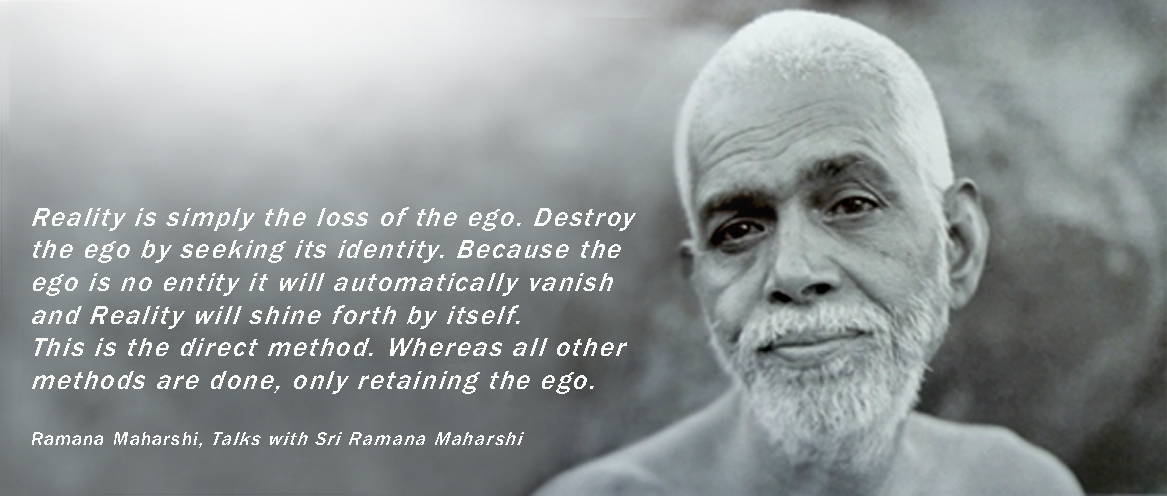
Practice [vichara marga]
Atma-vichara [Self-enquiry, Who am I?]
„What a wonder! This ghostly ego, which is devoid of
form, comes into existence by grasping a form (body as ‘I’); it endures by grasping a form (by
continuing to cling to that body as ‘I’); it waxes more by
grasping and feeding upon forms (objects); having left a form, it grasps a form (having given up one body, it grasps another body as ‘I’);
(but) if one searches (for it by enquiring ‘Who am I, this
formless ego?’), it will take to flight (being found to be nonexistent)!
Know thus”.
~ Ramana Maharshi, Ulladu Narpadu
Once an uninvited guest came to the wedding party, a complete stranger to both families, but pretending to be a close friend of the bridegroom. At first the hosts believed him and treated with due respect. However, over time suspicions and doubts arose as to who this man actually was and by what right he appeared at the party. So the two parties met and started questioning each other. The impostor saw that he was sure to be exposed and treated as he deserved if he remained; so he quietly disappeared.
The impostor in this parable is the ego. It is neither the real Self, nor the body; so long as no enquiry is made, the ego persists and enjoys the status of the real Self; but when an enquiry is made — when the quest of the real Self is begun and persisted in — it will vanish, leaving no trace.
The highest destiny and the most important task of man is to start such enquiry, to go into the place from which the ego emerges and make its illusion dissolve.
„Just as one would dive in order to find a thing which has fallen into the
water, one should dive within [into the Heart] restraining speech
and [vital] breath with a keen mind, and know the
real Self, which is the rising-place (or source) of the ego,
which rises first. Know thus".
~ Ramana Maharshi, Ulladu Narpadu
Our innate longing for the fullness of happiness due to us by nature causes us to relentlessly - consciously or unconsciously - search for ways to obtain it. However, we usually make the mistake of taking as our starting point the reality of the ego on which we rely in this search as our true "I", our true Self. Such an approach makes us doom ourselves to failure in advance.
All questions about ultimate truths raised by the mind-ego are fruitless, posing them and wasting time seeking answers through the mind is a trap set by the ego. Any answer that appears in the mind is tainted by ignorance resulting from mistakenly taking the ego for something it is not, but only appears to be - our true Self.
The truth cannot be reached by the mind - sages unanimously proclaim.
Instead, says the sage of Arunachala, one must catch the perpetrator of our misery/unhappiness - the ego - and then get rid of it by inquiring into the Self it impersonates. Man should attain Self-realization, then he will obtain full happiness and the ultimate answer to all the questions bothering him and all of humanity - but not before. Finding the answer with even the most sophisticated efforts of the mind/intellect is impossible.
All questions, as Ramana Maharshi teaches, come down to one point: "Who is 'I'?".This question is absolutely fundamental, the first and, in fact, the only one to be asked. But by no means with the mind. The proper tool to accomplish this is the practice of Self-enquiry [Atma-vichara] offered to the world by Ramana Maharshi.
Nor is it a question that we as individuals would or could answer for ourselves. In fact, the meaning of this question is: who/what is the source of our personal "I" [ego] or what is its origin. Since it is the personal "I" [ego] that veils this source with itself, knowing who/what is the source of the arising of this "I" is only possible when the personal "I" disappears, which in turn is only possible when one continuously inquires into its nature in the manner taught by Sri Ramana. Thus, the Self-enquiry "Who am I?" is about searching for the source of the personal "I" from which the I-thought arises, immersing and abiding in this source.
--------------------------------------------------------------------------------------------------------------
Note: By no means should one think that true knowledge is achieved by intellectually asking oneself the question "Who am I?" and answering it intellectually, as many tend to believe reading similar teachings. Intellectual knowledge is not the true knowledge, whatsoever.
--------------------------------------------------------------------------------------------------------------
Inquiring into the nature of the "I" in the manner given/shown/taught by Sri Ramana is called Atma-vichara (other names: Self-enquiry, Self-inquiry, Who am I?, Self-attention, Self-investigation, Self-attentiveness, Self-abidance, vicara, vichara, jnana-vichara etc.). It leads to the discovery of the unreality of the ego, which disappears, unveiling our true Self as it really is, in its purity and fullness. Atma-vichara is the direct, practical path the only one leading beyond the conditioning and limitations of the mind-ego, leading directly to the realization of man's true nature, and with it to finding the fullness of happiness/love due to us by nature.
„A sadhaka, who earnestly and diligently desires to attain Liberation, must first of all learn to distinguish between what is permanent, substantial [sat] and what is not so [asat]. Through such cognizant investigation into everything, he must gain certainty beyond all possible doubts, hesitations and inconsistencies as to what he himself actually is, i.e., what constitutes his true essence. And having already known his true, natural state, he should constantly and unchangeably abide in it. This is the most proper and best sadhana; and it is called: vichara-marga. It is the fastest way to attain and directly know the Self”.
~ Ramana Maharshi Nauka Szri Ramana Mahariszi
(translated from Polish since we were unable to find the source text).
When embarking on this path, the seeking adept should first grasp/understand the teachings of the sages well, achieving the deepest possible insight into them. A part of this process can be introspective analysis more or less like this: "I am not the physical body, because when I sleep, another body takes over. Nor am I the mind, because when I sleep a deep sleep, I still exist, although the mind ceases to exist. Mind and body appear and disappear, but I exist continuously, so I am real as pure 'I am'. I can reject the body and mind as 'not- I', since they are merely objects perceived by me. However, I cannot reject 'I am', because this is the point from which the mind and body are rejected. Therefore, 'I am' is the truth about me; everything else cannot be me".
However, such learning of the teachings, insight into them and such analysis are only a pre-preliminary stage of the understanding of the theoretical basis needed to undertake the sadhana - are not yet the proper (or even preliminary) practice.
So what does a proper practice look like and where does it begin?
The first, absolutely essential and basic thing necessary on the path of Self-enquiry [Atma-vichara] is to fish out and grasp the pure sense of "I am" present within us (pure i.e. from adjuncts such as thoughts, identifications, etc.), which is accomplished through letting go of all second and third person mental objects and simultaneous directing/turning all attention on first-person awareness of "I" with the intention of knowing who this "I" is (from where the "I" arises, what is its source) as a result of which the I-thought disappears, and where it disappeared, spontaneously appears the pure "I am" [I- I, I am I].
Our personal existence carries within it an element of Reality, the light of Pure Consciousness manifesting as a sense of "I am". This "I am" belongs to Reality, it is the only constant and unchangeable element. If we discard the unreal part of our personality we can grasp what then remains, which is the pure "I am". This "I am" is the key to the door of realization; using it - says Sri Ramana - we will certainly reveal [realize] the Self(1).
Once Sri Ramana compared a seeker of the Self to a dog searching for its master, from whom it has been separated. The dog has something that infallibly leads him in the track of his master - his scent. By following him and discarding everything else, he finds him ultimately. "I am" in a man is what the scent of the master is to the dog searching for him. It is the only clue available to the seeker; however, it is a infallible clue. It must be grasped and held firmly, anchoring the mind in it so firmly that everything else is turned off. In this way, the mind will undoubtedly melt into the Self, the source from which the "I am" springs.
____________
(1) Note: contrary to what many people claim today, the one-time grasping of the sense of "I am" is not yet equal to Liberation [Mukti, Moksha] or realization of the Self.
„Although the concept of "I"-ness or "I-am"-ness is by usage known as aham-vritti, it is not really a vritti like the other vrittis of the mind. Because unlike the other vrittis which have no essential interrelation, the aham-vritti is equally and essentially related to each and every vritti of the mind. Without the aham-vritti there can be no other vritti, but the aham-vritti can subsist by itself without depending on any other vritti of the mind. The aham-vritti is therefore fundamentally different from other vrittis.
So then, the search for the source of the aham-vritti is not merely the search for the basis of one of the forms of the ego but for the very Source itself from which arises the "I-am"-ness. In other words, the quest for and the realization of the source of the ego in the form of aham-vritti necessarily implies the transcendence of the ego in every one of its possible forms”.
~ Ramana Maharshi, Maharshi's Gospel
Describing the proper practice of Atma-vichara (Self-enquiry), Sri Ramana writes [Upadesa Undiyar]:
"When one scrutinizes within:
«What is the rising-place of ‘I’?»,
The ‘I’ will vanish.
This is Self-enquiry [Atma-vichara].
In the place where ‘I’ merges,
The one existence-consciousness appears spontaneously
As ‘I-I’ [or ‘I am I’].
That itself is the Whole [purna]".
In another place he says [Guru Vachaka Kovai]:
"Restraining the mind from going outside [through the senses], and fixing it always in its Source, Self, which is known as the Heart, so that the vain ‘I’-thought will not rise again, is the Atma-Vichara [Self-enquiry]" .
Bhagavan also instructs [Letter to Ganapati Muni, The Mountain Path, 1982]:
"When the mind, the distinctive knowledge which rises from the non-distinctive state of "I" clings to and identifies with the Self, it is called true knowledge [...]
The state in which this pure sattvic mind shines clinging to the Self is called 'aham-sphurana' [...]
The source to which this sphurana clings alone is called the reality or pure consciousness [...]
When the pure sattvic mind abides in that sphurana and attends to its source, it is called upasana or meditation [of the Self - ed. note.] [...]
During the time of practice the natural state is called upasana (meditation [of the Self - ed. note.]), and when that state becomes firmly and permanently established it is called jnana [...]
The aforesaid attention to the source of the aham-sphurana alone is the path".
In Vichara Sangraham we can find the following words:
"If one now keenly enquires, ‘What is it that rises as “I”?’ then in the Heart a certain soundless sphurana ‘I-I’ will shine forth of its own accord. It is an awareness that is single and undivided, the thoughts which are many and divided having disappeared. If one remains still without leaving it, even the sphurana - having completely annihilated the sense of the individuality, the form of the ego, ‘I am the body’ - will itself in the end subside, just like the flame that catches the camphor. This alone is said to be Liberation by great ones and scriptures".
--------------------------------------------------------------------------------------------------------------
Note: In Ramana Maharshi's teachings we find a description of two different elements found on the spiritual path that, having fulfilled their essential role, subside.
The first is the auxiliary thought-question "Who am I?", which is a tool used to extinguish other thoughts and direct attention to the first-person "I am" consciousness [to the Self]. After fulfilling its role, this thought disappears on its own, like the stick used to bury in the fire.
Once attention is directed and maintained on the first-person "I am" consciousness, the root of the mind is merged in the Self and disappears, and in its place appears the sphurana I am I. This sphurana then destroys all hidden tendencies and the whole ego, the sense of "I am this body", after which the sphurana itself disappears, like fire burning camphor.
These two processes involve two different elements/processes and places on the spiritual path, they are different from each other and should not be confused with each other. The former is part of sadhana and happens many times; the latter is the culmination of a man's spiritual path and happens only once.
--------------------------------------------------------------------------------------------------------------
In one of the talks, he instructs [Nauka Szri Ramana Mahariszi]:
"Just as water in the pot reflects the enormous sun within the narrow limits of the pot, even so the vasanas or latent tendencies of the mind of the individual, acting as the reflecting medium, catch the all-pervading, infinite light of Consciousness arising from the heart and present in the form of a reflection the phenomenon called the mind. Seeing only this reflection, the ajnani is deluded into the belief that he is a finite being, the jiva.
If the mind becomes introverted through Self-enquiry into the source of aham-vritti, the ‘I-thought’, the vasanas become extinct, and in the absence of the reflecting medium the phenomenon of reflection, namely, the mind, also disappears being absorbed into the light of the one Reality, the Heart.
This is the sum and substance of all that an aspirant needs to know. What is imperatively required of him is an earnest and one-pointed enquiry into the source of aham-vritti".
In "Nan Yar?" he wrotes:
"The mind will subside only by means of the enquiry 'Who am I?’”. [...] At the very moment that each thought rises, if one vigilantly enquires ‘To whom did this rise?’, it will be known ‘To me’. If one then enquires ‘Who am I?’, the mind (our power of attention) will turn back (from the thought) to its source (Self), (then, since no one is there to attend to it) the thought which had risen will also subside. By repeatedly practising thus, the power of the mind to abide in its source increases".
In several places he says:
"Summa iru" - just be, be still or remain still. With these words, Sri Ramana Maharshi teaches practice of pure being (pure existence in the absence of all mind/mental activity and without a sense of doership) as the highest and most powerful tapas.
To the accusation posed by observers that the state of being still is a state of indolence, laziness and sheer doing-nothing, Sri Ramana replies with his usual sense of humor [Guru Vachaka Kovai]:
"The lazy state of just being and shining [as ‘I am’] is the state of svarupa [one’s own form or essence]. That great state is the state in which one is That [the absolute reality or brahman]. Revere as most virtuous ones those who have attained that lazy state, unattainable except by very great and rare tapas".
In Guru Vachaka, Kovai Sadhu Om adds in a commentary a clarification that "being still" is neither a state of laziness [doing-nothing] nor is it remaining like a stone in kashta-samadhi or laya state. It is the state of making an uninterrupted effort towards keeping Self-attention - the higher the proficiency, the lower the effort. Sri Ramana himself also confirms that the supreme tapas of being in a state of mouna, although to the layman it may look like a lazy state of doing nothing, is actually a state of intense, condensed activity.
When the state of the Self is experienced as our natural state, then Self-attentiveness becomes completely effortless it becomes the state of sahaja samadhi.
Elsewhere on the question asked [Sat-Darshana Bhashya]: „If I go on rejecting thoughts can I call it Vichara?” Sri Ramana answered: „It may be a stepping-stone. But really Vichara begins when you cling to your Self and are already off the mental movement, the thought-waves.
Questioner: Then Vichara is not intellectual?
Sri Ramana: No, it is Anthara vichara, inner quest”.
----------------------------------------------------------------------------------------------------
Atma-vichara - definitions.
Atma-vichara practice is a simple yet subtle practice, which is why it is perceived by many as complex and difficult even to understand. Ramana Maharshi has clearly defined it in his teachings, and that is where we recommend those who seek information about it to go. However, due to the various nuances outlined here and there, we advise that when seeking a definition of Atma-vichara, one should not limit oneself to a single teaching of Bhagavan, but take into consideration a cross-section of several of his various teachings addressing the issue, thus catching the various subtleties of the practising process.
If one narrows one's perspective to only one instruction, one may miss some important aspect of practice mentioned elsewhere. This is a common problem. Therefore, we recommend that one should always have a broad overall perspective that takes into account the entire Atma-vichara practice process, so that when dealing with a detail one does not lose sight of the picture of the whole.
We stipulate, however, that a full understanding of Atma-vichara practice "dryly", without performing it at its proper stage, is impossible. The Atma-vichara path reveals its beauty in its full glory to those who walk it (the proper stage), not to those who merely read about it.
We propose the following selection of teachings and the following order of consideration.
1. Maharshi`s Gospel:
"Self-enquiry by following the clue of aham- vritti [the T-thought] is just like the dog tracing its master by his scent. The master may be at some distant unknown place, but that does not stand at all in the way of the dog tracing him. The master’s scent is an infallible clue for the animal, and nothing else, such as the dress he wears, or his build and stature etc., counts. To that scent the dog holds on undistractedly while searching for him, and finally it succeeds in tracing him.
Likewise in your quest for the Self, the one infallible clue is the aham-vritti, the ‘I-am’-ness which is the primary datum of your experience. No other clue can lead you directly to Self-realisation".
There is an arch-important indication here of following the aham-vritti as a key element in the practice of Self-enquiry. If this element is performed incorrectly or is neglected, the practice performed will not be Atma-vichara - will lose its direct character and lead at most to laya states that are worthless in the context of Liberation, similar to deep sleep and bring a similar benefit.
Directing attention to aham-vritti is a critical point, especially important to watch for in those starting out in vichara; over time, a valuable habit of directing attention to "I am" is developed.
2. Nan Yar?:
„If other thoughts rise, one should, without attempting to complete them, enquire ‘To whom did they rise?’. What does it matter however many thoughts rise?
At the very moment that each thought rises, if one vigilantly enquires ‘To whom did this rise?’, it will be known ‘To me’. If one then enquires ‘Who am I?’, the mind will turn back to its source (Self), [and] the thought which had risen will also subside. By repeatedly practising thus, the power of the mind to abide in its source increases”.
This is a basic description of Atma-vichara practice in which there are several extremely important points/hints.
a) pointing out the absolute necessity of letting go of thoughts different from the I-thought and not following them, not allowing them to develop;
b) pointing out the key methodology of withdrawing attention from second- and third-person thoughts and redirecting it to the first-person thought "I am", aham-vritti, until the mind is immersed in its source, the Self;
c) pointing out the extremely important fact of combining in one step two processes: diverting attention from thought and directing it to "I am" [see point 2f, subpoint 1]
d) very important indication of the moment of thoughts arising as the one where the given methodology should be applied (if one has thoughts at full gallop and is unable to grasp this moment then there is no other choice he must start where he is, and persistently work until the moment of thoughts arising can be caught);
e) important indication that the thicket of thoughts is not an insurmountable obstacle for Atma-vichara - one must not give up because of it;
f) pointing out the two steps/stages of the entire process: (1) redirecting attention to "I am" ("‘To whom did this rise?’... ‘To me’") [here we are talking about combining in one step diverting attention from other thoughts and directing it to "I am" - resulting in grasping the pure "I" or "I am"] and (2) keeping one's attention on it ("If one then enquires ‘Who am I?’, the mind will turn back to its source (Self)") [here we are talking about keeping one's attention on the previously grasped "I am" - resulting in immersing the mind in the source, the Self]
(A while before, Bhagavan also says: „The thought ‘Who am I?’, destroying all other thoughts, will itself finally be destroyed” pointing to the use of the thought/question "Who am I?" as a tool to destroy all other thoughts and redirect attention to "I am". However, this auxiliary thought/question can be used only in the first [point 2f, subpoint 1] of the aforementioned steps/stages; in the second, merely maintaining attention on "I am" is required, with no more room for asking any mental questions (as explained in more detail by Sadhu Om in The Path of Sri Ramana Part I);
g) pointing out a very important aspect of the gradualness and slowness of the process;
h) an indirect indication of the requirement of effort and work (we especially point this out to proponents of spiritual sprinting, who think they will manage the Self-realization in five minutes).
3. Upadesa Undiyar verse 19:
When one scrutinizes within:
«What is the rising-place of ‘I’?»,
The ‘I’ will vanish.
This is Self-enquiry [Atma-vichara].
Indication of the key moment of the start of the proper Atma-vichara i.e., the moment of the disappearance of the I-thought (the root of the mind, which, as mentioned earlier, subsides into the Self).
In the following 20th verse, Bhagavan indicates what happens after the I-thought disappears in this way: spontaneously the I- I [I am I], the aham-sphurana and the experience of the Self appears (important information for those worried about what happens when their I-thought disappears).
4. Padamalai, Bhagavan`s Promises and Declarations, pt. 24:
„Keeping one’s attention on the subtle consciousness that is experienced by the extremely subtle mind is personal service to me”.
There are two important clues here:
a) pointing out the subtle consciousness that clinging to is all about; it is not the mixed consciousness available in everyday experience to every human being, nor is it the “conscious living” popular today that consists of a little more knowledge , consciousness and sensitivity within the same mixed consciousness. It's about pure consciousness, which we have access to after the I-thought disappears and the mind is immersed in the source;
b) an indication of an extremely subtle mind [in other words pure-sattvic mind], which is the only one capable of experiencing pure consciousness. "[...] pure sattva is alone the natural characteristic of the mind, and this stands clinging to the reality. However, in this pure sattvic state, the 'l-thought' is no longer really a thought, it is the Heart itself". [...] „The state in which this pure sattvic mind shines clinging to the Self is called 'aham-sphurana'” - Bhagavan explains in his letter to Ganapati Muni.
Such a pure sattvic mind is required to perform the proper Atma-vichara correctly.
(Particularly important information for those who try to perform Atma-vichara and attain Self-realization without cleansing the mind, on the march, with a mind contaminated with rajas/tamas, trying to sit down for a few minutes, concentrate hard and with the question “Who am I? “ to reach the Self, thinking that this gives completion to a man's spiritual path; what they can achieve in this way is spiritual insight, also possible with a mind contaminated with rajas/tamas, not the experience of the Self, which is available only with a purely sattvic mind; not to mention Self-realization.
One possible exception - a Spirit Giant of Ramana's ilk can do everything in a few minutes; but such one - by Ramana's own admission - already has all the work behind him done in previous incarnations. And it is very, very rare.)
Note: we do not recommend the use of any supplementary mind purification techniques besides Atma-vichara. Such techniques, although they will purify the mind, will not direct it correctly to the Self, and often to something different than the Self, thus creating a new problem (described by Sadhu Om in The Path of Sri Ramana Part I with the allegory of learning to ride a bicycle). Atma-vichara in its preliminary stage has the power to purify the mind while directing it correctly to the Self, and there is no need to support it with any additional technique.
5. Guru Vachaka Kovai verse 389, Upadesa Undiyar verse 30:
"Restraining the mind from going outside [through the senses], and fixing it always in its Source, Self, which is known as the Heart, so that the vain ‘I’-thought will not rise again, is the Atma-Vichara [Self-enquiry]".
„What is experienced,
If one knows that which remains
after ‘I’ has ceased to exist,
That alone is excellent tapas”.
Bhagavan here gives a clear indication of the proper Atma-vichara, which is what we are dealing with when: the mind is being fixed in its Source, Self so that the vain ‘I’-thought do not rise or to put it another way when: experienced is what remains when all traces of 'I' [I-thought, ego] are removed or even simpler when: ‘I’ has ceased to exist.
(A particularly important piece of information for proponents of the theory that says that at the stage of practice there is no possibility of the disappearance of the I-thought, the ego, because this happens only once and is equal to the Self-realization and is therefore unattainable at the stage of practice [tapas]; as you can see, Bhagavan Ramana has a different view on this, calling such a state of affairs "tapas").
6. Maharshi`s Gospel; Padamalai, (Chapter: Liberation and Silence, pp. 27):
„Your duty is to be, and not to be this or that. ‘I am that I am’ sums up the whole truth; the method is summarized in ‘Be still’.
And what does stillness mean? It means ‘Destroy yourself [i.e. ego - ed. note.]; because, every name and form is the cause of trouble. ‘I-I is the Self. I am this’ is the ego. When the I is kept up as the I only, it is the Self. When it flies off at a tangent and says ‘I am this or that, I am such and such’, it is the ego”.
„Since becoming established in the state of the Self is both the means and the goal to be attained, remain still”.
“Summa iru” meaning 'just be' or 'be still' is Bhagavan's supreme and simplest verbal instruction, punctuating his entire method (often misinterpreted as a call to do nothing).
However, as Sri Ramana himself admitted, for most adepts this recommendation is impossible to apply, for which Bhagavan recommends an effective remedy: a necessary effort in the serious practice of Atma-vichara.
We can still find here an explanation that being in the Self is both a path (effort) and a goal (effortless). It points out two extremely important unique things: (1) on Sri Ramana's path, the path and the goal are of the same nature, (2) and: the taste of the happiness of the Self is already available at the stage of practice.
This is not to be found anywhere else.
(There is a principle that says that if the means leading to the goal is not of the same nature as the goal, it will not lead to the goal. Since on the path of Sri Ramana the path and the goal are of the same nature - the nature of Silence, the Self - then this path really has the power to lead to the Self-realization or Liberation [Mukti, Moksha]. Other paths, that do not meet this condition, will not lead the adept to Liberation).
----------------------------------------------------------------------------------------------------
Note: the phrase “destroy yourself” used here by Bhagavan in no way means doing any harm to your own body. Ramana Maharshi is talking here about the ego, which, as he explains, is an illusory entity, a chimera, an imposition that obscures our true Self; if we destroy the fatamorgan by dispelling it and seeing what is behind it, we will not suffer any harm or loss.Likewise in the case of ego destruction.
----------------------------------------------------------------------------------------------------
7. Nan Yar?, Padamalai, Self-enquiry, pp. 37:"The place where even the slightest trace of the thought ‘I’ does not exist, alone is Self. That alone is called ‘Silence’ [Mouna]".
"However much instruction the Guru gives, the true support for spiritual aspirants is the enquiry they perform into the nature of their own Self".
Here Bhagavan Ramana equates the stage of proper Atma-vichara practice with the state of Silence [mouna], in which he gives his most profound instructions [mouna-upadesa]. He also points out the supremacy of the practice of abiding in the Self [proper Atma-vichara, Silence] over all words, thus guiding adepts to the path of practice. Sri Ramana's path is a thoroughly practical path, not a theoretical one - only those who perform the recommended practice can truly benefit from it.
This is the fundamental issue.
Thus, those who have a need for deeper exploration of the path of Sri Ramana are recommended to get into the state of Silence [mouna] defined as above (a.k.a. the state of proper Atma-vichara), where they will receive directly from Bhagavan-Self the knowledge and experience of what cannot be described in words.
----------------------------------------------------------------------------------------------------
Note: We highly recommend reading the description of the event resulting in the Self-realization of the sixteen-year-old Venkataraman (the young Ramana Maharshi), even learning it by heart if one wishes, but we do not recommend trying to copy-and-paste this process and expecting the same immediate result in oneself. Ramana Maharshi performed the entire process in 20 minutes, which is a phenomenon on an epochal scale, but such a one appears on Earth oonce every thousand, if not several thousand years. If, Dear Reader, you are reading these words, it means that you didn't do it in 20 minutes, and you are facing a gradual and slow process, stretched over many years, which will inevitably - despite the fact that the method is the same - take a slightly different course for you than for Ramana.If you apply one and the same medication for depression to two different patients and in one it recedes after 20 minutes and in the other after 20 years, the experience of treating depression in these two patients will differ.
In addition, we recommend that the information found in the aforementioned description of Sri Ramana's realization about restaining/stopping the breath be treated with caution. Advice: neither try to stop the breath in your Atma-vichara practice, nor catch on to these words as a lifeline looking for an excuse not to practise Self-enquiry.
On the path of Ramana Maharshi breath is not worked on directly.
One works with the mind (the preliminary stage) and one holds directly to the Self with the pure-sattvic mind (the proper stage), and as the breath and the mind - as Sri Ramana explains in the Upadesa Undiyar - are related to each other like two branches growing from the same tree, this affects the breath secondarily. It is, however, a process that regulates itself, is effortless, natural and safe, which cannot be said of the paths of direct, active breathwork (e.g. the Hathayogapradipika warns of the dangers of this).
Attempts to work directly with the breath open the door, but it is not the door to the Sri Ramana path.
Nowhere in Ramana Maharshi's teachings describing the Atma-vichara technique do we find any instruction to actively stop the breath, and Sadhu Om in The Path of Sri Ramana Part I strongly discourages from such ideas.
We join him
----------------------------------------------------------------------------------------------------
Guidelines from Sri Ramana's disciples.
Swami Annamalai, one of Ramana Maharshi's closest disciples and an eminent Self-enquiry pracitser, describes the essence of Atma-vichara practice as follows [Living By The Words Of Bhagavan]:
"Continuous inhalation and exhalation are necessary for the continuance of life. Continuous meditation [of the Self] is necessary for all those who want to stay in the Self.
[...] Don’t give these I-am-the-body ideas any attention. 'I must eat now'; 'I will go to sleep now'; 'I will have a bath now': all thoughts like these are I-am-the-body thoughts. Learn to recognise them when they arise and learn to ignore them or deny them. Stay firmly in the Self and don’t allow the mind to identify with anything that the body does.
Question: What is the correct way to pursue self-enquiry?
Answer: Bhagavan has said:
'When thoughts arise stop them from developing by enquiring, "To whom is this thought coming?" as soon as the thought appears. What does it matter if many thoughts keep coming up? Enquire into their origin or find out who has the thoughts and sooner or later the flow of thoughts will stop'.
This is how self-enquiry should be practised.
When Bhagavan spoke like this he sometimes used the analogy of a besieged fort. If one systematically closes off all the entrances to such a fort and then picks off the occupants one by one as they try to come out, sooner or later the fort will be empty. Bhagavan said that we should apply these same tactics to the mind.
How to go about doing this? Seal off the entrances and exits to the mind by not reacting to rising thoughts or sense impressions. Don’t let new ideas, judgements, likes, dislikes, etc. enter the mind, and don’t let rising thoughts flourish and escape your attention.
When you have sealed off the mind in this way, challenge each emerging thought as it appears by asking, 'Where have you come from?' or 'Who is the person who is having this thought?'. If you can do this continuously, with full attention, new thoughts will appear momentarily and then disappear. If you can maintain the siege for long enough, a time will come when no more thoughts arise; or if they do, they will only be fleeting, undistracting images on the periphery of consciousness. In that thought-free state you will begin to experience yourself as consciousness, not as mind or body.
However, if you relax your vigilance even for a few seconds and allow new thoughts to escape and develop unchallenged, the siege will be lifted and the mind will regain some or all of its former strength".
He gave the following advice to one of the adepts [Living By The Words Of Bhagavan]:
"Go deeply into this feeling of I. Be aware of it so strongly and so intensely that no other thoughts have the energy to arise and distract you. If you hold this feeling of I long enough and strongly enough, the false I will vanish leaving only the unbroken awareness of the real, immanent I, consciousness itself".
In another place, when asked about the progress on the Atma-vichara path, he described it as follows [Living By The Words Of Bhagavan]:
„As we start to move inwards we experience the peace and bliss of the Self in a very diluted form. The deeper we go, the stronger the experience becomes. Eventually a time will come when we don’t want to leave this experience at all. Instead, there is a continuous urge to go deeper and deeper into the Self.
[…] If you practise intensively and correctly you will find that the experience of this peace is addictive. When this happens you will lose interest in everything except the Self. [...]
When you lose all desires and attachments, the pure gold of the Self will reveal itself to you. In that final state you don’t experience peace and bliss. You are that peace and bliss. In that state you are the equal of Siva”.
----------------------------------------------------------------------------------------------------
First person - second person.
In the teachings of Sri Ramana we encounter the concept of three persons: first [I], second [you] and third [he, she, it]. The objects from which attention should be diverted are said to be second- and third-person objects, while the subject to whom attention should be directed is first-person.
Discussing this issue, Sadhu Om - author of numerous valuable commentaries and explanations of Ramana Maharshi's teachings - sticking to the analogy of a movie projector once used by Bhagavan, points out that when the light of consciousness passes through the cliché of our vasanas, it takes on two forms: the seer [first person] and the seen [second and third person]. This means that the first person “I am this and that” which we commonly identify with as “I” in our daily lives, is already a product of wasan and is one of the images [names and forms] projected onto the screen of existence by the light of consciousness - it is not pure consciousness.
When, in the practice of Atma-vichara, we withdraw our attention - at all levels, from the densest to the subtlest - from second and third person thoughts, in accordance with Bhagavan's teaching by destroying [extinguishing, quieting] these thoughts as "not-I" at the point and time of arising, and when at the same time and also with the help of this mechanism we direct our attention and focuse it one hundred percent on the first person, the “I”, then this first person shows us the truth about itself: this first-person “I” reveals itself to us as a second person, as “not-I”, and as such disappears just like all the other than “I” thoughts of the second person.
What remains then is the pure “I am”, called here by Bhagavan Ramana sphurana “I-I” or “I am I” - and it is not the ego. As Bhagavan said [Ulladu Narpadu, verse 30]: "Although it appears (seemingly anew), it is not ‘I’ (ego); it is the Whole Reality, the Reality which is Self".
At this point, the experience of pure existence, “I am” consciousness, begins. This is the stepping into the proper stage of Atma-vichara practice, the stage of “just being”, where the pure light of consciousness burns out [destroys, annihilates] our eternal hidden tendencies. When they are all annihilated Self-realization takes place.
We draw your attention to this crucial and very subtle point. Without a real, authentic - done really/truly/authentically in practice, not imagined or understood - discovery that the present first person is a false first person, that it is “not-I”, there will be no true, proper, full Atma-vichara. Nor Liberation.
----------------------------------------------------------------------------------------------------
Effort or grace?
"It is effulgent in the Heart, the inner being, the real
Self. It draws you from within. You have to attempt to get
in from without. Your attempt is vichara, the deep inner
movement is grace, arul. That is why I say there is no real
vichara without grace nor is there grace active for him
who is without vichara. Both are necessary".
~ Ramana Maharshi, Sat Darshana Bhashya
Asked what is crucial on this path - one's own effort or grace - Bhagavan Sri Ramana said [Arunachala Ramana, 1982]:
"[...] It is by the grace of God that you come to desire to know yourself. This desire to know yourself is itself a clear sign of the Atman’s grace. So, there is grace already working as the source of your effort. Grace is not an external quality of the Self but its very nature. It abides in your Heart, pulling you inward into itself. The only task you must do is turn your attention inward and search the source of ‘I’. This is the only personal effort we have to put in. [...]"
We, through our effort, try to reach the Self from outside, grace draws us from within; both effort and grace are essential. There is no Atma-vichara without grace, and there is no active grace without Atma-vichara, says Sri Ramana.
On another occasion, he also said [The Mountain Path, 1969]:
"It is not the body that desires to obtain the grace. Therefore it is clear that it is the awareness that shines here as ‘you’. To you who are the nature of awareness there is no connection during sleep with the body, the senses, the life force [prana ] and the mind. On waking up you identify yourself with them, even without your knowledge. This is your experience. All that you have to do hereafter is see that you do not identify yourself with them. In the states of waking and dream try to remain as you were in the state of deep sleep. As you are by nature unattached, you have to convert the state of ignorant deep sleep, in which you were formless and unattached, into conscious deep sleep. It is only by doing this that you can remain established in your real nature. You should never forget that this experience will come only through long practice. This experience will make it clear that your real nature is not different from the nature of God".
And [Sri Ramana Jnana Bodham]:
"If we perform sadhana to the limit of our abilities, the Lord will accomplish for us that which is beyond our capabilities. If we fail to do even that which is within our capabilities, there is not the slightest fault in the grace of the Lord".
----------------------------------------------------------------------------------------------------
Attitude.
"Those who meditate on the Self and do good deeds, if they labour hard without feeling ‘This is a mammoth task! There is no one to help! Is this possible for me?’ then the help of God will come automatically" - Sri Ramana assures [Letters from Sri Ramanasramam].
Before this help comes (or better said, before he can feel it) the adept should work without the slightest wavering of faith and to the maximum of his strength and capability.
----------------------------------------------------------------------------------------------------
Humility.
„A humble attitude of mind will give you redemption, transporting
you to the world of the immortals. Without humility, you will
drown in the pitch blackness of hell”.
~ Ramana Maharshi, Padamalai
Just like oxygen for breathing, humility is necessary to follow the path of Sri Ramana.
Some outside observers question this, viewing this path as that of a warrior and asking where this humility comes from. It comes, for example, from the fact that all the strength, weapons and power of this warrior are aimed at himself, at his personal "I [ego], which is a storehouse of pride and lack of humility.
But not only that. Humility is interwoven into Sri Ramana's path in several places and has several dimensions.
Ramana Maharshi himself says so about humility on his path [Sat Ramana Darsanam]:
„The power of humility, which bestows immortality, is the foremost among powers that are hard to attain. Since the only benefit of learning and other similar virtues is the attainment of humility, humility alone is the real ornament of the sages. It is the storehouse of all other virtues and is therefore extolled as the wealth of divine grace. Although it is a characteristic befitting wise people in general, it is especially indispensable for sadhus. (1A)
Since attaining greatness is impossible for anyone except by humility, all the disciplines of conduct such as yama and niyama, which are prescribed specifically for aspirants on the spiritual path, have as their aim only the attainment of humility. Humility is indeed the hallmark of the destruction of the ego. Because of this, humility is especially extolled by sadhus themselves as the code of conduct befitting them.
[…]
The Supreme Lord, who is the highest of the high, shines unrivalled and unsurpassed only because he remains the humblest of the humble.
When the divine virtue of humility is necessary even for the Supreme Lord, who is totally independent, is it necessary to emphasise that it is absolutely indispensable for sadhus who do not have such independence? Therefore, just as in their inner life, in their outer life also sadhus should possess complete and perfect humility(1B) […]”.
____________
(1A) „Sadhus” in this context are those who have devoted their entire lives to spirituality taking as their goal only Liberation.
(1B) In the case of humility on the path of Sri Ramana, the same principle applies as in the case of renunciation: outer humility alone, without inner humility, is without value. With that said, the humility that flows from the ego-person's immersion in the Self is of the nature of the Source/Self, and does not at all have to conform to people's made-up definitions of humility, particularly debasing oneself, self-contempt or masochism.
----------------------------------------------------------------------------------------------------
Summa iru.
"Except for those who have completed everything and who have a
mind that is free from desires, remaining still [summa iruttal] is
not easy".
~ Ramana Maharshi, Padamalai
Indicated to clarify the meaning of the instruction "summa iru" - just be or be still, the simplest and highest of all the teachings on the path of Sri Ramana, yet for most elusive and overly often misinterpreted as a trite call to do nothing – Sri Ramana says [Padamalai]:
"The wonderful meaning of the one supreme word [ summa iru] is to know and rest in the Atma-swarupa through the enquiry ‘Who am I?’".
Elsewhere, he adds [Maharshi`s Gospel]:
"And what does stillness mean? It means ‘Destroy yourself'; [tj. ego - ed. note.], because, every name and form is the cause of trouble.
‘I-I is the Self. I am this’ is the ego. When the I is kept up as the I only, it is the Self. When it flies off at a tangent and says ‘I am this or that, I am such and such’, it is the ego".
In another place he further adds [Day by day with Bhagavan]:
"Question: What should one do in order to remain free from thoughts as advised by you? Is it only the enquiry ‘Who am I?’
Bhagavan: Only to remain still. Do it and see.
Question: It is impossible.
Bhagavan: Exactly. For the same reason the enquiry ‘Who am I?’ is advised.
All the age-long vasanas carry the mind outward and turn it to external objects. All such thoughts have to be given up and the mind turned inward. For that, effort is necessary for most people.
Of course everybody, every book says, ‘Summa iru,’ i.e., ‘Be quiet or still’. But it is not easy. That is why all this effort is necessary. Even if we find one who has at once achieved the mauna or supreme state indicated by ‘Summa iru’ you may take it that the effort necessary has already been finished in a previous life".
Swami Annamalai explains the phrase “summa iru” in Ramana Maharshi's teachings this way [Living By The Words Of Bhagavan]:
„Bhagavan’s famous instruction ‘summa irru [be still] is often misunderstood. It does not mean that you should be physically still; it means that you should always abide in the Self. If there is too much physical stillness, tamoguna [a state of mental torpor] arises and predominates. In that state you will feel very sleepy and mentally dull. Rajoguna [a state of excessive mental activity], on the other hand, produces emotions and a mind which is restless. In sattva guna [a state of mental quietness and clarity] there is stillness and harmony. If mental activity is necessary while one is in sattva guna it takes place. But for the rest of the time there is stillness. When tamoguna and rajoguna predominate, the Self cannot be felt. If sattva guna predominates one experiences peace, bliss, clarity and an absence of wandering thoughts. That is the stillness that Bhagavan was prescribing”.
----------------------------------------------------------------------------------------------------
Jagrat-sushupti
"O man who, caught by the dangerous snares of the
world and struck by the sharp arrows of cruel
miseries, are suffering greatly and are wandering in
search of the attainment of supreme bliss, the sleep in
which there is no loss of consciousness [i.e. wakeful
sleep or jagrat-sushupti] alone is the imperishable
happiness".
~ Ramana Maharshi, Guru Vachaka Kovai
In Sri Ramana Maharshi's teachings and commentaries on them, we come across the term jagrat-sushupti defined as "the state of sleep in waking", "the state of wakeful sleep", "wakeful sleep", "sleeping wakefulness", “sleepless waking”, “wakeless sleep” etc.
It is a state that is a combination of full awareness of the waking state and the lack of perception of any objects/thoughts other than ourselves characteristic of deep sleep; there is the awareness of the waking state and the stillness of deep sleep. Jagrat-sushupti is not the same as walking or deep sleep considered separately; it is said to be atijagart (beyond wakefulness) and atisushupti (beyond sleep); it is a combination of perfect awareness and perfect stillness.
In this state, one remains aware of one's own existence/being (as in waking state, except that here this sense of existence is pure, unmixed with any adjunct), but the mind cogniting objects does not appear (as in deep sleep).
The state of jagrat-sushupti arises as a result of constant enquiry through Atma-vichara practice, and is the state of experiencing pure “I am”. In some simplified terms, it can be said that the task of the adept practising Self-enquiry is to “invoke” in the state of walking, while being fully awake/conscious, the state of deep sleep.(1C)
As Bhagavan once said to one of the pilgrims [The Mountain Path, 1969]: „ [...] you have to convert the state of ignorant deep sleep, in which you were formless and unattached, into conscious deep sleep. It is only by doing this that you can remain established in your real nature. You should never forget that this experience will come only through long practice”.
The aspirant must make efforts to stay in this state until all the tendencies [vasanas] pulling him away from it are completely extinguished. When the aspirant recalls this state with effort and the state seems to come and go, it is still a stage of practice, although advanced. When the state prevails continuously in all previous states (waking, dreaming and deep sleep) and, as a result of the jnanagni's complete firing of the wasan, the chit-jada-granthi knot is broken, the three states no longer alternate. Only one state remains then: Turiya or Turiyatita.
____________
(1C) Note: based on what is written here, the reader should not conclude that Atma-vichara leads to some state of numbness, swoon, half-sleep, lunaticism or anything like that, as this will be an all-around erroneous, opposite of fact conclusion. The state of the Self is a state of full, pure, perfect consciousness, at which our current state of walking seems like a lunatic dance.
Nor should this state be equated with the popular “conscious dream” [or lucid dream] first described by psychiatrist and writer Frederik van Eeden, as these are two fundamentally different states which, solely due to the poverty of language unable to describe the subtle levels of human nature, have been named the same, or similarly. Confusing the two with each other will be a catastrophe for one who practices Atma-vichara.
The state described here is certainly a far cry from stupor, lunaticism, torpor or similar things.
Those who reach a state of stupor or fall asleep in their practice are inevitably making a mistake somewhere, and/or are doing the practice by only partially quieting the mind but not getting into the source of the mind, and/or their mind is polluted with tamas, which they still have to deal with.
Also, the state described here should not be confused with the laya state, which is a state of suspension of the functions of the mind, in which, however, there is no conscious holding of “I am”. It is the same type of state as the deep sleep we enter daily due to fatigue. This state can also be achieved through certain practices, but it is worthless in the context of Liberation because:
a) interferes with daily activities with which it cannot be reconciled;
b) the happiness felt there is similar to that felt during deep sleep and similarly is reflected in daily life;
c) neither sanskaras nor vasanas are destroyed in it, the adept comes out of it with the same bundle of sanskaras and vasanas.
And although the state of laya in its effects differs only slightly from deep sleep - if it differs at all - some people consider it to be the highest spiritual achievement, questioning the existence above it the state of sahaja samadhi or, in other words, the natural state equal to Liberation.
In his treatise on samadhi, Swami Sivananda calls such states jada-samadhi and speaks strongly critically of them, saying among other things [Samadhi Yoga]: "This is a state like deep sleep. The Samskaras and Vasanas are not fried by this Samadhi. He [adept] does not return with superintuitional knowledge. This cannot give Mukti. This is a kind of feat only. This is not a sign of spirituality".
Swami Annamalai comments on the state of laya as follows [Living By The Words Of Bhagavan]: "Laya [temporary suspension of all mental faculties in a trance¬like state] is virtually the same as sleep. Experiencing this state is not helpful to your sadhana. Laya is not meditation, it is unconsciousness; it is tamoguna in a very strong form. Meditation needs an awake mind, not an unconscious one. Sleep and laya increase the identification with the mind. You may feel a little peace during laya, but when you wake up from this state the mind becomes very active again and the peace is all lost".
Ramana Maharshi advises that, in order to avoid such undesirable states on his path, one should practice from the very beginning with Self-attention, i.e., holding on to the light of “I am”. He refers with similar disapproval to the states of so-called “emptiness”, “void” or “nothingness”, saying that they happen in beginners, but will not happen if the disciple walks from the beginning with Self-attention on the ray of “I am”.
More about laya states can be found in the texts of Sadhu OM or Swami Annamalai on our sites.
----------------------------------------------------------------------------------------------------
Note: Falling asleep while trying to perform Atma-vichara practice does not always mean that the practiser is a beginner adept; under certain circumstances, it can also happen to more advanced adepts. Falling asleep during Atma-vichara practice is always a sign that something has gone wrong and the adept has been caught in a sleep trap, but it is not always a sign of being a beginner on this path.
Progress.
"Just as by churning the curd butter is extracted and by
friction fire is kindled, even so, by unswerving vigilant constancy
in the Self, ceaseless like the unbroken filamentary flow of oil, is
generated the natural or changeless state or nirvikalpa samadhi,
which readily and spontaneously yields that direct, immediate,
unobstructed and universal perception of Brahman, which is at
once Knowledge and Experience and which transcends time and
space.
This is Self-Realisation
and thereby is cut asunder
the hridaya-granthi or the Knot of the Heart.
The false delusions of
ignorance, the vicious and age-long tendencies of the mind, which
constitute this knot, are destroyed.
All doubts are dispelled and the
bondage of Karma is severed".
~ Ramana Maharshi, Talks with Sri Ramana Maharshi
Achieved through Atma-vichara, at first with great effort and for a very short time, the experience of the Self comes more and more easily with time and lasts longer and longer.
If the practice is carried out correctly, deeply and intensely enough, the experience becomes established and strengthened - the center of gravity is slowly shifted from the mixed/reflected consciousness, the personal "I" or ego, to Pure Consciousness, the impersonal “I” referred to by Sri Ramana as “I am I” or “I-I” [aham-sphurana], which is not ego.
The inner power of the Self takes possession of the mind, which is brought to the state of Pure Consciousness and begins to shine in pure form; in this state, the roots [vasanas and sanskars] of all impurities are burned out and irretrievably destroyed (along with them all the cares that plague man disappear; desires, fears, anxieties and sufferings, etc., which belong exclusively to the ego and dissolve along with it).
When all vasanas are thus burned out there is a final breaking of the bonds of karma along with the body-consciousness knot, and the mind is irreversibly - like a river flowing into the ocean - merged into the Self and never rises again. Even the sphurana “I-I” disappears, passing into the constant and unchanging state of swarupa, our own true and perfect nature of Existence-Consciousness-Happiness [Sat-Chit-Ananda].
This is the Self-realization and Liberation [Moksha, Mukti]: the highest summit and the completion of man's spiritual path.
Everyday life and spirituality.
„Everyday life is not divorced from the Eternal State. So long as
the daily life is imagined to be different from the spiritual life these
difficulties arise. If the spiritual life is rightly understood, the active
life will be found to be not different from it”.
~ Ramana Maharshi, Talks with Sri Ramana Maharshi
Most people think that spirituality is completely disconnected from everyday life and can hardly imagine that it could be otherwise, most often considering the trance-like states and visions that appear to some saints or yogis as essential spirituality, thinking that these are the unattainable heights of the spirit. Ramana Maharshi instructs that all visions, even divine ones, manifest below the plane of realization; in fact, they belong to the realm of the psyche, arise in the mind, testify to its insufficient purification and, as such, are an obstacle rather than a goal on the spiritual path. True spirituality is completely free from them - it is existence in our natural state, as existence-consciousness-happiness [sat-chit-ananda]. These kinds of trances and visions can occur in the early stages of the spiritual path and, by serious, aspiring to the spiritual summit adepts, should be rejected immediately.
Atma-vichara practice begins above their level and is completely free of them.
The case is similar with siddhis, or so-called miraculous powers, which, although commonly regarded as a sign of greatness of spirit, are not such at all, being a trap for the spiritual aspirant. If they happen to realized sages [Jnanis], then they are of a different nature, manifesting without a sense of doership and carrying no danger (we write more about siddhi in the tab Advaita, this topic is also discussed at greater length in Guru Vachaka Kovai).
On one occasion Sri Ramana was asked how to reconcile devotion to the Self with the daily routine of work that the world demands. Bhagavan replied [Maha Yoga]:
“Why do you think you are active? Take the case of your coming here. You left home in a cart, took your seat in a train, alighted at the (Tiruvannamalai) station, again got into a cart and found yourself here. When asked, you say that you came here from your town. Is it true? As a matter of fact you remained as you were; only the conveyances moved; just as these movements are taken as yours, so also are the other activities. They are not yours; they are God’s activities”.
The questioner objected that such an attitude will simply lead to blankness of mind and work will come to a standstill. Sri Ramana told him:
“Go up to that blankness and then tell me”.
----------------------------------------------------------------------------------------------------
Is the practice of Self-enquiry [Atma-vichara] difficult?(1D)
"It is due to maturity of mind [chitta-paripaka] that what is very
difficult for the many is extremely easy for the very few".
~ Ramana Maharshi, Padamalai
Many claim that the practice of Self-enquiry taught by Ramana Maharshi is very difficult. In one of his talks, Sri Ramana addressed this thread, in passing showing why he sometimes recommended - or seemed to recommend - to questioners paths other than Atma-vichara.
One of the visitors said to Sri Ramana: „Bhagavan, Self-enquiry [Atma-vichara] is very difficult. Instead of it, can I practise such-and-such yoga and meditation?”. Sri Ramana nodded in confirmation. When the visitor left, some of the disciples began to wonder aloud why Bhagavan had apparently given permission for such practices, so Sri Ramana explained:
„He stated 'Self-enquiry is very difficult', which means he didn't want to practise it at all, so what could I do? Even if I told him not to practise this yoga and meditation he still wouldn't take up Atma-vichara practice. In a few months he will come back and say that this yoga and meditation is too difficult asking if he can practise mantra-japa instead. After doing japa for a while, he will notice that his mind is still restless, so he will come back here and ask if he can take up chanting religious songs instead. This all means that he is not fit for any practice. If a person is able to make some effort to chant songs, perform japa or any other sadhana, he can make the same effort to practise Self-enquiry [Atma-vichara]”.
Other times someone said to Bhagavan that he felt that he was wasting his time practising Self-enquiry, because although he had tried to practise it many times he always found that he was losing his attentiveness, so he asked if it would not be better if he practised some japa instead? Bhagavan replied: „You have nothing to be afraid of. You are like a man who is afraid to let go of a tree branch, even though he is standing on the ground with both feet. Do you think that even if you let go of the grip with which you held on to the Self, the Self can ever let go of the grip with which it holds on to you?”
____________
(1D) In Atma Vidya Kirtanam, Sri Ramana calls the practice of Atma-vichara easy, saying: “Ah!, so very easy is atma vidya (knowing the Self)! Ah, so very easy!". This is undoubtedly true when we look at Atma-vichara from an objective point of view, because looking at it this way it turns out to be easy and even of all the paths the easiest, because it doesn't require us to take any action on the part of body, speech or mind that all other practices or paths require. Self-attentiveness is about holding on to the pure sense of “I am”, which is so natural and obvious to us that there can be nothing simpler and more accessible than that.
However, if we look at it with the eye of a beginner adept whose mind is still full of various habits and tendencies, whose sense of “I am” is heavily mixed with adjuncts such as “this body”, and he is only making his way through the preliminary stages of the path of Sri Ramana, such an adept will find the practice difficult or very difficult. Nevertheless, as such an adept assiduously, steadfastly and persistently undertakes the practice of Self-attention, his mind turns away from habitually directing itself toward objects and turns toward the Self, the sense of “I am” is purified of adjuncts, and the practice becomes easier and easier. At an advanced level, the adept is able to quickly and effortlessly grasp the sense of “I am” and maintain attention on it - for such an adept Atma-vichara is easy.
Nowadays, however, we can observe the phenomenon of declaring the ease of Atma-vichara preached by the mouths of beginner spiritual aspirants. Although they have not yet broken through the preliminary, preparatory stage of this path, they claim that Self-enquiry causes them little or no difficulty and that they are able to perform it without much trouble under all circumstances - nay, they even take to teaching it to others.
Is it really that easy? If one takes a closer look, the “Atma-vichara” they perform typically turns out to be a mental “vichara”, usually consisting of mentally asking oneself from time to time the question “who am I?” (or similar), attempting to get a quick intuitive answer to this question, combining this question with some counterproductive to Atma-vichara techniques, or “sitting” proforma a moment or two a day and asking oneself this question.
Such “vichara” is undoubtedly easy, except that it is not the proper practice of Atma-vichara taught by Sri Ramana Maharshi.
----------------------------------------------------------------------------------------------------
Atma-vichara and mysteriousness.
"To call the truth of the Self, which is natural to
everyone, a mystery, is a great joke".
~ Ramana Maharshi, Padamalai
There are also those who make the following accusation against Atma-vichara: it is mysterious.
Many years ago, Sri Ramana Maharshi already referred to it, stating that the whole secret of this path is that there is no secret.
Bhagavan Sri Ramana teaches his path in a completely open, straightforward manner, in no way shrouding anything in mystery. The reader will also find a similar approach on our site: in the texts posted here we avoid all complications and ambiguities, all aspects of Sri Ramana's path are discussed in an extremely straightforward manner, we put everything in the simplest possible terms, being even accused of being too open. If some of the translated texts, due to the author's writing style, are more difficult to read, we usually try to reduce this difficulty in translation as much as possible.
So why the allegation of mysteriousness?
In the 965-970 verses of Guru Vachaka Kovai, Sri Ramana expounds on the essence of divine grace, explaining that in order that the jivas may not have the slightest difficulty in knowing and attaining God, the Supreme in his incomprehensible grace shines forth in each and every jiva without exception, not as something distinct from it but as the inherent, ever-present “I am”. He also says that in such a situation it is wrong to accuse God of lacking grace toward us; on the contrary, since the jivas do not direct their attention to the Self, the existence-consciousness that always shines forth as “I am”, but constantly direct their attention to the objects of the second and third persons, God should not be blamed for the lack of grace, but only the jivas (for turning away from it).
Since Atma-vichara is nothing more than a method of grasping and holding onto the sense of “I am”, therefore the accusations leveled against it of being mysterious or inaccessible can be countered with the same logic used by Bhagavan in the aforementioned verses, pointing to ourselves as the proper recipients of accusations of any mysteriousness.
Atma-vichara is not mysterious, Atma-vichara is subtle. It requires grasping and clinging to “I am” alone, which the scriptures say, is the subtlest of subtle.
In order to practise proper Self-attention, one needs an inward-facing pure and subtle mind (sattvic mind), equipped with dispassion, the ability to discriminate and a powerful mumukshu (longing for Liberation). If the mind is extroverted, agitated or dull (rajas or tamas), infatuated with the world and directed toward external objects, the practice of Self-enquiry will fail.
To such a mind Atma-vichara may seem mysterious.
„It is done by practice and dispassion and that succeeds only
gradually. The mind, having been so long a cow accustomed to
graze stealthily on others’ estates, is not easily confined to her
stall. However much her keeper tempts her with luscious grass
and fine fodder, she refuses the first time; then she takes a bit;
but her innate tendency to stray away asserts itself; and she slips
away; on being repeatedly tempted by the owner, she accustoms
herself to the stall; finally even if let loose she would not stray
away. Similarly with the mind. If once it finds its inner happiness
it will not wander outward”.
~ Ramana Maharshi, Talks with Sri Ramana Maharshi
----------------------------------------------------------------------------------------------------
The uniqueness of Atma-vichara.
The Atma-vichara taught by Bhagavan Sri Ramana Maharshi is fundamentally different from all other known paths meant to lead to Liberation (or spiritual paths in general), being both the completion and culmination of them.
The features that distinguish Atma-vichara from other practices/paths are the following:
1. On the other paths, the sadhaka still takes the ego for himself, for his true self, thus committing the elementary mistake that falsifies all the effects of sadhana On the Atma-vichara path, this mistake is not made.
2. Atma-vichara is the practice of being, not of doing.
3. In Atma-vichara practice, attention is focused on the first person, whereas on other paths attention is directed to second- or third-person objects.
4. Atma-vichara is the practice directly leading to Liberation, since its essence is to turn attention to the Self and cling to it. There is not any indirect element in between that does not belong to the Self.
5. The proper Atma-vichara begins where other paths, based on the assumption that the ego is the “I”, at best end.
6. The Atma-vichara path leads through the “I” and has the nature of the Self. If the practice was not of the nature of the Self, it could not lead to the Self. If the means leading to the goal is not of the same nature as the goal, it will not lead to the goal.
7. The path of Sri Ramana is the path of experience(1E), not of faith or imagination.
(Naturally, living faith [sraddha] is essential from the very beginning. It must be backed up by surrender of all matters to the Supreme and reliance on His grace, a practice leading to the state of pure existence which is the essence of true devotion giving the experience of the Self, up to the dissolution of the personal "I" in the Source.)
8. Atma-vichara practice is a non-forceful method. It is not about confronting the mind or forcibly mastering and controlling it, but about starving the ego-mind, not allowing it to appear and dissolving/melting/merging it into the Self.
9. Atma-vichara is the only sadhana that destroys the ego, any other path presupposes the preservation of the ego-mind as the instrument that performs sadhana and cannot be practiced without it.
10. Atma-vichara destroys vasanas, which die only when exposed to the pure light of the Self; other methods only restrain them - when the restraint ends, the vasanas revive.
11.Atma-vichara is the only one that directs us to a place, from which as jivas we have emerged.
12. It is completely informal – requires no initiations, anointings, sacraments, rituals, ceremonies, vows, courses, diplomas, certificates, acceptance of sannyasa, affiliation with any religion, wearing of special robes or hairstyles, confinement to a monastery or anything of the sort.
Sri Ramana sometimes compared Atma-vichara to tempting with juicy grass a cow that runs away from us to snack on other people's property, so that the cow, in time, returns to its stall and, even let loose, does not run away.
He also said [Guru Vachaka Kovai]:
"By confronting it no one can destroy the mind’s nature [of rising and jumping out through the senses]. The only way to destroy it is to ignore it as something non-existent [i.e. as a mere false appearance]. If you know and consciously abide in Self, the base [for the rising and setting] of the mind’s nature, the velocity of the mind’s nature [i.e. the velocity with which it rises and jumps out through the senses] will gradually come to an end [since there will be no one to attend to it]".
Bhagavan also points out that the whole process generally proceeds gradually and slowly, comparing it at one time to a cow tempted by luscious grass that is slowly changing its habit of running outside, and at another time to a dense forest whose trees, in order to ignite the fire of jnana [jnanagni], must be dried. The trees in this vast, dense forest are innumerable vasanas [hidden tendencies], and in order for them to catch fire and burn to ashes they must first be dried, which is accomplished by means of vairagya [dispassion] or not directing attention to them. Only when the vasanas forest is dry can it burn in the fire of true knowledge [jnanagni], when the light of Pure Consciousness like a mighty wall of burning fire reaches out and instantly devours the entire vast, dense and dry forest, turning it into ashes.
For consolation in Guru Vachaka Kovai he adds:
"When one daily practices in this manner, since the impurities are being removed from the mind, it will become purer and purer to such an extent that the practice will become so easy that the mind will reach the Heart as soon as the enquiry is commenced.
____________
(1E) The word “experience” is used here for lack of a better term. It does not refer to the kind of experiencing that occurs in relation to sense objects.
"Yoga
teaches chitta vritti nirodha (control of the activities of the mind).
But I say Atma vichara (Self-investigation). This is the practical way.
Chitta vritti nirodha is brought about in sleep, swoon or by starvation.
As soon as the cause is withdrawn there is recrudescence of thoughts.
Of what use is it then? In the state of stupor there is peace and no
misery. But misery recurs when the stupor is removed. So nirodha
(control) is useless and cannot be of lasting benefit".
~ Ramana Maharshi, Talks with Sri Ramana Maharshi
----------------------------------------------------------------------------------------------------
Atma-vichara versus other paths.
Atma-vichara practice (integrally intertwined with bhakti) is the only one that possesses the ability to annihilate the ego. The task of all other spiritual paths is limited to the purification of the mind, and that is where it ends, as they are incapable of destroying the ego.
Bhagavan refers to such “other” paths in the opening stanzas of Upadesa Undiyar, saying that they purify the mind and show the path to Liberation (verse 3), to later reveal the path that leads straight and directly to Liberation.
This leading through ego annihilation “Path to Liberation” is exclusively Atma-vichara, but only a purified mind is able to recognize this. One who is able to see this and undertake the practice recommended by Sri Ramana has no need to follow any other path, because Atma-vichara will not only ultimately destroy his ego, but in the meantime will purify the mind much more efficiently and effectively than any other method.
Other paths are for those who have not yet realized that the goal is to get rid of the personal “I” [ego] and that the way to do this leads only through Self-attention. Such people cannot yet be called mature spiritual aspirants, because a mature aspirant is one in whom a genuine need to dissolve the personal “I” [ego] in the Self [Source] has emerged.
The only benefit to be gained from following such “other” paths is to purify the mind to the point of recognizing the importance of Self-attention and becoming ready to take it. As Sri Ramana said, the benefit of a purified mind is that it points the way to Liberation, i.e., purification enables the mind to discern, understand and gain full conviction that holding on to “I am” is the only path to Liberation and allows one to take the first - and subsequent - steps on it.
Atma-vichara appears to be “intellectual analysis of oneself” only to those who lack sufficient purity of mind to perceive and comprehend that we can only know ourselves through Self-attention, and consequently also lack sufficient attraction and predilection to cling to the Self, which is the correct method of practising Atma-vichara.
Self-enquiry is the only reliable, direct method of realizing the unconditioned Absolute Being that we truly are. Every other spiritual path presupposes the preservation of the mind [ego] as the instrument that performs sadhana and cannot be practiced without it. The ego may take different, increasingly subtle forms on the successive steps of these paths, but it will never be destroyed. Annihilation of the ego, on the other hand, is the condition sine qua non for realization of the Self or Liberation, and there is no possibility of Liberation with the ego functioning.
Attempting to eliminate the ego through other, indirect sadhanas is similar to a thief who has disguised himself as a policeman and catches the thief, i.e., himself. Only Self-attentiveness can reveal the truth that neither the ego nor the mind really have existence and enable the adept to realize pure, undifferentiated Being [Self or Absolute].
Purely being the Self that we actually are is the only way to realize the fullness of happiness [ananda], which is our essential nature. Since the Self is not conscious of anything other than itself [I am], “being the Self” simply means not being conscious of anything other than “I am”, which is all that the practice of Atma-vichara requires. Sri Ramana said in the 26th verse of the Upadesa Undiyar: “ [...] Being Self is itself knowing Self, because Self is that which is not two [...]”.
Every other sadhana requires the performance of some kind of action [karma] by the mind, body or speech, while Atma-vichara requires only the dissolution of the mind without a trace of even the slightest action by keeping full attention on its source, “I am”. Thus, all other sadhanas are practices of “doing”, while Atma-vichara is the practice of “being who we really are” in perfectly pure Self-awareness. Since "just being” is much easier than any “'doing”, that's why Bhagavan called Atma-vichara the easiest of all paths.
When Sri Ramana says that only through Self-attention can one see and realize the truth that the ego and the mind have no existence, he is by no means biased in promoting his path, as some might think, and he is not criticizing the other paths. He only communicates the truth that the other paths can purify the mind, but cannot destroy it (sometimes he has even recommended some of these intermediate paths to pilgrims asking him questions). However, the paths for purifying the mind should not be confused with the path that annihilates the mind and leads to Liberation, which is the only one actually taught by Bhagavan Sri Ramana Maharshi.
Bhagavan teaches that Atma-vichara is a direct path, but this does not at all mean that it urges us to frontally attack the mind and directly confront it, because that is not what its directness is about. The directness of Atma-vichara is to directly focus one's attention on the Self, “I am”, in order to thus remain in the Self while ignoring the mind. We can therefore say that Atma-vichara is “hiding” from the mind and avoiding it, rather than confronting it face to face.
This is the same tactic with which Rama defeated the demon Vali. Vali had such a power that he took over half of the power of whoever confronted him face to face, so he automatically became more powerful than anyone joining the fight with him. Therefore, Rama, unable to defeat him in an open confrontation, hid behind a tree and shot him from behind.
Just as Vali took on the power of his opponents, so too when we try to fight the ego-mind in direct battle we give and add some of our strength to it, since our attentiveness is what nourishes, feeds and sustains it; so the more we give it attention (i.e., the more thoughts we generate), the more strength we give it. Therefore, the only way to destroy the mind [ego] is to direct and focus all attention on “I” or “I am”, thus ignoring all other thoughts that constitute the mind.
All other sadhanas, which are certain activities performed by the “I”, attempt to destroy the mind [ego] using the mind as a tool to do so. Bhagavan Ramana compares them once to someone trying to defeat the demon Vali face-to-face, another time to a thief disguised as a policeman catching himself, another to someone trying to catch (or bury) his own shadow....
----------------------------------------------------------------------------------------------------
True tapas.
"Alas, because of the delusion caused by not knowing
that tapas, which is one’s natural duty, should be
done with love, people torture themselves in the fire
of miserable tapas, in spite of the fact that the Ocean
of Bliss [the true Goal of tapas] is always brimming
over".
~ Ramana Maharshi, Guru Vachaka Kovai
In dictionaries, the term “tapas” is defined as asceticism, an intense spiritual endeavor, often associated with some form of mortification of the body, the purpose of which is to burn away spiritual impurities, while literalistically the word means burning with fire or self-inflicted torments. Several types of asceticism relating to the body, speech or mind are customarily distinguished, further dividing them into satvic or pure asceticism, rajasic or tainted by ostentation or the desire to gain honor/name or fame asceticism, and tamasic asceticism, which involves tormenting oneself or harming other beings.
However, Bhagavan Sri Ramana, in the 30th verse of the Upadesa Undiyar, gives us a new definition of this term, saying that experiencing what remains after the disappearance of the personal “I”, i.e., the state of Atma-nishta (i.e., being in the Self, which is the Ocean of Happiness), is the true, excellent tapas. Since the Self is the Ocean of Happiness, being in the Self can in no way be suffering or torment.
Although in the context of the direct path one can sometimes encounter the expression “austere tapas”, its austerity is by no means suffering or torturing oneself. What then is it?(1F)
Some, in the name of practising tapas, perform austere practices in relation to the body, which can only be called tapas in the literal sense of the word, and are performed only to fulfill desires in this world or the next. These desires can be selfish (satisfying one's own needs) or unselfish (satisfying the needs of others or the world), but they can only occur as long as the ego lasts. However, the goal of true tapas is the Ocean of Happiness, which can only be achieved when the ego is annihilated.
Thus, adepts seeking to follow the direct path should avoid such ego-strengthening practices and perform only the true, supreme tapas of annihilating the ego. The only path of ego-destroying tapas is Self-attention [Atma-vichara]. Is self-attention self-torturing? Since there is the principle of “Such a path, such a goal”, the path is always of the same nature as the goal, and since each of us knows from deep sleep experience that the state of absence of ego is full of bliss, it is clear that abandoning the ego and clinging to the Self [Self-attention], which is something nearest and dearest to all of us, is also an experience of bliss, far from experiencing torture, suffering, torment or misery.
If we are practising Self-attention [Atma-vichara] but not experiencing the happiness-bliss mentioned here, it means that we are not really practising the proper Atma-vichara yet: either we are only at the preliminary stages to it, or we are practising something completely different thinking that it is Atma-vichara.
Happiness is our true nature, but as a result of our ignorance-born lack of attentiveness to the Self, we abandon it and suffer. Therefore, it is our natural and fortunate duty to restore Self-attentiveness in order to abide in one's true nature, i.e., bliss-happiness, and this is the true, highest and most excellent tapas, which is love and happiness, not self-torture or suffering whatsoever.
____________
(1F) Some people looking at Sri Ramana Maharshi said dismayed: “What terrible asceticism! What mortification of the body! This man lives like a savage, clothed only in a scrap of cloth! He walks around naked, barefoot, with nothing but a stick! This is supposed to be happiness! This is supposed to be wisdom?! This is supposed to be the path for all?! This is supposed to be modern spirituality?! A mockery of some kind!”
Others, looking at the same Ramana Maharshi, said with indignation: “What a terrible lack of asceticism!” This is supposed to be tapas! This is supposed to be asceticism! This man eats lavish meals three times a day, reads newspapers, works in the kitchen like a housewife, sits comfortably stretched out on the sofa, and has pillows placed under his hands. This is supposed to be Jnani! This is supposed to be Jnana! A mockery of some kind!”
None of these and similar diagnoses are correct, they only indicate a lack of basis for a proper view of the essence of things.
We also caution here not to incorrectly assume that indulging in sensual pleasures, aspiring to and savoring what is considered in the world to give happiness - e.g., family, wealth, respectability, career, recognition, fame, etc. - is the “happiness” of the true tapas of Sri Ramana's path. Unfortunately, some adepts adopt this infantile interpretation thinking that this is the “happiness” of Advaita, and their attitude is modern neo-sannyasa.
----------------------------------------------------------------------------------------------------
Ramana Maharshi about aham-sphurana.
Between March and August 1931, Ganapathy Muni lived in Sirsi, city located in the state of Karnataka, writing a series of more than twenty letters to his Guru Sri Ramana Maharshi during that time. Since Sri Ramana did not respond to these letters, the replies were written by clerks from the ashram's office, with the exception of a letter dated May 20, 1931, when Bhagavan gave verbal answers to questions written down by a devotee and sent to Ganapatii.
Since Bhagavan has given such priority to this topic, we, too, treating it as such, post below Sri Ramana's response explaining the essence of aham-sphurana [The Mountain Path, 1982]:
"Though it is a fact that scriptures like Vasishtam say, as you have mentioned, that the ego is of three kinds, you should take the 'I-thought' to be truly only one. When the mind which is the 'I-thought' rises, it can only do so by catching hold of something. Since this ego rises between the insentient body and the reality it is given such names as chit-jada granthi (the knot between consciousness and the insentient), jiva (the individual soul) and so on.
The 'I-thought' which rises in this manner appears in the form of the three gunas, and of these three, the rajas and tamas aspects cling to and identify with the body. The remaining one which is pure sattva is alone the natural characteristic of the mind, and this stands clinging to the reality. However, in this pure sattvic state, the 'I-thought' is no longer really a thought, it is the Heart itself.
'The wise understand the apparent meaning of prajnana (consciousness) to be the mind, and its true meaning to be the Heart. The Supreme is not other than the Heart'.
~ Ramana Gita, V. 18
When the mind, the distinctive knowledge which rises from the non-distinctive state of 'I' clings to and identifies with the Self, it is called true knowledge. It may also be called 'knowledge which is the movement of the mind in the form of the self' or 'knowledge in an unbroken form'. The state in which this pure sattvic mind shines clinging to the Self is called 'aham-sphurana'.
This sphurana cannot remain independently apart from the reality, but it is the correct sign which indicates the forthcoming direct experience of that reality. The source to which this sphurana clings alone is called the reality or pure consciousness. In Vedanta this is expressed by the saying 'prajnanam Brahma', or 'pure consciousness is the absolute reali'. When the pure sattvic mind abides in that sphurana and attends to its source, it is called upasana or meditation; when one is firmly established in the state which is the source of that mind, this is called jnana.
'During the time of practice the natural state is called upasana (meditation), and when that state becomes firmly and permanently established it is called jnana'.
~ Ramana Gita, 1.13
Concerning this unbroken awareness, in Vivekacudamani, verse 380, it is said:
'Self, which is self-effulgent and the witness of all ever shines (as 'I-I') in the mind. Taking this Self, which is distinct from what is unreal as the target (of your attention), experience it as 'I' through unbroken awareness'.
The non-existence of the sense of limitation is the fruit of meditation. This is indeed the unbroken experience. This is natural to God and liberated souls.
When the mind, having pure sattva as its characteristic remains attending to the aham-sphurana, which is the sign of the forthcoming direct experience of the Self, the downward-facing heart becomes upward-facing, blossoms and remains in the form of that (the Self); (because of this) the aforesaid attention to the source of the aham-sphurana alone is the path. When thus attended to, Self, the reality, alone will remain shining in the centre of the Heart as 'I am I'".
A more extensive commentary on this letter can be found here .
----------------------------------------------------------------------------------------------------
"To seek to know the significance of life is itself the result of good
karma in past births. Those who do not seek such knowledge are
simply wasting their lives".
~ Ramana Maharshi, Talks with Sri Ramana Maharshi
Ramana Maharshi one day called Atma-vichara the great yoga - MAHA YOGA - the culmination and crowning achievement of all other paths. Most often, however, the path that Sri Ramana teaches is called VICHARA-MARGA, the path of wisdom, the path of Atma-vichara, the path of Self-enquiry, the path of Self-knowledge, Self-knowledge, Self-awareness, Jnana-marga, Atma-sadhana or simply the path of Sri Ramana.
"Attending to second and third persons instead of
turning towards and attending to the first person is an
attention based only upon ignorance (ajnana).
If you
ask: Then is not the attention to the ego also an
attention based upon ignorance? So why should we
attend to this ‘I?’, then listen.:
The reason why this ‘I’ dies when enquired into, ‘What
am I? is as follows: This thought ‘I’ is a reflected ray of
Jnana (Self), (and it alone is directly connected with
Self, whereas the other thoughts are not); (so) when the
attention goes deeper and deeper within along the ray
‘I’, its length decreases more and more, and when the
ray I’ dies that which shines as ‘I’ is Jnana (Self)".
~ Sadhu Om, Atma-vichara Patikam
----------------------------------------------------------------------------------------------------
Sadhana and the world.
„The boat may remain in water; but if water enters the boat, it will
bring great catastrophe. Likewise, a man may live in the world [...] but if the world enters the man, his whole
life will be miserable”.
~ Ramana Maharshi, Guru Vachaka Kovai
In one of the talks Sri Ramana says [Letters from Sri Ramanasramam]:
"Question: If the jnani knows that the world is ultimately real, why does he usually tell questioners that it is not?
Ramana Maharshi: In the sadhak stage [the stage of being a spiritual seeker] you have got to say that the world is an illusion. There is no other way.
When a man forgets he is Brahman, who is real, permanent and omnipresent, and deludes himself into thinking that he is a body in the universe which is filled with bodies that are transitory, and labours under that delusion, you have got to remind him that the world is unreal and a delusion. Why?
Because his vision which has forgotten its own Self is dwelling in the external material universe. It will not turn inwards into introspection unless you impress on him that all this external material universe is unreal.
When once he realises his own Self, and also that there is nothing other than his own Self, he will come to look upon the whole universe as Brahman".
Elsewhere [Nan Yar?]:
"One should consider the universe (one’s whole life in this world) to be like a dream [...]"
[Nan Yar?, another translation]:
"Question: Will there not be realization of the Self even while the world is there (taken as real)?
Ramana Maharshi: There will not be".
Sadhu Om in one of his commentaries adds that such a view of the world is a required for sadhaka practice of vairagya necessary to “attain” Jnana.
--------------------------------------------------------------------------------------------------------------
Neither understanding nor explaining what it is about treating the world like a dream is easy.
In one of the commentaries on the teachings of Sri Shankara from Vivekachudamani talking about treating the world “like a dream”, we find words stating that the world of objects is revealed to us as long as we ask manas about them, but when that questioning is not there, the world ceases to be real.
This is a very pertinent point that we bring to the attention of the reader.
Not sending inquiries to manas about the world is a key factor in allowing it to be treated in the manner recommended by Ramana Maharshi and Shankara. Putting this advice into practice has a lot to do with non-attachment/desirelessness/renunciation [vairagya] and surrender [bhakti], which we write a lot about in our sites.
In one of his talks Ramana Maharshi advised a pilgrim asking how to treat the world and life in it, to treat it similarly to the way a teller at a bank treats the not his money he has been handling all day. We recommend this hint to the reader's attention.
Certainly these teachings should not be understood as a call to escape from the world into a hermitage, as Sri Ramana did not recommend such a thing on principle.
How he recommended living in the world is well illustrated by the analogy of peeling nuts.
When we peel the nuts from the green shell with our bare hands, we will get our fingers dirty. But if we lubricate our hands with oil first, our fingers will stay clean.
Similarly, a sadhaka who believes in the reality of the world and is preoccupied/infatuated with it will get dirty with it. However, if he "lubricate" himself properly with Atma-vichara (combined with bhakti) he will remain pure even while living in the world.
This is the direction indicated by Sri Ramana for sadhakas.
----------------------------------------------------------------------------------------------------
Sri Ramana's assurances/declarations to his disciples/devotees.
„Gentle, golden Padam, victorious in his grace, cured the deadly
wound of the mind, so that I am no longer tormented by thoughts
of ‘tomorrow’".
~ Śri Muruganar, Padamalai
For his disciples/devotees following the path he showed, Sri Ramana left the following declarations and assurances:
[Padamalai - Bhagavan’s Promises and Declarations, excerpt]
„Like the children of an emperor, my devotees are heirs to abundant rejoicing.
Abandon the drama [of the world] and seek the Self within. Remaining within, I will protect you, [ensuring] that no harm befalls you.
If you enquire and know me, the Self within, in that state there will be no reason for you to worry about the world.
For the cruel disease of burning samara to end, the prescribed diet is to entrust all your burdens to me.
In order that your needless anxieties cease, make sure that all your burdens are placed on me through the courageous act of depending totally on grace.
If you completely surrender all your responsibilities to me, I will accept them as mine and manage them.
When bearing the entire burden remains my responsibility, why do you have any worries?
Why do you still retain this attachment to the mental concepts of 'I' and ‘mine’ when, on that day, you had offered up all those things to me, avowing them to be mine?
Seek m y grace within the Heart. I will drive away your darkness and show you the light.
This is my responsibility”.
----------------------------------------------------------------------------------------------------
"One should, with faith, hand over to Iswara all of the
burdens, such as the family and the body, which naturally
appear, and then remain without anxiety. Otherwise one
cannot perform, with a one-pointed mind, either devotion
or self-enquiry".
~ Ramana Maharshi, Padamalai
----------------------------------------------------------------------------------------------------
Summary:
"He whose mind has been purified
through upasana and other means or by merit acquired
in past lives, who perceives the imperfections of the body
and sense-objects, and feels utter distaste whenever his
mind has to function among sense-objects and who realises
that the body is impermanent, he is said to be a fit person
for self-enquiry".
~ Ramana Maharshi, Sri Ramana Gita
Systematizing and putting into a clear framework the typical process of coming to and performing the Atma-vichara [Self-enquiry] practice, one can distinguish a few different, graduated stages.
1. The pre-preliminary stage – where the adept becomes thoroughly familiar with the theory needed to follow the direct path, gains an understanding that their bodies are not the Self, acquires a conviction of the unreality of what is asat and does not meet the criteria for reality given by the sages, a conviction of the need to remove the ego, an unwavering faith in the teachings of the Satguru, develops sufficient dispassion, longing for Liberation and all the necessary qualities mentioned in the scriptures, along with proper devotion, etc.
This is a stage that may require more or less effort and take more or less time - depending on how sincerely and deeply the adept dives into it and what his condition is at the starting point i.e. what he has worked out in previous incarnations. This is the time of pre-preliminary work of preparing the land for planting. It is not yet Atma-vichara.
It is easy to get stuck at this stage: a cursory understanding of the teachings and too little development of the qualities needed to seek Liberation are the most common reasons for this. It's even worse if someone hastily decides that he has already reached the non-dual state at this point - believing, that no or almost no effort is required for this, simply reading and understanding - and proceeds to teach other people from this position. One may reasonably doubt whether such a person has correctly understood theoretically what the whole thing is about.
2. Preliminary stage of Atma-vichara – at which adept attempts to turn the mind away from objects and turn it towards the "I" with the intention to knowin the source from which the "I" rises, in order to catch the pure "I am" to the exclusion of everything beyond it (which is already the next stage).
A stage that requires (usually) tremendous effort. This is a time of deep plowing, sometimes on fallow ground as hard as concrete. It happens that some people go out to this role adopting a posture as if they were getting down to plowing, but they lift up the plow and make only empty runs, deceiving themselves. This means that they probably need to return to the previous class.
Those who try to practise Atma-vichara treating it as some kind of spiritual entertainment, some kind of hobby, perform it proforma, want to prove something to themselves or someone by doing so, to get another trophy for their spiritual CV, or to show that it doesn't work, etc., these ones will certainly not pass this challenging initial stage.
In order to successfully complete this stage one needs a strong longing for Liberation, an equally strong dispassion, an accompanying ability to distinguish sat from asat, along with great determination and steadfastness in performing the practice, even if it seems to bring no results, all combined with appropriate devotion.
At this stage a great many people drop out because the aforementioned qualities are not developed enough in them.
---------------
At this stage, in order to make the task easier and, in the case of many, feasible at all, it is helpful to use the supportive question "Who am I?" or "Who is this I?" (or similar), with the help of which penetrating thoughts one can extract and grasp the "I" or "I am", discarding everything other than the "I".
However, beware - such a question in itself is not yet Atma-vichara; it has an auxiliary function and should be treated as such. One should be careful that it does not turn into either a mantra or a passive tossing of it into mind space in anticipation of an intuitive answer, as both of these uses are incorrect interpretations of Ramana Maharshi's Atma-vichara practice and are ineffective on the path to Liberation.
-------------------------------------------------------------------------------------------------------------
Note: the helpfulness of using this type of question is an individual matter, some will find it helpful, others will not - you should investigate this yourself, we do not undertake here to give a general recommendation. It is perfectly possible to go through the preliminary Atma-vichara stage without using any question.
-------------------------------------------------------------------------------------------------------------
At this level, there are also difficulties in determining precisely when Atma-vichara actually begins. Some researchers argue, not unreasonably, that this stage in itself should not yet be counted as such.
In verse 19 of Upadesa Undiyar, Bhagavan Ramana gives a strict definition of Atma-vichara, saying that Self-enquiry is when, as a result of inner inquiry: "What is the rising-place of ‘I’?", that I [I-thought] disappears. He goes even further in "Nan Yar?" where he says: "Always keeping the mind fixed in Self alone is called ‘Self-enquiry’".
This highest definition of Atma-vichara excludes all preliminary efforts to divert attention from thoughts and objects. In it, Bhagavan makes it clear that we are not really dealing with the proper Atma-vichara until the adept grasps what lies beneath the veil of the personal "I", which, for this to happen, must disappear.
Thus, neither of these two strict, valid definitions of Atma-vichara includes the situation when someone tries to perform such an enquiry, but the disappearance of the I-thought and the grasping of the pure "I am" does not happen. So looking at this topic from this standpoint, the assessment mentioned at the beginning would be correct.
However, the fact that the vast majority of adepts attempting to practise Self-enquiry can't reach that point for the moment, but aren't deprived of the chance to do so some time from now, makes one look at the whole process in a broader perspective and consider such attempts, if done correctly, to be Atma-vichara - or, strictly speaking, its preliminary stage - as well.
Ramana Maharshi seemed to approve such a broad approach and applied it himself, but he also did not forget to point out in several places where the Atma-vichara actually begins. It should be remembered that even if someone today, while attempting to perform Self-enquiry, does not reach the moment of the disappearance of the I-thought, it is not unlikely that in a year, 5, 10, or 20 years he will reach that moment, and then this entire period will - from an overall perspective - count towards the sadhana of Self-enquiry. Without all those years of work, success would most likely not have been achieved (from an even broader perspective, previous incarnations also count).
We, likewise, are inclined to take such a broad view while emphasizing, however, that:
a) in order to avoid misunderstandings, it is definitely worth separating the preliminary stage of Self-enquiry from its proper stage, treating initial efforts as a preliminary stage, and the proper stage as the essential Atma-vichara;
b) various mistakes can be made at the preliminary stage of Atma-vichara; when this preliminary stage is performed correctly or with marginal mistakes (or the mistakes are vigilantly and continuously corrected) and it ultimately retains the power to bring about the disappearance of the I-thought, it can be considered a preliminary stage of Atma-vichara. When, on the other hand, this stage is performed with significant, uncorrected mistakes, causing the power to bring about the disappearance of the I-thought to be lost, this cannot be considered a preliminary stage of Self-enquiry - it is some kind of unspecified thing, most often taking the form of some kind of mental practice.
c) the unique effects ascribed to Atma-vichara are given only by its proper stage, not the preliminary stage; in the preliminary stage the mind is turned inward and purified, and spiritual maturity is worked out, which is also of considerable importance, but this does not yet give one a taste of the juicy fruits that the proper Atma-vichara brings.
--------------------------------------------------------------------------------------------------------------
Note: in all such discussions, one should never lose sight of the truth of where Atma-vichara sensu stricto begins: where the I-thought [the root of thoughts], immersed in its source, disappears, and "I am I" [I-I] spontaneously appears. (And this is still a stage of practice, not yet the final Self-realization as some believe).
--------------------------------------------------------------------------------------------------------------
Here another difficulty arises: in determining the sharpness of the boundary between the preliminary stage and the proper Atma-vichara. We do not undertake to determine unequivocally whether this boundary is sharp or blurred; one can even risk the thesis that it is both.
On the one hand, the disappearance of the I-thought and the emergence of the light of the Self occurs in the blink of an eye; on the other hand, at the preliminary stage, the residues of tamas and rajas slowly subside and sattva with all its effects begins to dominate, while towards the end, when the veil of ignorance becomes thinner and thinner, the light of sphurana can break through it.
Ramana Maharshi once answered the question "suddenly or gradually?" with a question: "When the sun rises, does the darkness subside suddenly or gradually?" - we wholeheartedly co-sign this answer with both hands. If the adept wants to find out whether the sun of the Self rises for him suddenly or gradually, he must come to that place himself and find out for himself in practice.
-------------------------------------------------------------------------------------------------------------
3. The stage of proper Atma-vichara – begins with the disappearance of the I-thought and the appearance of the pure "I am" [called here "I am I" or "I-I"]. If the adept at the previous stage has correctly diverted his attention from the second and third person objects and turned it completely to the first person, the sense of "I am", and has maintained it on this sense long enough and strongly enough, the false "I" disappears giving way to the light of the Self. At first, this phenomenon is generally short-lived, quickly and often slipping away, resulting in a return to the previous stage and the need to repeat the work of turning the mind away from objects. However, this phenomenon once invoked, even briefly, is a milestone on a man's spiritual path. The experience of the pure "I am" is the experience of the happiness of the Self and the surfacing of its light in the form of aham-sphurana [I-I, I am I]; the adept who has hitherto walked in darkness can now walk in the light. It is a fundamentally new quality of his spiritual path, and sometimes of his entire life; it is the time when a plowing man digs up the treasure.
Sri Ramana, by saying that, in fact, Atma-vichara begins when all mental movement has already ceased and the adept has begun to cling to the Self, confirmed that proper Atma-vichara begins at this point, and everything before is just a prelude to it, although - and this is important - his teachings also apply to the earlier stage and are crucial to its completion; prior to Ramana Maharshi's appearance, it was not known how to complete these preliminary steps, and the entire path was practically closed - adepts attempting to follow the instructions recorded in the Vedas did not achieve success (as explained by Sadhu Om in his book The Path of Sri Ramana).
A small percentage of those attempting to undertake Atma-vichara practice reach this stage; the vast majority drop out at the two earlier stages. Sometimes people who are at the first, pre-preliminary stage, confuse the spiritual insight occurring there with the experience of the Self obtained at the third stage, and prematurely declare their spiritual path completed.
At this proper stage, the effort is inversely proportional to the degree of advancement - the more proficient the adept at Self-attention, the less effort he or she puts into it.
Two more phases of proper Atma-vichara are said to apply to very advanced practisers, which we no longer write about here. It is not even necessary to distinguish these successive phases; one can safely stop at the three stages mentioned above, adding that the adept gradually becomes more and more established in the practice of proper Atma-vichara, from briefly grasping the "I am" consciousness at the beginning, to continuously maintaining this state at the end. The final phase is crowned by the Self-realization.(1G).
---------------
Note: At the contact point between the proper stage and the preliminary stage in the descending direction, it is also possible to use the auxiliary question „Who am I?”, "Who is this I?" (or similar). If, as a result of the workings of the vasanas, the adept loses the state of Self-attentiveness, i.e., thoughts begin to appear, they should, according to Sri Ramana's words, be destroyed at the point and time of arising, and this very question used at the time of the formation of the thoughts, even before they develop and gain strength, can be of assistance in this, so that by destroying them at the very beginning of their formation the state of Self-attentiveness can be restored.
- - - - - - - - - - - - - - - - - - - - - - - - - - - - - - - - - - - - - - - - - - - - - - - - - - - - - - - - - - -
On the borderline of the preliminary and proper stages, it is still possible to distinguish an intermediate phase, when attention has already been diverted from the thoughts of the second and third persons and turned to the first person, but the I-thought has not yet been immersed in the source, and in its place the sphurana I am I [I-I] has not yet spontaneously appeared. For this reason, we do not yet count this state as part of the proper Atma-vichara, but it is also no longer the process of diverting attention from the objects - we treat it as a "gate" to the proper Atma-vichara. How long one needs to stay in this "gate" is an individual matter, and we do not undertake to give a general advice in this regard.
We speak of this phase, moreover, with great caution due to the fact that it is not easy to grasp and can easily be confused with the phase of diverting thoughts, since there is no specific indicator of it (unlike the proper stage, where the indicator is the appearance of aham-sphurana and the experience of the happiness of the Self); moreover, thoughts are working on several subtle levels which are not easy to notice and control - hence it may seem that this phase has already been reached and all second and third person thoughts have been abandoned, when in the meantime at deeper levels such thoughts are still active.
We recommend waiting patiently in this "gate" for the experience of the Self, which - if indeed there has been a 100% diversion of attention from thoughts and turning it fully to the "I am" - is just around the corner.
- - - - - - - - - - - - - - - - - - - - - - - - - - - - - - - - - - - - - - - - - - - - - - - - - - - - - - - - - - -
Note: Although Ramana Maharshi indicated in several places where the proper practice of Atma-vichara actually begins, he never introduced in his teachings such naming of the various stages as we operate.
It may not have been necessary a hundred years ago, but in our view today, when Eastern spirituality along with Sri Ramana's teachings has been carried away by stream of spiritual pop-culture, such a move is highly advisable, making it easier for people of different levels of spiritual advancement to navigate the path of Sri Ramana and know where they are at a given moment. This can help prevent some beginners themselves from rashly believing that they have already completed the spiritual path and reached the goal, when in fact they have not completed and have not reached, and it can also help prevent some trying their hand at Atma-vichara from rashly giving up and believing that it doesn't work, i.e., it doesn't have any extraordinary results, when in fact it does, but the peak at which those results appear must first be [usually] laboriously climbed.
Besides, it is very helpful in accurately describing Sri Ramana's path.
For these reasons, we consistently refer to these stages in all our texts.
- - - - - - - - - - - - - - - - - - - - - - - - - - - - - - - - - - - - - - - - - - - - - - - - - - - - - - - - - - -
In the Guru Vachaka Kovai, comparing jnana-marga to the process of yogic pranayama consisting of exhalation [rechaka], inhalation [puraka] and retention [kumbhaka], Sri Bhagavan divided it into three phases respectively:
1. Giving up the name and form [the false aspects] of the world, or in other words the sense of “I am this body”, is exhalation [rechaka].
Without exhalation, that is, without abandoning the desire for anything different from “I am”, we will not perform the next phase, because there will simply be no room for inhalation.
2. Diving inward by subtly enquiring “Who am I?” and grasping “I am” is inhalation [puraka].
3. To remain constantly one with the Self as “I am That” is retention [kumbhaka].
____________
(1G) This and that reader may notice that the description of Atma-vichara practice found in our sites differs from quite a few other descriptions by contemporary commentators, interpreters or those teaching Self-enquiry.
This is because most of these people describe only the preliminary stage of Atma-vichara practice (sometimes even questioning the existence of the next stage), while we largely focus on the stage of proper practice, and treat the preliminary stage as an introduction: necessary, essential and even fundamentally important work that needs to be done properly, but in itself does not yet provide anything particularly exceptional.
Although on our website we discuss both the preliminary and proper stages of Self-enquiry, in the overall context considering both of them important, the emphasis is on the latter. When we talk, for instance, about experiencing happiness/bliss as a true tapas, the Silence [Mouna] achieved in the stage of the practice, or the practice that transcends the dominion of the ego, then we always talk about the proper Atma-vichara, never the introduction to it. In some places we make this clear, in other places the reader must recognize it on his own.
Ramana Maharshi gave teachings to various people, often adapting his words to their lesser capacities, with the result that he recommended or seemed to recommend (as did his disciples) certain indirect practices. However, such practices are not the essence of his path; they are merely some intermediate steps appropriate for those who do not yet have an inclination toward Atma-vichara.
Sri Ramana's teachings found in our sites are intended to be directed to those more mature adepts, those who are already capable of attempting to perform Atma-vichara practice with such indirect/intermediate steps omitted. For this reason, as a rule, we do not recommend any indirect/intermediate practices and even discourage them, although such practices may be recommended by other commentators of Sri Ramana's teachings, and may also be found in some of the books or articles posted on our portal.
----------------------------------------------------------------------------------------------------
Different variants of the Atma-vichara.
"To abide clinging to the Self is shanti [peace]. The cessation and destruction of the rising ego is mouna. The consciousness that is free of thinking and forgetting is the experience of jnana. The total drying up of vasanas is the life of liberation".
~ Śri Muruganar, The Shining of my Lord.
Primarily as a result of differences in the spiritual maturity of disciples and different approaches to spiritual practice, different interpretations were born and different variants of performing Atma-vichara became popular. Here is a comparison of some of the most popular ones in terms of their effectiveness in leading to the ultimate goal - Moksha.
1. Intuitive insight.
Methodology: sit for a while, quiet the mind, concentrate and, drawing as deep as possible, ask the question “Who am I?” or similar, and in a flash of intuition you will get the answer completing the spiritual path of the adept (note: there may be different variations of this technique).
Effectiveness: variant ineffective. In the case of most people at all, in some cases it can give spiritual insight, but spiritual insight is not the point here. In rare cases, it can be the beginning of the correct practice of Atma-vichara (most likely only in those adepts who have already practiced it correctly in previous lifetimes and have now just recalled it).
Reasons for ineffectiveness:
- merely rough quieting of the mind, without extinguishing second and third person thoughts at all levels, without which it is impossible to grasp a pure i.e. additive-free sense of “I” or “I am”;
- intuition, belonging to the realm of the subtle intellect, is not a tool for knowing the Self;
- the state of experiencing “I am” must be maintained and established; a one-time entry into it does not end the practice.
Effort required: as a rule, not very great.
Effect: as a rule, also not very great - spiritual insight ranks on the initial rungs of the spiritual ladder and is no special achievement.
2. Mantra, self-questioning.
Methodology: to mantra “Who am I?” or repeat this or a similar question in your head from time to time.
Effectiveness: variant ineffective.
Reasons for ineffectiveness: Bhagavan Ramana compared such a practice to the behavior of a drunkard babbling to himself “Who am I? Who am I?.
Note: Sri Ramana also said that even the repetition of “I, I” will lead the adept to the right place i.e. to the proper Self-attention. However, it is not a matter of mechanically repeating “I, I”, but of extinguishing thoughts different from “I” by replacing them with “I” thought.
Effort required: depends on how one applies oneself to the mantra.
Effect:: none, unless one performs it as described in the note.
3. Doing nothing.
Methodology: to do nothing, because Sri Ramana instructed to just be and the Supreme (Guru, Grace, Self, Arunachala) will do the rest.
Effectiveness: completely ineffective variant.
Reasons for ineffectiveness: The interpretation of Bhagavan's teaching to maintain a common silence/quietness and just be doing nothing in an ordinary state of mind is completely wrong. Silence in Ramana Maharshi`s teaching is not speechlessness or silence all around, but a pure state of being “I am” beyond speech and thought. As Bhagavan himself said, it is unattainable by march, so he gave an effort-requiring practice to reach it step by step.
Effort required: none.
Effect: adequate to the effort - also none.
4. Self-attention - diverting attention from objects, turning it to the “I”/"I am" and maintaining it there.
Methodology: to cease following any, even the most subtle mental objects of the second and third person and simultaneously redirect attention to the first person. Can be performed with the help of the auxiliary question “Who am I?” (or similar) extinguishing thoughts different from “I” and redirecting attention to “I”. When attention is fully diverted and maintained on “I-thought”, it disappears revealing the true first person “I am I”, which is not the ego. This state must be maintained. Only this is “just being” and Silence [Mouna]. This is where the real tapas of experiencing the happiness-bliss of the Self begins. At this level, hidden itendencies [vasanas] impossible to destroy before are destroyed (slow process), and when they are all annihilated, there is a final breaking of the bonds of karma and Liberation [Moksha].
Effectiveness: variant effective.
Reason for effectiveness:
- Meticulous and in-depth purification, extracting and grasping the sense of “I” or “I am”, which is the only one connected to the Self; only moving on the ray of this “I”, purified of all adjuncts, do we return to the place from which we emerged;
- the sense of “I” thus purified, on which attention is kept, loses the form of thought and reveals the “I am I”, which has the nature of the Self; the practice goes beyond the mind and takes on the nature of the Self;
- the light of pure consciousness shining here alone has the power to destroy hidden tendencies, without the destruction of which there is no Liberation
Effort required: in the preliminary stage usually enormous, sometimes titanic, as you progress it becomes less and less, in the advanced stage the practice is almost effortless. Everything is accomplished slowly and gradually (exceptions are so rare that we doubt whether they should be mentioned at all).
The effort put in is answered by Grace, which performs the seemingly impossible.
Additionally, total surrender of everything to the Supreme (God, Guru, Self) is required - the weight of life on one's shoulders equals difficulty in practice and inability to complete it. Effect:
- at the preliminary stage: painstaking, slow purification of the mind and redirecting it inward, often perceived by adepts as a lack of results and a vertical wall impossible to pass
--------------------------------------------------------------------------------------------------------------
Note: Comments by Sri Ramana's disciples indicate that at this initial stage adepts are practically unable to determine for themselves whether or not progress is being made, so they recommend patience, steadfastness and perseverance - the method is certainly correct, they add.
--------------------------------------------------------------------------------------------------------------
- at the stage of entering the proper stage of practice: experiencing a foretaste of the happiness-peace-bliss of the Self. As a result of losing the attentiveness to the Self, one leaves this state and has to return to it; as one progresses, one becomes more and more firmly established in it.
- ultimately: the natural state, our true nature, Sat-Chit-Ananda; realization of the Self, breaking the bonds of karma and Liberation from the wheel of misery; being happiness-peace-bliss of the Self. Enduring, permanent state - there is no going in and out of/to it.
Naturally, only the latter variant is the correct and effective Atma-vichara taught by Ramana Maharshi.
----------------------------------------------------------------------------------------------------
Lady Mouna.
"That bliss that grows in the field of Mouna is not attained and
experienced in any other field".
~ Ramana Maharshi, Padamalai
[Padamalai - Liberation through mauna, excerpt]
"The loving, lustrous smile of that divine Lady Mouna, the lady of liberation, will dispel the darkness of bondage.
Through her propitious grace-bestowing glance, the delusions of wealth, property and family ties will cease to be.
Cherish as the most lofty brahmacharya this householder’s life of living blissfully in union with the Lady Mouna, and know, that joyfull worship of that ever-youthful maiden is the most fitting of all dharmas.
Whatever labours you have to undergo, cherish as pure gold your worship of that blissful Lady’s lustrous feet.
With you yourself as she, and she herself as you, becoming one, merge together within the Heart.
Let your life, in which you live in the state of blissful oneness, beguiled by her charms, stand as a delightful example to others.
If you naturally remain in submission to her authority, she will unite you with the realisation of the state of Siva.
In the presence of that divine Lady Mouna do not raise your head as 'I'. If you raise your head even a little as 'I', that lady will not display to you even the smallest fraction of her face.
In the ecstasy of devotion one may sing and one may dance, but it is Mouna that bestows liberation.
If you adhere to that path of Mouna, the means to liberation, there will be no suffering of any kind.
The supreme reality that is liberation is experienced only by perfect Mouna. Indulging in thoughts drives it away.
To attain liberation, the door to which is Mouna, the ego that rises as a separate 'I' should be completely destroyed".
----------------------------------------------------------------------------------------------------
The most common misunderstandings and mistakes made when trying to undertake Atma-Vichara practice.
I tell you repeatedly: 'You are the Self. Everything is Self.'
However, if this is not your direct experience, then pretending that 'everything is one' can get you into trouble.
Advaita [non-duality] may be the ultimate experience, but it is not something that the still distinctive mind could practice.
Electricity is a useful form of energy, but it is also potentially dangerous. Use it wisely. Don't put your finger in the socket thinking: 'all is one'.
----------------------------------------------------------------------------------------------------
We stipulate that what we write below applies only to the direct path of Sri Ramana Maharshi from the moment of making serious attempts to perform the Atma-vichara practice onward, and does not apply to other paths or theoretical approaches to it (i.e. Atma-vichara), or any previous preparatory practices.
The path of Sri Ramana is fundamentally different from other spiritual paths. When we refer below skeptically to, for example, repeating mantras or experiencing so-called “emptiness/void” our comments apply only to adepts seriously trying to perform Atma-vichara practice and maintain the attained state, but to no one else. We understand, respect and appreciate that on other paths mantras are necessary and helpful to adepts, and the experience of “emptiness/void” can be quite an achievement, but in case of Atma-vichara the opposite is true. The same is true of the many other behaviors/practices listed below referred to as “mistakes” on the path of Sri Ramana, which are not considered to be mistakes at all on other paths.
Nor do these remarks apply to people who sympathize with Ramana Maharshi and his teachings, but who do not undertake the practice of Self-enquiry, or who do so only symbolically. When we say, for example, that psychology will do no good to an Atma-vichara practising adept, this does not apply to such people who sympathize with Sri Ramana on theoretical grounds - to them psychology can bring considerable benefit within the limits within which it operates of course.
Please keep in mind the basic division of spiritual aspirants into those who have a strong longing for Liberation and zealously pursue it - sometimes called mumukshu - and those who do not have such a desire and do not make such efforts. In the former, spirituality is directed toward the actual, practical transcending and abandonment of the personal "I", while in the latter it is usually based on the personal "I", which is to be preserved and made happy, hence the different spiritual teachings addressed to these two groups of adepts. What is beneficial for the latter group may be very bad for the former, while what is daily bread for the former may be unacceptable radicalism for the latter.
We ask the reader to understand these important differences.
--------------------------------------------------------------------------------------------------------------
Ramana Maharshi said that anyone who came within the gracious gaze of the Guru will certainly be saved, provided however, that he or she follows without fail the path shown by the Guru. With a view to pointing out potential pitfalls to those attempting to undertake the practice of Self-enquiry, we have dedicated a sizable portion of this site to a discussion of the most common mistakes encountered in the process
It is not our intention dwelling on someone's mistakes or empty criticism for criticism's sake but only providing assistance to serious adepts in identifying dead ends which it is better to avoid getting into.
We limit ourselves to pointing out certain ideas, concepts or techniques that don't work with Atma-vichara, make it difficult or impossible, but we don't criticize people who stick to these concepts or techniques. We hint at what doesn't work and why it doesn't work, but everyone chooses for themselves what path they want to take. We respect those whose choices and spiritual path are different from ours. We wish them well.
----------------------------------------------------------------------------------------------------
- Mentally repeating the question “Who am I?”.
One of the fundamental reasons why Sri Ramana's basic instruction - “enquire who the ‘I’ is or investigate who the ‘I’ is” - has been misunderstood by many people, i.e. as a recommendation to repeat the question “Who is ‘I’?”, is the fact that the word used by Bhagavan, meaning “investigate” or “enquire”, has generally been translated into other languages as “question”.
The term Atma-vichara is usually translated into English - from which further translations are made - as „Self-enquiry”, which has led many to misunderstand its proper meaning as simply asking the question: “Who am I?” However, such a question remains a purely mental activity and is clearly not the proper practice of Atma-vichara as taught by Sri Ramana. When he said that we should investigate “Who is I?” he did not mean the mental process of asking ourselves this question, but the earnest penetration/investigating/inquiring of our basic consciousness of “I am” to get to know, what it really is. So if we use the English phrase “Self-enquiry” then we should remember that it does not mean self-questioning, but Self-investigation.
When Ramana spoke of the essence of Atma-vichara or “Who am I?” he by no means taught that we can realize our non-dual Self by simply asking ourselves again and again mentally (let alone verbally) the question “Who am I?”. Such mental repetition/mantra of the question “Who am I?” Ramana Maharshi compared to the attitude of a drunkard mumbling to himself “Who am I, who am I?” (see: Ekatma Panchakam), making it clear that this is not the Atma-vichara practice he teaches.
However, note: even asking the mental question “Who am I?” is part of the properly performed preliminary [initial] phase of Atma-vichara practice. If the question so asked is aimed at the sense of “I” or “I am”, and is aimed at and ultimately leads to extracting/isolating this sense from among thoughts and grasping it, then it is as correct as possible and most often a necessary tool in the preliminary phase of Atma-vichara practice.
In summary: asking oneself mentally in the likeness of a mantra the question “Who am I?” is not the practice of Atma-vichara as taught by Ramana Maharshi; asking oneself mentally from time to time the question “Who am I? ”, which admittedly does not take the form of a mantra but does not lead to quieting the mind and grasping the sense of “I am”, is also not the practice of Atma-vichara as taught by Ramana Maharshi; asking oneself mentally the question “Who am I?” in the manner of a quiz, in which intuition is supposed to provide us with an instant and all-ending answer to this question, is not the practice of Atma-vichara as taught by Ramana Maharshi; asking the mental question “Who am I?”, which targets the sense of “I” or “I am” and leads to quieting the mind and grasping that sense, is a correct technique for the preliminary stage of Atma-vichara practice as taught by Ramana Maharshi - nevertheless it is still a mental activity that is not yet the proper practice.
Any mental activity - nor asking oneself the question “Who am I?” or any other - is not the proper Atma-vichara. However, if the effect of asking the question in this way is to focus on the sense of “I” to the exclusion of all thought activity in such a way that the I-thought disappears revealing the pure “I am” (thus giving the beginning of the proper practice - the beginning, not the end), this question will become a valuable tool for the preliminary stage of Atma-vichara practice (with most people needing a lot of time and effort to complete this preliminary stage and move on to the proper one; those who do so quickly are rare).
So the question “Who am I?” used correctly is the key that opens the door to abiding in the Self, but the same question used incorrectly becomes a mere mental activity.
______________
On this topic, we recommend the following article to the reader's attention:
Repeating 'who am I?' is not self-enquiry
- Liberation through intuitive insight.
An incorrect, very common way of doing Atma-vichara practice is to mentally ask oneself “Who am I?” while waiting to receive the answer in the form of a flash of intuitive/spiritual insight, which, according to the teachers who teach it, brings the ultimate and complete knowledge that ends duality, practice and the spiritual path of the adept giving Liberation.
Unfortunately, this is not a correct interpretation of the end of spiritual practice and Atma-vichara as taught by Ramana Maharshi, and spiritual insight - taken here as realization of the Self - is just one of the intermediate steps on the spiritual path of wisdom (according to sage Vasistha, it is the second step on the seven-step path), from which there is still a very long way to Liberation and true non-duality.
However, adepts are often told that such insight is all that can and should be achieved (e.g., convincing them that it is non-dual knowledge and realization of the Self), that in spirituality there is nothing beyond that, everything is settled in five minutes with instant insight. This, unfortunately, is not the case.
Intuition, which is the subtle intellect, belongs to the realm of buddhi and as such is not a tool for reaching the Self, for which buddhi is the veil. Sri Ramana explains that the activity of buddhi [buddhi vyabara] is also the activity of mind [chitta vyabara], and for the experience of the Self to take place it must cease.
- Considering the reasoning/intellectual knowledge of Adwaita teachings as true knowledge.
The Self cannot be known either through intellectual excellence or through theoretical knowledge gained from books, lectures or by logical inference. Knowledge gained in this way is barren or at best of little use. Everything reveals itself only in the highest state of Jnana - the state of true, Pure Knowledge-Consciousness - with the eradication of the ego and the unveiling of the Self. If the sense of ego has not been annihilated, then any knowledge possessed is only mere ignorance or ajnana (non-jnana).
In Guru Vachaka Kovai we find the following words:
"A girl who has not attained the age of puberty feels very happy, thinking the grandeur of the celebration of her marriage to be conjugal union. Likewise, the learned who have not enquired within and known Self, feel very proud and happy about the verbal Vedanta they prattle, thinking it to be the non-dual knowledge [advaita jnana].
Those who have learnt the supreme science of Self [atma-para-tattva] only by reading and hearing from scriptures, who rate themselves very highly because of their power of intellect, yet who have not tested themselves [enquired into themselves], the knowers of the scriptures, thereby losing their individuality and drowning in bliss, test [with the yardstick of their scriptural knowledge] Jnanis, who are in Silence. Oh tell me, what a great foolishness is this!"
Whatever a person believes - whether being a dualist or a non-dualist - the mere strength of his belief and deep conviction in the principles he adheres to can in no way constitute Jnana or true Knowledge. Such Knowledge, conceived only intellectually or learned theoretically, is called “paroksa jnana”. Paroksa and Jnana are mutual opposites.
"The knowledge which is devoid of both knowledge and ignorance, alone is [real] knowledge" - this is how Sri Ramana defines true knowledge in Upadesa Undiyar.
- Focusing/meditating on a spot on the right side of the chest.
Those who correctly understand Sri Ramana's teaching know well that although he said in the context of Ayurveda's teachings that the heart is located on the right side of the chest, he never advised anyone to meditate on this location. It is very unfortunate that some adepts, having not bothered to reflect on the 22nd verse of the Ulladu Narpadu Anubandham, which says: „That [heart] exists both inside and outside, but it is not that which exists inside or outside” (and more in the note: "The real spiritual Heart is not a place in the limited body, but is only the timeless, placeless and unlimited Self, whose form is the pure consciousness ‘ I am’. Though this real Heart is said to exist both inside and outside, it is in truth that which exists devoid of all such distinctions as ‘inside’ or ‘outside’ [...]"), meditate over the right side of the chest and yet recommend such an erroneous practice to others.
- The trap of “being and not doing”.
Atma-vichara is a practice of being, not doing - adepts are to refrain from all mental activity; in other words, they don't have to do anything, they just have to be.
The word “just” as used here implies that in order to “be” in the manner recommended by Sri Ramana, one must abandon thinking about any objects and focus one's attention solely on “I am” - i.e. just be - to the exclusion of all mental activity. This means completely quieting the mind while directing all attention to “I am”. If our thoughts are directed to any second and third person objects, it will mean that some activity has been added to our “being” i.e. there is still some “doing”, and our mind is not fully quieted, so it will not be a state of “just being and not doing anything”, but it will be a state of “being and doing something (acting)”.
Falling into the trap of “being and doing nothing” are those who believe that the Sages' instructions about “being and doing nothing” mean that they are to make no effort on the spiritual path and simply be in the state they are in at present, unconcerned about the future and the past. This is an oversimplification that distorts the teaching, and the resulting attitude by no means leads to Moksha. In order to “just be and do nothing”, one must first do a tremendous amount of work to reverse the mind's existing habits of directing itself toward objects and turning it toward the subject, to then maintain that state, while getting rid of the like and dislike to act and to eat the fruits of actions, and make it so that any sense of doership has disappeared(2, 2A).
In one of his teachings, Bhagavan referred with irony and humor to similar misinterpretations of this teachings and promotion of mere "doing nothing" saying [Guru Vachaka Kovai]:
"If the verdict is that actionlessness alone is Jnana, [then it would mean that] the verdict is that even the actionlessness due to leprosy is Jnana!"
____________
(2) It should be remembered here that the state of being [existence] to the exclusion of all mental activity is an advanced stage of Atma-vichara practice. If an adept makes diligent and zealous efforts to turn and fix his attention on the “I” or “I am” while following Sri Ramana's teachings, but has not yet succeeded in mastering the complete exclusion of mental activities, we are in no way criticizing such an attitude. We refer here only to the attitude of those who, not having mastered the mind, do not undertake any practice thinking that this is the being that the sages teach about.
____________
(2A)We can also recall here the culturally close example of the Christian mystic John of the Cross, who, in describing the narrow path of perfection - the path to God - uses the words [Ascent of Mount Carmel]:
„On the way to the mountain, nothing, nothing, nothing. And at the top of the mountain, still nothing”.
while formulating the numerous and difficult conditions under which one can embark on this path.
So “nothing” in spiritual view is not the same as “doing nothing” in the popular understanding of the term.
- Different definitions of the term “ego”.
In Ulladu Narpadu Sri Ramana defines the term “ego” this way:
"The insentient body does not say (or feel) ‘I’. Existence consciousness (sat-chit, the real Self) does not rise (or subside). (But) in between (these two) an ‘I’ rises as the measure of the body that is in between the body and the real Self a limited ‘I’ – consciousness in the form ‘I am this body (rises in waking and subsides again in sleep). Know that this (‘I am the body’ – consciousness) is (what is called by various names such as) the knot between consciousness and the insentient (chit-jada-granthi), bondage (bandha), the individual soul (jiva), subtle body, ego, this mundane state of activity (samsara) and mind (manas)".
In Nan Yar? he says:
"The thought ‘I’ is indeed the first thought of the mind; that itself is the ego (ahankara)".
Such and only such a definition of the ego is correct from the point of view of the teachings of Adwaita and Ramana Maharshi.
If we narrow the meaning of the term to that used in Western psychology, or worse, to the popular understanding of the term operating in Western societies, we will not be able to properly understand Sri Ramana's teachings nor follow them.
In the Advaita system and in Sri Ramana's teachings, the ego, so defined, must be destroyed through the practice of Self-attention - an absolutely necessary condition for Self-realization. And there is not the slightest room for negotiation on this issue.
However, some people - not infrequently in the belief that they have found the golden mean between annihilating the ego and being driven by it - claim that the ego doesn't need to be destroyed at all, it just needs to be “nurtured”,"educated", “loved”, “tamed”, “programmed”, etc. so that instead of causing trouble, it becomes a useful tool in life. This indicates, unfortunately, a significant deficiency in understanding and distinguishing the basic truths of Advaita; saying that it is possible to realize non-dual truths with the ego is like saying that it is possible to fly and stand on the ground at the same time. This is a common mistake made by neo-Advaita.
On the topic of “taming”, "loving" or similar treatments of the ego, Ramana Maharshi spoke out, saying [Padamalai]:
"Seeing him, the ego, the degraded chandala, is defilement. Even hearing about him is defilement. He is an untouchable".
- Practice of being a witness or observer.
The word “witness” [sakshi] is used in the Vedanta scriptures in a special sense and should be understood as such. The writings explain that the Self or Brahman is the witness with respect to all activities in the same way that the sun witnesses everything that happens on Earth, i.e., all activities take place in the mere presence of the Self and by virtue of its mere presence, just as everything that happens on Earth takes place in the mere presence of the sun and by virtue of its mere presence.
However, just as the sun remains untouched and uninterested in anything that happens on Earth, so does the Self remain untouched and uninterested in any activity (i.e., it does not direct its attention to any activity) that happens in its presence.
Ramana simply instructs that we should remain like the sun, unbound and uninterested in anything that happens or doesn't happen in our presence. For this reason, he also says: “remain aloof from all activity”, because someone who truly stays aloof from something won't be even the slightest bit interested in it and won't give it the slightest bit of attention. If a person directs his attention to anything it means that he is interested in it or, in other words, is attached to it. Therefore, in “Nan Yar?” Sri Ramana defines non-attachment, the state of remaining aloof from everything that is non-Self, in this way: „Not attending to what-is-other (anya, that is, to any second or third person object) is nonattachment (vairagya) or desirelessness (nirasa)”.
Unfortunately, nowadays many who write or give lectures on spirituality recommend to their adepts, readers and listeners that they should observe everything that happens around them or take a witnessing attitude towards it (i.e. that they should direct their attention to it while observing).
In this way, a misconception is born in the minds of many aspirants that being a witness or observer of the objects of the second and third person is a true, leading to Liberation [mukti] practice of Jnana-sadhana and that by observing objects or witnessing them, a person can separate himself from them. However, in fact, such operating of attention is only a method of deeper bonding with objects, not detaching from them. That's why Sri Ramana teaches that Self-enquiry - which is attention directed solely to the first person or subject - is the only method of knowing the Self and thus the only method of detachment from all that is non-Self.
- Psychological interpretation of ancient teachings.
Some psychologists going back to ancient teachings such as “Know thyself” and translating them into modern language redefine the meaning of the terms used by the sages and change the meaning of their teachings. Taking their cue from ancient wisdom, they state that knowing one's thoughts, emotions, character traits, personality, etc. is “knowing one's true self”, and such knowledge is “self-knowledge”. They spread these interpretations in their lectures, books or articles, giving them the nimbus of scientificity and popularizing such a view.
This is, unfortunately, completely inconsistent with the essence of the teachings of ancient lore and the sages, and indicates a lack of even elementary understanding of these teachings. Using such an interpretation is clearly an obstacle to even taking the first step on the path of Sri Ramana.
- Jnana yoga - the yoga of the intellect.
There is a popular definition of jnana yoga that describes it as “the yoga of the intellect”.
Because the path of Sri Ramana leads to true knowledge - jnana - it is also sometimes called the path of jnana or other names using the word “jnana”. Putting the two together, some adepts come to the simplistic conclusion that the path of Sri Ramana is the path of intellect. Nothing could be further from the truth.
Knowledge obtained through the intellect [gained through shravana or manana] about the Self is referred to as paroksha jnana, and in the Guru Vachaka Kovai such “jnana” is called the opposite of direct knowledge obtained through direct experience of the Self [so-called aparoksha jnana], gained through nididhyasana, the state of experiencing the Self. In order for the experience of the Self to take place, the activity of the intellect must cease - so the intellect is in no way a tool for knowing the Self.
- Self-realization or otherwise Self-knowledge (improperly called "enlightenment"(3)) by means of the so-called “satsang”.
It is popular nowadays to expound various spiritual teachings at meetings called “satsangs”; some people claim that attending their “satsang” gives awakening, enlightenment or realization.
In the traditional view, Satsanga is a powerful tool that removes attachment to objects of this world and leads to realization of the Self. However, the word “Satsanga” is by no means a mere meeting of people who consider themselves spiritual, or a meeting of the first better teacher with students willing to listen to him, and used in such a context it is incorrect and misleading. The term “Satsanga”, when used correctly, is used either to refer to being in the company of Jnani (sages who have realized the Self, or Jivanmuktas) or to refer to inner communion with the Truth - Sat; neither of these two conditions is fulfilled in the case of the popular “satsangs” offered by various teachers today.
At the moment, no embodied man is more widely known to be a Jivanmukta (3A) (realized sage) and would give darshanas enabling one to be in his physical presence, rightly called Satsanga. Inner communion with Sat, on the other hand, is accomplished through the practice of Atma-vichara and requires great maturity, perseverance and deep commitment to the practice, and is certainly not accomplished through verbal communication of intellectual or even spiritual insights, sharing of book knowledge, discussions or psychological therapy sessions with an overlay of non-duality philosophy, to which today's “satsangs” most often boil down.
Sometimes at such meetings the teachings of Sri Ramana Maharshi or other sages are interpreted incorrectly, which, instead of helping spiritual aspirants, can have the opposite effect.
Some even teach Atma-vichara on them, but this is usually superficial and misses a lot of its essence - it resembles a swimming school run by someone who can't swim himself, and tells his students to blow mattresses and lie down on them in the water, saying: “well you see, you swim, you swim!”. Listening to such interpretations by disciples with a genuine longing for Liberation and trying to follow them in their own practice is at best a waste of time.
Self-realization is indeed achieved through Satsanga - but only that realized as an inner communion with the Truth-Sat within one's self, which is accomplished slowly by means of correctly, reliably, persistently, zealously and devotedly performed Atma-vichara practice.
____________
(3) As far as we know, the traditional Advaita Vedanta does not use the term “enlightenment” or “awakening” to describe the highest spiritual state - these are terms from other traditions and do not necessarily mean the same thing as what is referred to in Advaita as “Mukti”, “Moksha”, “Liberation” or “ Self-realization”. These words were not used by Ramana Maharshi either. Most often, when he spoke of pure consciousness or true knowledge, he used the Tamil word “arivu”, which is the equivalent of the Sanskrit word “jnana”. He also often used the Sanskrit term “atma-jnana” to describe realization of the Self, and another Sanskrit word “mukti” or the Tamil word “mutti” for spiritual Liberation.
Nowadays, however, the terms “awakening” or “enlightenment” are quite commonly used in the context of Advaita's non-dual teachings, which, in our opinion, contributes to a great deal of conceptual confusion and thus dilution of these teachings, if one considers the other carelessly used words. Some people even use the term “enlightenment” to explain Ramana Maharshi's teachings - regardless of the fact that Sri Ramana didn't use the word, although he could have -, because it has become so widespread that people expect to hear about “enlightenment” and are disappointed if they don't.
The term “enlightenment”, moreover, is already used today even by personal trainers or proponents of so-called “scientific views” to describe their state of knowledge; the word is thus already losing its spiritual connotation, passing into a catalog of common terms, also used in marketing, self-promotion or to make oneself feel better.
We consider the use of the buzzword “enlightenment” in the context of Sri Ramana's teachings to be inadvisable and even, in view of its ambiguity, not too safe, and we do not recommend it.
More on the misuse of the term “enlightenment” and the resulting consequences can be found in contemporary spiritual literature.
(3A) What's obvious, we don't know everyone who conducts so-called "satsangs"; we can't exclude the possibility that some realized sage is currently living in the body and conducting authentic Satsangs. If we find out about such a one, we will immediately post such information on this site.
- Instant “realization”.
Both the sastras and the Ramana Maharshi say that realization happens in a fraction of a second, or you could say: it is instantaneous.
Some, reading such instruction, conclude that these words mean that there is no need for any effort-demanding or time-consuming practice, because realization happens the moment they have grasped the meaning of the teachings, e.g., having read them.
Really?
The sastras and Ramana speak of the crowning act of the aspirant's spiritual journey, which happens in a split second, but is preceded by long years (incarnations) of arduous, in the initial stage requiring great effort, practice. The whole process resembles the ripening of an apple: it takes a long time for it to mature from the bud stage to the fully ripe fruit, but it takes a second for it to fall off the branch and fall to the ground - which is the analogy of realization here(4).
On the other hand, people who simplify and misinterpret this teaching take understanding, becoming aware of something, or a flash of intuition as Self-realization, which, like realization, happens immediately, but is not related to breaking attachments, identification with the body, the annihilation of sanskaras/vasanas or the severing of the body-consciousness knot, but is merely a spiritual insight into the meaning of the teachings, which is a middling stage of spiritual practice (according to Vasistha, the second stage on the seven-step path of wisdom).
Sticking with the analogy of an apple, spiritual insight could be compared to the act of pollinating a flower, which can now slowly blossom, grow, mature and transform into fruit (provided the pollination was successful), but this is still a very distant state from falling off the branch into fully ripe fruit, and does not guarantee it at all.
The siastras deliberately called the post-realization state the “fourth state” - thereby clearly distinguishing it from the three relative states we are familiar with (waking, dreaming and deep sleep) - letting us know that Self-realization is inherent in transcending these three states and ending functioning at the relative level of being in order that aspirants who happen to have spiritual insight, and who continue to invariably function entangled in the realities of the manifested world with alternating states of walking, dreaming and deep sleep, do not sometimes wrongly take it as realization of the Self.
____________
(4) For the record, it should be added that in addition to the following gradual Liberation [krama mukti], sudden, instantaneous Liberation [akrama mukti] is also known, but the only known example of such a sudden process is Sri Ramana Maharshi, who himself once said [The Power of the Presence]: "[...] I was overtaken by akrama mukti [sudden Liberation] before I passed through any of the above-mentioned stages of krama mukti [gradual Liberation]".
Some claim that they had such a sudden Liberation after Sri Ramana's darshan, however there is no confirmation of this; moreover, their behavior, the books they wrote or the teachings they preached after the event indicate that it was more in the nature of a transient experience of aham-sphurana or intermediate states of awakening/enlightenment, not a final, permanent and unchanging state of Liberation.
A good example of this is the case of Kunju Swami, who upon his arrival at Ramana Maharshi was bestowed by Bhagavan during darshan with a glimpse that brought with it the experience of the Self with all its consequences. Kunju Swami recognized that this was the ultimate realization of the Self, so he concluded that he no longer needed to stay in the company of Sri Ramana, as everything that needed to be done had been done, so he returned home enjoying this state. However, it soon became apparent that this began to slowly pass away, until finally it was almost completely lost. Kunju Swami then returned to Sri Ramana realizing that he had confused the transient experience of sphurana with the permanent state of swarupa, and remained with Bhagavan until the end of his life in the body, spending most of that time trying to realize the latter.
More people reported similar sensations and experiences in the presence of Ramana Maharshi; it is likely that some of them - unlike Kunju Swami - for one reason or another did not realize that the state they had experienced was not yet the ultimate state, and considered that they had already completed their spiritual journey.
Note: in writing the above we are in no way depreciating the extraordinarily valuable phenomenon of aham-sphurana, we are merely pointing out that it is not yet a state of Self-realization or swarupa, but only (or already) a foretaste of it.
- Becoming aware of the Self in the triad order.
Many English texts/translations of the teachings of either Advaita or Ramana Maharshi use the ambiguous word "realize" to describe the "attainment" of the non-dual state of the Self, which can mean both "realize the Self" as well as „become aware of something”, „understand clearly”, „give form to something”, „make a profit from a transaction”, „add to or complete”, „cause to happen” etc.
Most of these meanings deal with quite mundane matters and are not very suitable for expressing the overly subtle spiritual moment of "attaining" the non-dual state. When this word is used it carries the risk of being misread [misunderstood] by some of the adepts, who are inclined to put under the word they read the meaning that is most firmly established in their minds, which involves a high probability of distorting the essence of the instruction.
The word "realize" is very often understood in the context of spiritual teachings as "to realize" in the sense in which we humans become aware of certain things on the relative plane of the manifested world, which by definition presupposes the existence of the one who realizes something, the process of realization and the thing realized (triad: realizer, realizing, realized). However, the "attainment" of the non-dual state does not take place in the order of such (or any other) triad, since in it there is only One without the second, so there can be no triad.
Someone can, for example, "realize" that they are getting older, that they are working too much, that they don't feel well, etc. but non-dual culmination of a spiritual path is not an act of "realization" of the same nature as the above examples. Unfortunately, the ambiguity and fixed meanings of the word can create such an impression in the minds of aspirants and cause them to draw erroneous conclusions. Such disciples may think that, having realized in the mental realm (in other words, having "become aware" within a mixed, relative consciousness) that they are not the body but the Self, they have just completed the spiritual path of advaitavedantic practice, when in fact they have not even stepped onto it yet.
Non-dual "realize" (realization of the Self, Self-realization) is not the same as mental "realize" (becoming aware in the triad order within a mixed, relative consciousness).
Alas, many people confuse the two with each other.
- Attention and Self-attention.
There are various - known for centuries or modernized - techniques using attentiveness/attention. All of them (except Atma-vichara) involve operating attention in such a way that it is directed to objects/items different from ourselves (e.g., breath, sensations arising in the body, thoughts, etc.), while Atma-vichara is the exclusive directing of attention to ourselves ("I", "I am", the Self) to the exclusion of all objects, hence its other name: Self-attention or Self-attentiveness .
If we direct attention to anything that is separable from ourselves (i.e., we can exist without it, for example, in deep sleep), it will be directing attention outward, towards objects (material or mental).
To put it most simply:
Atma-vichara = attention/attentiveness + „I am”.
Other techniques = attention/attentiveness + objects.
Adepts not aiming for Liberation may benefit in some relative way from using methods that direct their attention to external objects, as their mind through the power of concentrating attention will strengthen.
However, adepts striving for Liberation will not benefit from this - their mind, although it will be strengthened, will be misdirected in the process, causing them to move away from their goal of Moksha, and they will have to put in extra work to redirect their mind to the right track. Such an adept may find it more difficult to direct his attention to the subject when he undertakes Atma-vichara practice than if he had not used these methods before; in fact, such a phenomenon has been observed many times around Sri Ramana, when sincere and zealous disciples who had not previously practiced any special techniques made faster and greater progress on the path of Self-attention than those who came to him with their minds already conditioned by having previously used practices intended for less mature adepts.
It can be compared to fishing out a pearl at the bottom of the sea. Atma-vichara is a technique of directing oneself to the place where the pearl is located and diving into the depths with a stone tied to one's waist, while other "attentive" methods are swimming on the surface of the sea in different directions - although adepts will learn to swim well in this way and develop the necessary muscle strength, they will move away from the place where the pearl lies and will have difficulty finding it, nor will they acquire the skill to dive deep, with the result that it may be significantly more difficult for them to fish it out.
Therefore, all those who sincerely and earnestly seek Liberation by following the path of Sri Ramana are advised to stay away from "attentiveness/mindfulness practices" that direct attention to anything other than "I am". By the same token, attentional techniques that attempt to create a hybrid of object attentiveness with Atma-vichara, for example, instructing the adept to focus attention on the impressions received by the senses and then asking the question "Who am I?", are not Atma-vichara either, and more often are a hindrance rather than a help to it.
- Time-based and timeless "here and now".
Greatly popular among spiritually oriented people has become in recent years the instruction on the necessity of living in the "here and now" extolled as a panacea for all the ailments of life. This instruction, like many spiritual circulating teachings, has its roots in the teachings of ancient or modern sages, but, like other instructions, it has not escaped reinterpretation and a fundamental change of the essence.
The vast majority of those promoting the "here and now" philosophy today speak of living in the "here and now" as focusing on currently occurring events/impressions in present time and experiencing them to the fullest, without thinking about either what will come later or what came before. In other words, it is recommended to live as fully as possible in the present time, focusing on what we are doing at a given moment, without worrying about the future or the past - with no additional conditions or requirements. This forms the essential core of popular contemporary teaching about the "here and now", and as a rule this teaching does not go any further than such or similarly formulated thesis. Thus, one speaks of the time-based "here and now", experienced by a person on the relative plane of life.
This is a diametrically different interpretation of the meaning of the instruction about living "here and now" from what - through apparently the same instruction - the sages recommend. For the sages do not teach about the "here and now" lying in the present time, but about the timeless "here and now", which can be lived only on the condition of the absence of the personal "I" and the present time.
To put it most simply:
Time-based "here and now" = living of the personal "I" in the present time.
Timeless "here and now" = living beyond the time without the appearance of a personal "I".
Whereby the timeless "here and now" is coming up as a result of enquiring into the "I" (first person/present time) and thus discovering the lack of real existence of the first person/present time.
The popular time-based "here and now" can bring a person some fairly obvious psychological benefits, resulting from focusing on the present moment and thereby cutting off many unnecessary worries and concerns from the past or future. However, this phenomenon is generally short-lived and is related to the very simplistic and unrealistic assumption that we are able to direct our thoughts in such a way that they will stop running back and forth and miraculously disappear at the command of "here and now".
Admittedly, it can be said that a time-based concept formulated in this way is a step in the right direction, since it directs one to the first person (present time), but if the execution of this step is not accompanied by an enquiry into the essence of this first person (present time) with the intention of knowing the ultimate truth about it (him), then such a time-based "here and now" will not be of great benefit.
Living in a timeless "here and now" is the highest form of spiritual practice and spiritual human life (and life in general), the same as what Sri Ramana recommended with the words "summa iru"- just be, and it requires the abandonment of the personal "I" with all its consequences, the way to which leads through very rare, demanding and lofty tapas; it is not the same as living in a time-based "here and now.
- Conditioned Liberation.
There are those who declare that they are guided by the teachings of Sri Ramana; they assert that they are following his path and their only goal is Liberation, but.... - and here follows a list of conditions under which this Liberation could possibly come to them.
In doing so, they seem to forget that each such condition is formulated by their personal "I" [ego], which thus modifies the spiritual path so that it is safe for it, and thus ineffective on the path to Liberation. Each such condition/restriction is the resultant of a variety of active vassanas, whereas to practice Atma-vichara, one needs the dominance and ultimately remains of only one vassana: sat-vasana, the disposition to cling to the Self alone.
The path of Sri Ramana which involves starving the ego goes beyond its dominion and leads to its annihilation, necessarily leaving no room for the ego to set any conditions and fulfill them.
- During the practice something "comes out" and needs to be worked through.
On various indirect spiritual paths, one can encounter the so-called "coming out" of the mind during practice of various previously unseen problems (e.g., intrusive thoughts, emotions, fears), which must be dealt with, confronted or worked through as part of these paths.
It is different on the direct path of Atma-vichara, which is clinging to the Self, not confronting the mind and working with its creations.
If something like this happens to someone during Self-attention practice, it is a sign that they are either doing the practice incorrectly, have just given up doing the practice, or are at the preliminary stage of the practice and are de facto only trying to establish a proper practice.
If in an adept practising Atma-vichara such things "come out" in the mind during practice, it means that he has just lost his attention to the "I am" and at that very moment he went out of the practice - so the problems arose not during the practice, but during leaving the practice caused by a lack of Self-attention [pramada].
On the path of Sri Ramana, the vasanas/sanskars that are the source of problems are destroyed as a result of simply holding on to the Self, and not as a result of actively fighting them or some similar method of working them through.
However, vasanas (except in very, very rare cases) will not disappear so immediately. In almost all adepts, they will interfere with practice by causing thoughts to emerge and pulling them out of the state of Self-attentiveness or preventing them from entering it. What to do then?
As Ramana Maharshi teaches us in Nan Yar?: if thoughts begin to appear should be destroyed at the point and time of arising using the "Who am I?" method. It is necessary to grasp the I-thought present in each arising thought, immerse it in the source from which it emerged and maintain this state. One should not follow, attend to or work with the plot created by the thoughts.
"As and when thoughts rise, one should annihilate all of them through enquiry then and there in their very place of origin" - here is the correct method of "working through" the creations of the mind given by Sri Ramana in Nan Yar?
______________
In the case of strong vasanas, which make it significantly more difficult to maintain attention inside and cause friction, Sri Sadhu Om recommends performing alternating shravana, manana and nididhyasana.
As long as the vasanas (tendencies to direct outward) are strong, says Sadhu Om, the mind will often be drawn outward, so that repeated efforts to direct inward will create some friction and tension. Because of this, he recommends in such a case not forcibly forcing continuous nididhyasana (Self-enquiry practice), but instead recommends taking a rest every so often, and during that time doing shravana (reading or listening to the teachings) or manana (reflecting on the teachings).
- Taking a non-dual perspective in actions.
Sri Shankara is credited with an important warning, which is also pointed out by Sri Ramana. [Tattvopadesa:] „The seeker should always have the non-dual truth in his Heart, but should never express non-duality in action. [...]”
At first glance, this statement seems unjustified. Many soon after becoming acquainted with the doctrines of non-duality try to take them as a starting point for their actions, considering it as appropriate and proper as possible - after all, they want to embrace everyone and everything in a non-dual unity from the non-dual perspective they have just understood, what could be wrong with that?
Those who take this attitude, however, fail to consider the fact that as long as our ego lives and acts, it is impossible to genuinely take a non-dual perspective, and all we can take is the ego's imagined non-dual perspective, or, in other words, false non-dual perspective. Reflecting on the truths of the Advaita helps dissolve the ego and strengthens one's devotion to the truth, but actions that take the highest teachings of non-duality as their starting point can be deadly, as it is the enemy [the ego] which is veiling the truth that would drive them.
That as long as there is erroneous dual knowledge as a result of the active ego-sense, and duality is perceived as real, any action based truly on the non-duality are impossible. Only a realized sage can truly apply the teachings of non-duality. From imagining non-duality and attempting to apply such imagined non-duality in action, one can at best sink deeper into the depths of confusion and earn the reputation of a freak.
- Experiencing "void/emptiness".
Some adepts claim that while practising Atma-vichara they experience "emptiness", or that "emptiness" is, in their view, the ultimate state that crowns a person's spiritual journey. Also, some spiritual schools maintain that ultimately no Self remains, there is only emptiness [sunya].
Ramana Maharshi in Guru Vachaka Kovai referred to the phenomenon of so-called "emptiness/void" in the following statements:
„By turning Selfward, you destroy your delusion, this world; what then remains as ‘this is void’ is known by you, Self; so, to destroy this [apparent] void as well, drown it in the ocean of Self-Knowledge”.
„When viewed from the standpoint of the eternally self-existent Cause, even the three, seven or twentyone worlds will appear to be real. But when one sees only the names and forms of the world as real, then even Brahman, their cause, will appear to be absolutely non-existent or void [sunya]”.
„There certainly does exist a reality [sat-vastu], which is Jnanananda; that state is not a void [sunya] but a perfect whole [purna]”.
"Since Self shines without another for it to know or to make it known, it is true knowledge; it is not a void (though devoid of both knowledge and ignorance about objects). Know thus”.
[The above sentence is also an excerpt from Ulladu Narpadu]
Sri Ramana thus states unequivocally that such a thing as "void/emptiness" is definitely not the ultimate state of Self-realization or Liberation. Since he is speaking from the point of view of one who has "achieved" this state, we are entitled to assume that he knows what he is talking about.
In the above teachings, he also indicates when some adepts may think they are dealing with "void/emptiness" and what they should do at that time, and what point of view causes them to perceive "void/emptiness" [sunya] even in Brahman, the Self, which is fullness [purna]. Similarly, none of Sri Ramana's senior disciples ever spoke of experiencing "void/emptiness" in the practice of Atma-vichara or, even less, "void/emptiness" as the ultimate, highest spiritual state. It is true that Ramana was once asked about something similar in his own meditation practice by Swami Annamalai - this was when Swami was mainly working on building the ashram and had not yet gotten down well to Atma-vichara - but this was met with disapproval by Bhagavan and a comment suggesting the occurrence of similar phenomena in beginning adepts.
Muruganar also referred to emptiness in one of his notes, saying [Sri Ramana Jnana Bodham]: "If you are brave enough to remain still without the presence of the ego and in such a way that all manifestation completely ceases becoming void, then Brahman will shine everywhere as nothing but supreme happiness". This is exactly the same tune as Ramana's, plus an indication of what void/emptiness we discover in true knowledge: the void/emptiness of manifested objects, not Brahman or the Self.
We, too, have never encountered the experience of "void/emptiness" in the Atma-vichara (other than indicated by Muruganar recognition of the empty nature of objects) and don't really know what those talking about it mean.
The simplest and healthiest logic dictates that if there is someone who experiences the so-called "void/emptiness" and later remembers it and talks about it, this "void/emptiness" necessarily cannot be an all-pervading real void, because this person had to exist in this event in order to later be able to talk about it - so there was something in the whole experience that can hardly be called a void: his/her existence(4A).
Nevertheless, it is possible to identify several factors in which the search for "void/emptiness" may originate.
Firstly, "void/emptiness" may be encoded in certain pre-programmed mental calques taken from other spiritual or religious traditions with which the adept approaches Atma-vichara practice and which he superimposes on it - so it appears to him that he is experiencing "void/emptiness", because this is how his mind was programmed beforehand. In such a situation, it is best to get rid of these calques. It was already apparent from the observations of Ramana's disciples that people coming to Bhagavan with a pure mind and an earnest longing for Liberation, unencumbered by any previously practiced methods and not impregnated with any spiritual or religious dogmas made faster and greater progress than those who came with well-mastered intermediate practices and a head full of spiritual knowledge, and who had considerable difficulty in discarding all this baggage in order to practice Atma-vichara effectively.
Secondly, one may encounter a certain stage of practice in which it appears that the mental realm has already been controlled, but the sense of "I am" has not yet been grasped, or in other words, the mind has not yet been immersed in the Self; this is usually because the subtler mental levels are still active - so that de facto thoughts movement is still taking place - which interferes with the grasping of "I am". In such a situation, one should deepen one's practice and, as taught by Sri Ramana, immerse the mind in the Self, then this mediocre experience will disappear.
Also, those who, in practice arrive at laya states similar to deep sleep, which are undesirable on the direct spiritual path, they may appear to have arrived at "void/emptiness". Such states, says Sivananda, seduce only laymen - from a practical standpoint, they are no different from deep sleep and should be carefully avoided. Why, we write a little earlier on this tab.
--------------------------------------------------------------------------------------------------------------
Note: This is also mentioned in the Kaivalya Navaneeta as the "emptiness/void/vacuum" that the adept transcends along with the five sheaths to attain fullness. --------------------------------------------------------------------------------------------------------------
Third, the tendency to speak of "void/emptiness" as the ultimate experience is for those who theoretically, intellectually try to describe the non-dual state, most often, moreover, fearing this "void/emptiness".
In Padamalai we find a reference to this saying:
„Padam is the Self, the pure consciousness, the infinite expanse that ignorant folks get frightened of and mentally recoil from, thinking it to be a void”.
Such people are encouraged to do their own practice on the direct path of atma-sadhana until entering the state of the Self, so that they can verify for themselves the veracity of the claims of "void/emptiness".
Sri Ramana Maharshi leaves not the slightest doubt: the state of Self-realization or Liberation [Mukti, Moksha] is the perfect experience of the fullness of existence, consciousness and happiness/bliss - it is not a void(4B).
____________
(4A) However, there are people who claim to have negated their own existence or to have meditated its "emptiness" or "voidness", while explaining their continued existence - necessary, after all, to at least talk about it - in a very convoluted way, saying that they supposedly "exist, but don't exist" because they "don't identify with their existence" or somehow similarly.
If such attitudes were transferred to our physicality, it would be analogous to when someone denies the beating of his own heart or meditates its emptiness, after which he goes to a cardiologist, has an EKG test done and takes heart medication. How much common sense is there in this?
Such procedures of negating or meditating the emptiness of one's own existence take place no where else but in one's own mind, starting there and ending there. In this way one can create any concept in one's mind and negate it or meditate on its emptiness any number of times. How much this translates into facts, what sense and value it has on the spiritual path is left to the reader's judgment. However, anyone wishing to ascend the direct path of Sri Ramana should stay away from such practices.
(4B) As an aside to such considerations, it may be mentioned that sometimes writings say that the Self is neither this nor that: neither emptiness nor fullness, thus pointing out its transcendental nature beyond the reach of words and the possibility of description, even with a word like "fullness". The Self is beyond the reach of words.
- First realization then purification.
There are people who say more or less like this: "I had an experience of realizing the Self (or Nirvana, Moksha, etc.) followed by a difficult time of purifying the mind".
Unfortunately, in practice, this order does not occur - once the Self is realized, there can no longer be any question of purifying the mind, because in the act of realization the mind is annihilated or dissolved in the Self [mano-nasa] and cannot be reborn. It is impossible to purify something that is not.
However, it happens - and it is not at all uncommon - that a man receives an experience of a glimpse of his own true nature, which, although it bears its clear marks, is not yet a realization - it is not full, does not destroy the mind, is short-lived and passes away. However beautiful, this is not yet the end of the road, but - if the experience is properly used - only its beginning.
If one has had a spontaneous experience of this kind that passed, followed by problems resulting from impurity of mind, it was not yet Self-realization. We caution against hurra euphoria and declaring oneself a new Buddha after such an experience.
- Temporary abandonment of Atma-vichara in favor of other practices.
Faced with the difficulties encountered with Atma-vichara, a desire arises in many to abandon this direct practice in favor of others that are indirect and, they feel, easier.
Referring to this Swami Annamalai said in one of his talks [Living By The Words Of Bhagavan]:
„Questioner: Many people find self-enquiry very difficult. Even most of Bhagavan’s devotees seem to follow a bhakti path. If one cannot do enquiry successfully, should one first purify the mind with japa?
Swami Annamalai: No. If you have some interest in the path of self-enquiry you should follow it even if you feel that you are not very good at it. If you want to do self-enquiry effectively and properly you should stick to that method alone. Other methods may be good in their own right but they are not good as preparations for self-enquiry.
If you are serious about becoming a good violin player, you take lessons from a good teacher and practise as much as you can. If you encounter some difficulties you don’t switch to the clarinet for a few months, you stay with your chosen instrument and keep practising till you get it right.
The best preparation for self-enquiry is self-enquiry”.
If anyone who feels attracted to Atma-vichara but encounters difficulties in practising it and comes up with the idea of practising some other method for a period of time in preparation, he will not thereby overcome the obstacle before him and will not gain any benefit on the path of Atma-vichara as a result of such a move; on the contrary, he may, for example, misdirect his mind through this indirect practice and when he decides to return to Self-attention he will have two obstacles to overcome instead of one.
We emphasize, however, that this recommendation applies to adepts who are attracted to and interested in Atma-vichara; those - as Swami Annamalai said - who are serious about it.
- Going out of the body.
There are those to whom what is popularly known as "going out of the body" happens. People experiencing this phenomenon usually describe it as a feeling of separating from their physical body and being beside it, observing the body from somewhere above or from the side. It may occur to some that such "going out of the body" is the same as breaking the body-consciousness knot spoken of in the context of Atma-vichara.
Such people are reminded of Advaita's teachings, which speak of several bodies beginning with the physical and ending with the causal body; all are bodies and all form the body-consciousness knot. "'Going out of the body" involving separation from the physical body is not some spiritual achievement (although it sometimes happens, for example, when practising certain types of yoga) in the context of Advaita's teachings, and is basically the same as leaving the physical body during sleep and grasping onto the subtle dream body.
This is definitely not the point.
- The theory of 180 degrees
or the impossibility of the disappearance of the ego at the stage of sadhana.
Among the followers of Sri Ramana there is a group of those who sincerely believe that it is impossible to experience the absence of the ego at the stage of practice, because the one-time absence of the ego is already connected with its complete annihilation, its final and irreversible destruction, the severing of the body-consciousness knot, the destruction of all vasanas, the realization of the Self and Liberation; so the absence of the ego is the end of practice and not part of it, and happens only once as the culmination of the path. One should try, they say, but never before the moment of realization will one experience the conditioned by the absence of ego the true taste of the Self, one will only be more or less close to it.
To justify their position, they cite the 180-degree rule described in one of Sri Sadhu Om's texts, which states that a single 180-degree turn of attention from objects to "I am" ends the adept's path, and that during sadhana, going into such a state and returning from it is impossible, always a maximum of no more than 179 degrees is achievable. The only temporary state of ego absence that they believe is possible before Self-realization is the state of deep sleep (or related "unconscious" states, e.g., swoon or kevala nirvikalpa samadhi), which, however, is a mano-laya state that provides no benefit on the spiritual path and does not count.
On the other hand, these people support the thesis that the path of Sri Ramana, correctly understood, is a path on which the goal and the path are of the same nature - which is happiness (i.e., the Self and the absence of ego) - because the nature of the path cannot differ from the nature of the goal to which it leads, for a path with a nature different from that of the goal will not lead to this goal, which is, no doubt, fundamental, correct and indisputable rule. However, in recalling this principle, it is worth noting that it directly contradicts the previous thesis about the impossibility of experiencing the absence of ego while walking the Atma-vichara path, because if there is no experience of the Self on the path then the path will not lead to the Self - the nature of the path differs from the nature of the goal.
What is it really like? When considering this question, we suggest taking several things into account.
1. First, when Bhagavan Sri Ramana describes the proper practice of Atma-vichara in the 19th verse of Upadesa Undiyar he says:
„When one scrutinizes within:
«What is the rising-place of ‘I’?»,
The ‘I’ will vanish.
This is Self-enquiry”.
In the English translation by Sadhu OM, in the third verse there is the unambiguous phrase "the 'I' will die", while in the original Tamil version the words "talai-sayndidum" are used here whose literal translation is "will bow its head", which is colloquially used to describe the phenomenon of death.
However, by using this phrase, wasn't Bhagavan rather referring to the broader context of the absence of the "I" than its ultimate death, and isn't the Polish translation "the I will disappear" a more appropriate conveing of the meaning of this teaching than the definitive Sadhu OM`s "will die"? If Bhagavan was speaking here only of the final annihilation of the ego and its irreversible death, in the next line he would probably have used a term denoting the final state such as "Atma-jnana" or "Liberation" (as he did, for example, in one of the conversations recorded in Talks with Sri Ramana Maharshi), rather than the word "Self-enquiry". By saying "Self-enquiry", he referred to the process of practice and agreed that the ego disappears at the stage of Self-enquiry practice as well - we claim.
--------------------------------------------------------------------------------------------------------------
The Tamil phrase "talai-sayndidum" used by Bhagavan is translated from Tamil in translations other than those by Sadhu Om as "disappear" or "vanish", which means that it does not necessarily mean "death" what leaves a wider field of interpretation - disappearance can be temporary or definitive - and is, in our view, in line with Sri Ramana's intention; in our view Sadhu OM has needlessly narrowed the meaning of this phrase in his translation. --------------------------------------------------------------------------------------------------------------
2. Second, recalling Sadhu OM's teachings, it is worth looking at his opus magnum, The Path of Sri Ramana book, in which he describes in detail the practice of Atma-vichara.
In the chapter titled "The technique of Self-enquiry", Sadhu Om says that at the stage of practice without losing consciousness, the aspirant goes into a state similar to deep sleep, which is devoid of any attributes or adjuncts to "I am", however, feeling the vast difference between this state and deep sleep, thus indicating that it is not a state of mano-laya.
Further on he writes [The Path of Sri Ramana part I]:
„...Whenever the aspirant during the time of sadhana becomes extroverted from this voluntarily brought-about sleep-like state, he feels absolutely certain, ‘I was not sleeping, but was all the while fully conscious of myself’...” - making it clear that during the practice one "goes in" and "comes out" of this state without losing consciousness.
Moments later, he adds:
„...Those who experience many times this removal of the ego through practice, since they have an acquaintance with the experience of their pure existence-consciousness as ‘I am’ even after the removal of the ego...” - which leaves not the slightest doubt that, according to Sadhu Om, the adept comes into the state of absence of ego and experiencing the pure "I am" many times at the practice stage.
He then says:
„...By greater and more steadfast practice of abiding in this existence-consciousness, we will experience that this state seems to come often...”
to add after a while:
„...Why has it been said (in the above two verses of ‘Sadhana Saram’) that one ought to make effort repeatedly to be in that state (our existenceconsciousness) and ought to abide in it with more and more love? Because, until all the tendencies (vasanas) which drive one out of it are completely exhausted, this state will seem to come and go..."
and:
"...Just as the moving of clouds creates the illusion that the moon itself is moving in the opposite direction, the coming end going of the vasanas causes the illusion that our natural state of existenceconsciousness is often coming and taking possession of us of its own accord, and then going away leaving us..."
and also:
„...During the course of sadhana, an aspirant will now be able, by the strength of practice, to cognize tangibly what is the state of the absorption of the ego and what exactly is Self-consciousness, at which he has been aiming till now. Although his pure Self-existence, devoid of bodyconsciousness or any other adjunct, will often be experienced by him, this is still the stage of practice and not the final attainment!...".
Thus Sadhu Om states in a manner that is indisputable and leaves no room for doubt or polemic, that the adept, during the practice on waking state, repeatedly "comes in (and out)" into a state similar to deep sleep, being conscious all the time like in the waking state, in which he holds on to a pure "I am" devoid of all attributes or adjuncts, which is the disappearance or "subsidence" of the ego, which is certainly not the state of mano-laya, and which is not yet the state of Jnana or Liberation, since this is accomplished at the moment when all vasanas are destroyed. And the burning out or annihilation of vasanas takes place exactly in this state of "I am", which, although at the stage of practice cannot yet be considered a state of Jnana, in principle has the same nature - the nature of pure existence, happiness and absence of ego.
Equally clearly Sadhu Om addresses this issue in Sadhanai Saram, where he says:
„Having dived deep into the heart, which is the consciousness 'I' […] we should abide only as this existence-consciousness, which shines as 'I am' […] When we thus abide more and more in the natural state of Self, all the innumerable tendencies (vasanas) will be destroyed. […] Even before all the tendencies have been completely destroyed, by one’s own desirelessness (vairagya) and by the Grace of God, it is possible for one to attain the blemishless light of Self-knowledge. [...]
Therefore, abide in this existence-consciousness repeatedly and untiringly. Since there is the consciousness 'I am', this state is not sleep. Since there is a complete absence of thoughts, this state is not waking. It is the state of existence-consciousness, or sat-chit, which is the undivided nature of God, or akhanda-siva-swarupa. Therefore, unceasingly abide in this state with great love.
Why is it said, 'Abide in this existence-consciousness repeatedly' and 'Abide in this state with great love?' Because until all the tendencies (vasanas) which drive us out of this state have ceased to exist, this state will seem to come and go. Therefore, until those vasanas have been completely destroyed, it is necessary to have love and to make repeated efforts to abide in this state".
3. Third, the appendix "Sadhana and work” to The Path of Sri Ramana , where the theory of 180 degree is postulated, is accompanied by a commentary saying that it is an adaptation of a letter that Sadhu Om sent to someone, and it is difficult to say how the adaptation process affected fidelity to the original and whether or not these are one hundred percent Sadhu Om's ideas.
Moreover, it is not uncommon that after the death of a spiritual master, all the words he wrote down are treated with equal value, without taking into account that some of them may have been written down earlier in the master's life and may not necessarily properly reflect his ultimate conclusions, and may sometimes even be incorrect. In this way, it is possible to publicize as relevant the master's teachings what he himself threw in the trash or set aside as outdated.
We don't know if this was the case with this text (although we didn't translate it finding theses there that, in our opinion, are not consistent with the teachings in the book), but we do know that Sadhu Om in the actual book text didn't even mention a word about any 180 degrees being achieved only once - if that were a true and relevant teaching it would have to be included in the description of the Atma-vichara technique, because it would be fundamental and essential issue in the picture of the whole practice. Since this principle is not found in the book (nor in other explanations of Sri Ramana's teachings that we know of in his own writings), and there are the words quoted above that contradict it, we assume that it is not the relevant/proper teaching of Sri Sadhu Om.
4. Fourth, as Sri Muruganar mentions in Padamalai, the uniqueness and beauty of the path of Sri Ramana lies, among other things, in the fact that the spiritual seeker no longer has to rely on mere faith that somewhere down the road he will attain fulfillment, because on this path Bhagavan gives adepts the opportunity to taste the same flavor right from the stage of direct practice he teaches.
5. Fifth, the principle that the path leading to the goal must be of the same nature as the goal in order for it to lead to the goal is a principle from which there are no exceptions. Therefore, if Atma-vichara did not give the experience of the absence of ego on the path, it could not by any means lead to the absence of ego as the goal.
This rule is confirmed by Sri Ramana Maharshi when in the 579th verse of Guru Vachaka Kovai he says:
"Since Self is the eternal, non-dual Thing and since there is no means to reach It other than Self-attention, know that Self itself is the path, Self itself is the goal, and that they [the path and the goal] are not different".
Please note that Bhagavan does not say here "being close to the Self is the path" or "1, 5 or 10 degrees of deviation from the Self is the path", because then the goal and the path would differ.
6. Sixth, Bhagavan Ramana gave a proper definition of tapas in the 30th stanza of the Upadesa Undiyar by saying that experiencing what remains after the removal of the "I" [ego] alone is the excellent tapas, thus unequivocally, directly and beyond any doubt stating that at the stage of sadhana (practising tapas) the ego disappears.
He also defined Atma-vichara in the aforementioned stanza 19 of the same work, saying that Self-enquiry is when one scrutinizes within «What is the rising-place of ‘I’?» and the ‘I’ [ego] vanishes.
Also, the words recorded in the 389th verse of Guru Vachaka Kovai leave no doubt on the issue at hand. Bhagavan says there:
"Restraining the mind from going outside [through the senses], and fixing it always in its Source, Self, which is known as the Heart, so that the vain ‘I’-thought will not rise again, is the Atma-Vichara [Self-enquiry]".
It is also appropriate to mention Nan Yar? in this context and the following words written there:
"Always keeping the mind fixed in Self – that alone is Atma-vichara"
Therefore, if someone wants to seriously defend the thesis that it is impossible to experience the absence of ego [I-thought] during the practice of Self-enquiry [Atma-vichara], one should start by demonstrating the incorrectness of Ramana Maharshi's above-mentioned teachings and disproving them.
7. Seventh, at a certain stage of Atma-vichara practice, there is no longer any doubt that what one is consciously experiencing is the state of pure "I am" [Self].
- Repeating "I, I" as the equivalent of Self-attention.
In Nan Yar? Sri Ramana writes:
„Even if one incessantly thinks ‘I, I’, it will lead to that place (the source of the mind)”, which leads some to conclude that thinking "I, I" is a much easier equivalent to the practice of Self-attention with which they will achieve the same effect.
Unfortunately, no.
As Sadhu Om noted when commenting on this teaching, the absolutely fundamental problem for those beginning the practice of Atma-vichara is to recognize that awareness of "I" [awareness of "I am"] is something different from awareness of the body, mind or other mental objects, and to grasp the former, which gives rise to the proper practice of Self-enquiry.
To help beginning adepts take this milestone, the excellent spiritual teacher Bhagavan Sri Ramana has given helpful tools using which this task becomes feasible. The first is the question "Who am I?", which is a tool for directing attention toward the Self, as discussed earlier; the second is the "I, I" thinking mentioned in Nan Yar?
However, as Sadhu Om further explains in his commentary, such "I, I" thinking is only intended to lead the beginning aspirant to experience for a moment the sense of "I" or "I am" alone. Once this sense is experienced, the adept must abandon the "I, I" thinking and begin the proper practice of Self-attention, which is grasping and holding on to the sense of "I am" alone.
Thus, the function of thinking "I, I" is twinned with the function of asking "Who am I?" - both of these tools are designed to help adepts distinguish, fish out and grasp the sense of "I am", which will be the beginning of the essential practice of Atma-vichara, after which it must be abandoned. It should not be thought that the constant thinking of "I, I" is Atma-vichara or an equivalent or substitute for it, or that it is any option for Self-attention.
- Mini-vichara.
There are also those who, seeing that the vast majority of people who sympathize with Bhagavan Sri Ramana and his teachings do so only on the theoretical level having enormous difficulty in transferring this liking to the practical level - in attempting to do so they encounter, as they say, an unclimbable steel wall - suggest to these people to start with the initial stage or so-called mini-vichara, which is supposed to be, they believe, the first rung of the Atma-vichara ladder.
The proposed mini-vichara involves changing the focus of the "vichara" tool - instead of aiming it directly at the source from which the sense of "I" emerges, it is proposed that, for ease, it should be directed at specific mental states, e.g. suffering, depression, impurity of mind, etc. The task of such a vichara is supposed to be to draw all these - one by one, from the outer to the deepest layers - to the light of non-judgmental consciousness, which will deprive these mental creations of their power. After all the layers have been exposed in this way, the ephemeral nature of what we were interested in, i.e. our ego, is supposed to be revealed to us, which in turn is supposed to unmask the false notion we had about who we are.
Although Bhagavan Sri Ramana never spoke of such a practice in the context of his path, the people advising it assure that it serves as an initial step on his path and is in line with the spirit of his teachings. They propose such a procedure to enable Ramana's teachings to be more easily put into practice and to frame Bhagavan's practice in such a way that it is helpful to modern people in their daily lives.
Can such a practice really be the first step on the Atma-vichara path and is it really putting Ramana's teachings into practice?
We certainly have to agree with the authors of this concept on one thing: most who sympathize with Sri Ramana and his teachings do so only theoretically, so we understand and support the intention to encourage adepts to practise or the desire to make it more accessible.
However, we fundamentally disagree with the methodology adopted.
Let's imagine that we have the technology to drill wells by tracking/locating underground watercourses and drilling to the appropriate depth. However, if we modify this technology, for the sake of simplicity, abandoning the tracking/locating of underground watercourses and drilling deep enough wells, and instead proposing meter-long micro-boreholes here and there, we may undoubtedly learn something about the structure of the soil at the explored land, but water will certainly not be found. The whole technology will be turned upside down and will cease to serve its purpose.
Similarly, if we take "Atma" out of the Atma-vichara and consequently, instead of directing attention to the subject we start directing it to various mental objects, we thereby modify the very core of Self-enquiry making it something completely different. The whole technique will be turned upside down and will cease to serve its function. It will also cease to be a direct practice, because instead of directly dealing with the Source, we will be dealing with various mental, indirect states.
It is basically pointless to discuss such a mini-vichara further, we will only quote the words of Bhagavan, who in Nan Yar? referred to similar ideas in this way:
„Just as it is fruitless for one to scrutinize the garbage which is to be collectively thrown away, so it is fruitless for one who is to know himself to count the number and scrutinize the properties of the tattvas (the principles that constitute world, soul and God) which are veiling oneself, instead of collectively casting all of them aside”.
Thus, Sri Ramana explicitly stated that for the realization of the Truth, such practices dealing with psychic/mental states are fruitless. If such mini-vichara were helpful and necessary, an excellent spiritual teacher like Sri Ramana would certainly not have missed pointing it out to his disciples, meanwhile, as we see, he stigmatized it as fruitless
We, therefore, strongly discourage such a practice for adepts wishing to step onto the path of Sri Ramana in search of Liberation, as it absolutely does not have the spirit of the direct Atma-vichara practice taught by Sri Ramana, and he himself directly discourages it. If we wanted to call such a practice the first step of Atma-vichara, we would have to call most psychotherapeutic methods and their like the same way.
So what remains for beginners encountering this "wall"? Swami Annamalai said that the best preparation for Atma-vichara is Atma-vichara. Easy to say, but how to make it?
To try to search for the answer to this question, here is an authentic story of an adept(5), which is an example of the method that Swami Annamalai talks about. Since this person had contacted us more than once about Sri Ramana's teaching, we had a pretty good overview of the whole process he/she was going through.
This person first encountered Sri Ramana and his teachings more than a decade ago, and at the time his/her behavior was typical of most people: "True, this teacher is undoubtedly great and his teachings of the highest quality, but for me they are largely incomprehensible, too radical and far-reaching, besides, I want to live a normal life - I have a family, a job, children - and here it smells of asceticism, abandonment of life and existence in poverty; so I admire, but from a safe distance".
So this adept followed - as he/she had done for many years before - his/her indirect paths, one after another of which, although at first they evoked hope and enthusiasm, with time proved ineffective. Once all of them including classical psychotherapy had ceased to work, he/she found himself in a situation where the so-called "pain of existence" had become so acute that in desperation he/she grasped at Ramana Maharshi as a last resort, saying to oneself, "If not this, then there is nothing else left". However, she/he did so with complete honesty with oneself, not pretending to be "enlightened" because he/she had read all the books and gone through all the spiritual development courses, but with a sober assessment started from where she/he realistically was - that is, from zero.
Since the advaitavedanic path offers a three-step process, he/she began with shravana and manana - studying and reflecting on the teachings; and since she/he felt she/he had a much greater attraction to bhakti than Self-enquiry, she/he placed great emphasis on this aspect without cutting oneself off from Atma-vichara, reading and reflecting on the teachings of Atma-vichara, also incorporating as much attentiveness as she/he could into her/his life.
What's important, the whole process was by no means reading/thinking to feed the intellect (she/he already had that behind her/him), but an attempt, stemming from profound pain, to inquire into and grasp the deepest essence of the teachings, with an attitude characteristic of one who fights for life rather than one who seeks comfort or entertainment.
She/he read almost all of our portal lengthwise and widthwise. In the cases of many texts, she/he followed the method of reading each sentence and chapter three times recommended by Michael Langford, which she/he overly rashly laughed off at first.
A good dozen months went by like this, until one day the bhakti in her/him fired up - as if someone suddenly took a weight off this person's back and, as she/he said, "I was so light...". Unfortunately, the bhakti, as bhakti is, ignited for a moment like a meteor flying through the atmosphere and went out. Now there was even more despair because "something was almost there and suddenly it was gone...".
In the meantime, it became apparent that the various spiritual methods that had previously attracted this adept had completely lost their charm and enchantment. Moreover, when one day she/he took on a trip a previously attractive book by one of the modern authors and spiritual teachers, which was written in the spirit of Advaitavedanta and intended to guide adepts to the Self and even alluded here and there to Ramana's teachings, but which was written solely on the basis of the author's powerful intellect in the absence of his own practice of Self-enquiry, this adept was unable to read it. After a few sentences she/he dismissed it with disappointment saying: "what a nonsense, it's impossible to read it...". On the other hand, Sri Ramana's teachings, which she/he once found incomprehensible and which he/she had skipped, suddenly became clear and obvious.
We bring this to reader's attention because it is a characteristic occurrence in adepts embarking on the direct path, a phenomenon already mentioned by Sri Shankara. After stepping onto the path of Sri Ramana, any indirect practices that may have previously been helpful become counterproductive and cause only harm, so one develops toward them, to quote Shankara, "aversion as toward poison". In hand with this, there is a parallel blossoming of discrimination that allows one to grasp deeper, previously inaccessible levels of teachings.
But back to our adept's story. Seeing no other way out of the circumstances, she/he undertook the practice of Atma-vichara, but felt that she/he was struggling against an impassable vertical wall, so she/he sent desperate SOS signals into the ether. Apparently not in vain, because Bhagavan put someone in his/her way one day who said: "15 minutes a day is fine to do gymnastics for the healthy body, but if it's going to work, you need to do it so many and so many hours every day and better adjust your aiming mechanism".
This sounded not very enthralling, but as the person was in a situation with a weak negotiating position, so with great difficulty - but with determination, commitment and steadfastness - she/he began to practise the prescribed number of hours every day; and so the next few months passed. For the vast majority of the time, she/he had the feeling of banging her head against a wall; on a few moments, something seemed to shine through, only to disappear again in a moment. In doing so, she/he didn't neglect the bhakti aspect and tried attentiveness in her/his daily life, but the results were meager, so with helplessness she/he cried out for help again.
And Bhagavan once again did not refuse. One day on a walk, in a situation of ordinary, casual conversation regarding spiritual practice, someone told this person: "Here you are making a mistake. Correct it, do so-and-so. Do it now". And she/he did. At that moment a smile appeared on her/his face and the whole figure lit up and with an expression of disbelief mixed with joy painted on her face she/he said: "Wait, wait, I have something! Is this it? It is, wow, I have it! ".
Since then, there has been a change - it has been possible to capture the sense of Atma-vichara(5A) and intertwine it with bhakti, which also came into effect at the same time.
Although all external circumstances - work, family, responsibilities - remained the same, there was light instead of the darkness that shrouded her/him before.
The monstrous fears that had plagued this man suddenly lost their terribleness completely, and a smile caused by an inner joy unrelated to any object dawned on her/his lips. The earlier pain of existence was replaced by a gentle, unforced joy of existence.
The only complication became the need to explain to her/his colleagues where this sudden cheerfulness came from and what she/he was laughing at every now and then. The person also by no means escaped to a cave and did not fall into extreme asceticism - she/he leads a normal life, what's more, she/he suddenly spread his wings with vigor and energy pursuing passions from her/his youth previously put on a dusty shelf by the force of the mundane of life (we are describing here the state of affairs three months after the event, of course, we do not know what the future will bring).
It might seem to some that it all came about through one small, pertinent remark, so we must strongly emphasize that the foundation for this remark to be grasped and put into practice was built through hard work, determination, perseverance, steadfastness, honesty with oneself, trust and faith, combined with the work of grace. Without all of this, the remark would most likely have flown in with one ear and out with the other, as has happened more than once before.
We also stipulate that this is a description of stepping onto the path of Sri Ramana, and an adept who is in this place may still fall many times, but having once caught this thread, he will always have a path inscribed in his spiritual DNA to return to this state.
For possible followers, we recommend starting with the words of Nisargadatta Maharaj, who said that if this is not absolutely essential in our lives, we will not find enough strength and determination in ourselves and will not achieve success. In the case described, it was a matter of "life and death", it was supported by the above-mentioned qualities or attitudes and produced this result (although, we stipulate, the story described is not some kind of universal recipe and we ask that you treat it as an example only).
Sri Ramana Maharshi said that if by his method we seek the Self within and with a brave act surrender all our affairs to him based entirely on grace, then he will dispel our darkness and show us the light - that is his responsibility. In turn, we as his disciples are to enjoy abundant joy.
As you can see from the above example, these were not empty words at all.
____________
(5) The story described here was posted with the knowledge and permission of its protagonist.
(5A) What we are describing here is the grasping of the "I am" stream on its own by the disciple, which is different from both the so-called insight and the brief spontaneous appearance of the "I am" state or the temporary taking over of this state from someone else, in which cases the adept does not know how to return to it.
- Ramana advises: don't meditate. Compilations.
There are many instructions circulating on the internet, especially on social media, signed with Sri Ramana Maharshi's name, some of which may cause surprise among readers. One we came across, which seems to recommend abandoning meditation, sounds as follows:
„Don't meditate - be!
Don't think that you are - be!
Don't think about being - you are!”
Reading this, some adepts - especially those meditating - may feel confused, wondering why Ramana Maharshi is apparently advising them not to meditate. Moreover, one may also come across statements by contemporary commentators on Sri Ramana's teachings quoting his words forbidding some disciples to meditate.
In that case, is Ramana really recommending that we should abandon meditation or how else should we understand it?
When reading the records derived from conversations with Sri Ramana Maharshi, one should first consider to whom and in what context they were directed, using the basic key of dividing into adepts who are mature, aiming for Liberation and undertaking Atma-vichara practice leading to it, and adepts who are less mature, not aiming for Liberation and unable to undertake Atma-vichara practice. Bhagavan Ramana directed his essential, most profound teaching to the former, while in conversations with the latter - whom he sometimes referred to as "others" - he not infrequently stepped down to a level graspable to them, giving them slightly different, even seemingly contradictory instructions to those directed to the first group of disciples.
Sri Ramana clearly distinguished between object-oriented meditation and meditation of the Self, the former being considered inadvisable for his Liberation-oriented disciples and counter-productive on the direct path, so it is highly likely that in this sense he said to one of his disciples "don't meditate...". However, if this thought were to be elaborated upon and further written, it would probably look like this: "... over objects, meditate on the Self".
Ramana Maharshi sometimes referred to Atma-vichara as "meditation on the Self" or " Self-meditation" and recommended to conduct it uninterruptedly, and this is the very essence of his path, so it is difficult to seriously put forward the thesis that he recommended not to meditate, if by meditation we mean meditation on the Self or Self-meditation. However, any meditation that takes as its object of focus any physical or mental object is counterproductive for an adept on the Atma-vichara path, so he certainly did not recommend such meditation to his mature disciples and may have even strongly discouraged it.
However, if Sri Ramana was addressing his words to a person of lower spiritual maturity, unable to undertake the practice of Self-enquiry, it is very doubtful that he would have advised her against even object-oriented meditation if he/she couldn't do more. Asked about this on a general level, he said: "Any kind of meditation is good", then pointing out the differences between ordinary meditation and meditation of the Self. We also know from elsewhere else that Bhagavan recognized the value of even simple religious practices and religion in general, saying that even they fulfill their role for a certain group of people, distracting those people from committing evil deeds and conveying an elementary message about the existence of God.
The path of Ramana Maharshi requires that the adept's Self- meditative state become so strong that it encompasses his entire life with all its activities and is not limited to just "sitting in meditation". In this context, Bhagavan sometimes points out that one should not stick only to sitting practice and not think that one's path ends with such sitting - this can/should be the beginning to gain the proper power of holding on to the Self, but one should not stop there. Definitely such instructions should not be interpreted as a call to abandon meditation in general, as they speak of exactly the opposite.
We don't know - going back to the quoted words - where they were taken from, and we don't recall such a statement by Bhagavan. Most likely, it is a compilation of words or phrases gathered from several places put together into a nice-sounding aphorism, hopefully created with good intentions, but in the end likely to create confusion in the minds of Ramana Maharshi's followers.
We are not in favor of making a compilation of Bhagavan's single words out of context, nor of transmitting his teachings in an enigmatic form, even if they sound beautiful then; following the example of Sri Ramana, we insist on the clarity and simplicity of the message combined with fidelity to its essence.
If it is necessary to compile the teachings of spiritual masters then it is best to do so in such a way that they do not lose their original meaning in the process, combining not single words but larger fragments, preferably for clarity separating them in some way from each other, without adding own words.
If we were to, taking into account the essence and fullness of Sri Ramana's teachings, elaborate on the quoted words in such a way as to make them clear, we would say:
Don't meditate - be!
Don't meditate on objects, meditate on the Self - meditating on the Self is being the Self; so be the Self, not the ego-person!
Don't think that you are - be!
Don't think that you are, because every thought is opposed to being the Self - be the Self with exclusion of all thoughts! To exclude all thoughts and the ego-person thinking them, practise Atma-vichara.
Don't think about being - you are!!
Don't think about being, because the thought of being is a superimposition on the Self, and that means being the ego, not the Self - using Atma-vichara, get rid of the superimpositions, and you will be in the state of being the Self without superimpositions. Then you really are (who you are)!
Certainly, these words should not be interpreted as a condemnation of meditation and a call to abandon it, a recommendation not to do any spiritual practice and to be in the usual state of ego- person consciousness, doing nothing and just "being" like everyone else around (with the difference that one has read something and "knows" or "understands" something that others do not know or understand, which allows one to feel "non-dualist" better to "dualists").
Not at all the point.
"Being" in Ramana Maharshi's words is not the same as "being" in the ordinary sense of the word. We all "are"; there is no human being in the world who does not possess a sense of "I am". However, as a result of identification with the body/mind, we have a false sense of being an ego-person. Ramana Maharshi urges us to let go of this falsehood so that we are who [what] we really are in our true nature i.e. the Atman [Self], not the ego-person.
This is what is led to by the very demanding practice of Atma-vichara called meditation of the Self, which is the core of Sri Ramana Maharshi's teachings.
PS Compilations can also be encountered in more extensive collections of Sri Ramana Maharshi's teachings, where, without any delineation, selected and mingled sentences from prose, poetry and conversations with Bhagavan on a particular subject are combined in what appears to be a continuous stream of teachings.
Is this a good idea? Let everyone judge for themselves. We at least see the risk of losing the subtle nuances of the spiritual message and/or their spirit in such compositions.
- Bhava [bhavana].
In Eastern spirituality, the term "bhava/bhavana" is known, appearing particularly often in the context of bhakti, and usually meaning the mood or feeling that the aspirant takes on and is soaked up. In bhakti yoga, several bhavas are distinguished, and these are: santa-bhava (peaceful mood, resulting from respect or humility), dasya-bhava (servile mood, resulting from respect or submission), vatsalya-bhava (mood of a calf gazing at its mother, resulting from affectionate filial or fraternal affection), sakhya-bhava (friendly mood, resulting from feelings of friendship), and madhurya-bhava (sweet mood, similar to lovers' enjoyment); it is claimed that these should eventually develop into tasting the essence of the bliss of pure love transcending all bhava.
Once Ramana Maharshi was asked what bhava was appropriate for Atma-vichara practice. He replied [Day by Day with Bhagavan]: „ [...] You need not have any bhavana in the mind. All that is required is, you must give up the bhavana that you are the body, of such and such a description, with such and such a name, etc. There is no need to have a bhavana about your real nature. It exists as it always does; it is real and no bhavana”.
In Guru Vachaka Kovai Bhagavan explained it as follows:
"Whoever meditates upon Self in whatever bhava [i.e. in whatever form or with whatever feeling of relationship], attains It only in that bhava [i.e. in a qualified or saguna manner]. Those peaceful ones who remain quiet without any such bhava, attain the noble and unqualified state of Kaivalya [the nirguna state of Self]".
This means that it is inappropriate to adopt any mood-feeling bhavas while undertaking Atma-vichara practice or to try to color the Self with any feeling, mood or emotion. One should not predetermine any such states in one's mind, because, as Sri Ramana says, this runs the risk of superimposing another form or feeling on the Self, which will only give a saguna imperfect image of it, corresponding to a given bhava.
Discussing bhakti yoga in the 8th verse of the Upadesa Undiyar, Sri Ramana uses the terms anya-bhava and ananya-bhava; the former means meditation on God as different from us, the latter as not different from ourselves. The former is a subordinate type of meditation, the latter means de facto effort to grasp the Self and hold the attention na the Self , and the result of such practice - described by Sri Ramana in the next, 9th verse of this work - is sat-bhava, the state of Pure Existence, which is superior to meditation. Thus Bhagavan explains that bhakti yoga through ananya bhava (clinging to the "I") must eventually transform into Self-attention resulting in a state of abiding in the Self which is perfect devotion; thus the only bhava permissible in Atma-vichara is ananya - clinging to the "I" to the exclusion of everything else.
- Psychology and Self-enquiry.
Some Western psychologists, observing spiritual movements based on Eastern spirituality (including Advaita) transplanted to the West, sometimes practising one or another spirituality themselves, point out numerous problems in this area, resulting from deficiencies in the process of individuation of the adepts involved in these movements. They note that many of the Western enthusiasts of Eastern spirituality have deficiencies in the process of integrating their own personalities, which they try to escape from or bypass by putting on spiritual robes, which mostly results in superficial spirituality, under which unresolved personality problems are hidden.
Absolute spiritual truths that have nothing to do with the relative experience of the disciple are superimposed on the relative level of the personal "I", while bypassing the problems inherent in the disciple's personality and refusing to deal with them or what lies beneath them, they say. Such an approach, they further claim, leads to numerous dangers on the spiritual path.
These psychologists argue that as human beings we function on two planes: the relative and the absolute, and we should integrate both of them so that the absolute nature can express itself in a personal form. They suggest that a purely spiritual approach that ignores the psyche is inadvisable. They postulate that on the basis of a dialogue between the two approaches, we should first transform our personality so that it becomes a useful tool for higher purposes, to heal first the personal field instead of just seeking liberation from it. As a starting point, they propose to take the personality in order to complete the process of individuation to make it capable of integration with a higher, spiritual level.
Well, it's very likely that these psychologists may be right with regard to adepts who are on various indirect spiritual paths, above all those lost in pseudo-spiritual movements built on shallowed, twisted and distorted teachings of the East. Quite likely, their proposed solutions are relatively beneficial to these aspirants. We, not dealing with or engaging in either indirect paths or pseudospirituality, will not address this here.
However we advise not to think that getting the psyche in order automatically implies the ability to explore the deeper realms of the spirit, as the spiritual maturity required for this is a much more complex matter than a few psychological sessions.
And how do these theses and propositions relate to Sri Ramana's direct path?
To begin with, let's note the apparent lack of reference to the direct spiritual path and related experiences in the aforementioned analyses, which makes the picture drawn incomplete. One can guess that the people formulating them have no knowledge of this path and lack practical experience in this area.
What also shines through from their words is the tendency to consider our psychophysical structure as the base structure of man, while the spiritual structure as a kind of "add-on". Some even argue that a person who is too involved in spirituality cannot engage in his humanity, as if the spirit sphere contradicts humanity.
Advaita Vedanta seems to present quite the opposite philosophy: here the spirit [Self] constitutes the true nature of man, while mental and physical structures are adjuncts or veils [upadhis], through identification with which this true nature is veiled. It also speaks of the absence of the ego-person's substantive reality, on which psychology wants to build a foundation for deeper spirituality. On a broader level, Advaita also prescribes looking at the totality of human incarnations and seeing that the sole purpose of donning successive bodily sheaths is nothing less than the realization of the Self [Moksha], while psychology habitually narrows the picture by limiting itself to our one lifetime, emphasizing the realization of our personal goals within it.
Those who want to combine the two planes should first make sure that they are not harnessing two horses pulling in opposite directions to a cart.
Looking at the spiritual aspirants just trying to embark on the direct path of Sri Ramana, who are struggling in preliminary stage of Self-enquiry [Atma-vichara] practice, there is a wide range of varying maturity of adepts, less advanced of whom are probably able to benefit somewhat from psychologically working out some personal issues, which will be rather difficult in case of the more advanced ones.
We know of cases of those who tried without much success practising Self-enquiry, quickly giving up, and afterwards they engaged in other practices, went through various vicissitudes in life, underwent psychotherapies, and finally after ten or twenty years returned to Atma-vichara with a new approach, this time better equipped for deeper and more serious practice. In their case, various circumstances - including, to some degree, most likely, psychological work - helped them develop a better attitude. In this way they became better prepared at the initial stage, however, with this new maturity, the pull towards indirect spiritual practices or psychology tended to go away.
At the level of proper Atma-vichara spiritual maturity is needed, which, it can be assumed, also includes a mature psyche. However, this is only one element, not at all the most important.
The proper practice of Atma-vichara deals with residual latent tendencies in aspirants in a completely different way than psychology. While psychology pulls a particular dysfunction into the light of the mind so that the patient himself or with the help of a psychologist or psychotherapist can heal it, the resulting breach being patched up with healthier psychic matter, Atma-vichara pulls the hidden dispositions into the light of pure consciousness, which spontaneously - without the active participation of the adept or anyone else - burns them out, replacing them with the "matter" of the Self.
One could say that psychology prunes the weeds to let the useful plants grow, Atma-vichara burns the roots by exposing them to the scorching sun.
That, which has been pruned, will regrow; that, whose roots have been destroyed, will not be reborn.
At the stage of proper Atma-vichara, psychology is completely useless. For an Atma-vichara practitioner at this level, the advice of a psychologist is like the advice of a duck swimming in a pond, trying to teach a fish to swim in its own fashion. Psychology deals with the ego, the ego is fed and strengthened if dealt with, which obstructs or even make Self-enquiry impossible; Atma-vichara starves and destroys the ego, which automatically closes the door to psychology. Psychology and Atma-vichara are like water and fire - they cannot be reconciled. A romance with psychology will end for the Atma-vichara practitioner with severe turbulence at best, a fall from the path of Self-enquiry at worst.
By carefully counting how many psychological sessions Bhagavan Ramana Maharshi has undergone, we ourselves will find the precise answer to the question of how many are recommended for each sadhaka following his path.
In theory, on paper, everything is easy. If psychologists want to strenuously merge the personal and absolute planes, we suggest - understanding, that they themselves have already completed the individuation process - that they now get down to the latter side, i.e., that they familiarize themselves with the direct path, begin direct practice and, bringing it to completion, realize our absolute spiritual nature and at the same time merge this with the ego-personality. By doing so, they prove to us that it is possible in practice. Without this, by combining the personal plane with a merely theoretical knowledge of the absolute, they are de facto not combining anything, because they are moving all the time on the relative plane of the ego-mind.
Unless someone is satisfied with the mere imagination of the absolute - in that case spectacular success is undoubtedly possible, similar to the success of a beggar who imagines that he is a millionaire, and its practical value will be equal to the value of the imagined millions.
Already Carl Gustav Jung referring to Ramana Maharshi and his state of Self-realization said: [Maharshi Ramana, His Relevance Today, Delhi, 1980]: "[...] Psychology is incapable of adding anything to this, for it is far beyond the limits of its possibilities [...]", thus setting psychology in its proper place, far behind the teachings of Sri Ramana Maharshi. And we are afraid that nothing has changed in this regard since those words were spoken.
It is of course possible to understand the attachment to personality and anxiety of someone who reads about the "absolute", the "thought-free state" or the "impersonal (i.e., ego-person free) I-I". More than one probably imagines an emptiness-filled inert, inane, moving in semi-trans shell of a human body deprived of the ability to carry out basic social functions, because how else can an "impersonal I-I" look like?
Once upon a time, in response to similar doubts raised by a pilgrim asking: "If they [the Jivan-muktas] have lost the sense of doership, how can actions of their body, speech and mind go on? We do see [such] actions going on?", Ramana Maharshi said [Guru Vachaka Kovai]: „Rest assured that, since their inner attachments have died, they have God Himself residing in their heart and doing all those actions”.
--------------------------------------------------------------------------------------------------------------
Note In no way are we speaking against psychology in this thread. We consider psychology to be one of the more valuable fields of knowledge that brings considerable benefits to humanity, we even believe that it should be a compulsory subject already in elementary schools.
However, when it comes to an advanced spiritual practice such as proper Atma-vichara, it requires immersion in the realm of Spirit [pneuma], which is accompanied by the requirement to transcend the realm of psyche, which is dealt with by psychology, because - for the reasons given above - it is impossible to deal with these two realms simultaneously. --------------------------------------------------------------------------------------------------------------
- The question "Who am I?" without Atma-vichara.
Over the past years, a hard-to-count number of new spiritual-religious movements have appeared in the world, some of which have somewhere plugged in the question "Who am I?" and/or focusing on "I am" consciousness.
Some of Sri Ramana's sympathizers who have difficulty practising Self-attention turn to such movements hoping for help in mastering this difficult art for them, or at least a more comprehensive explanation of these issues.
We advise caution. Although the question "Who am I?" and the awareness of "I am" have become trendy, but in the vast majority of cases they are approached from the side of the mind, which is an extremely different approach from the one recommended by Bhagavan Ramana.
In the Upadesa Undiyar, Bhagavan says that in order for the experience of the light of "I am" consciousness [I-I, I am I] to manifest, the I-thought, which is the root of thought and mind, must disappear. This can only be accomplished through properly performed Atma-vichara practice, which is the core of Sri Ramana's teachings, and not in any other way.
If someone instead offers to deal with these issues within the mind, answering correctly but merely intellectually the question "Who am I?", then such an answer is of no practical value to a sadhaka. It does little better if one encourages one to ask this question and expect an intuitive answer [intuitive insight] - intuition, as Sri Ramana explained, is only a subtle intellect and as such is not a tool for knowing the Self. Similarly, it won't do much good if one recommends focusing and feeling the "I am" consciousness within in an ordinary state of mind - such "feeling" has no power to destroy the root of the mind.
All "understanding", "feeling", "sensing", "imagining", "visualizing", etc., take place in the mind and do not lead to the grasping of pure "I am". Of course, with the right dose of autosuggestion, one can "feel" various wonders for a while, but a serious practitioner should not even take such options seriously.
Unless, within the framework of "feeling", a person separates perfectly the first-person I-thought from all second- and third-person thoughts by abandoning them and enquiering into the source of that I-thought so that it disappears - then he will perform Atma-vichara correctly no matter what name he gives to it.
When looking around for a helping hand, it's worth remembering that on the direct path of clinging to pure "I am", either a realized sage (no such is known in the world) or an advanced sadhaka, repetitively reaching "I am", can help. Advice from others will be a rather poor help in this - well, if they don't do any harm.
- Self-salvation.
"This is self-salvation, and salvation comes from God, there is no self-salvation" - say with disapproval some Christian commentators coming across Sri Ramana's teachings.
On our sites we repeatedly emphasize that there are two factors at work on the path of Sri Ramana: our effort and grace. We, putting in our usually great effort, must go to the gushing source of grace inside us putting aside everything else except that, so that this grace alone, without our further participation as persons/souls, will do the rest.
Where, then, does the idea of finding self-salvation in this come from, since "salvation" - if we already operate with the term "salvation", which we do not use as a rule - is accomplished here by God's grace, not by our deeds? Probably from under-reading and/or misunderstanding.
The ideas of Liberation through deeds [karma] Bhagavan Ramana rebukes already in the first two verses of Upadesa Undiyar as incorrect; on Ramana Maharshi's path, Liberation is through grace, not through karma.
Where to go for grace Bhagavan points out by recalling God's answer given to Moses about his name, when God said [II Book of Moses, 3:14, English Standard Version]: "I AM WHO I AM".(5B). As Sri Ramana explains, God in these words introduced Himself by His true name - "I AM" - which is the source of grace and the same "I am" that resounds soundlessly within us; it is there that one should go.
On this "I am" the entire path of Sri Ramana is based.
In turn, how to go to this source and abide in it drawing grace is the central thread of Bhagavan Ramana's teaching; this is called Atma-vichara.
Some formulate an additional caveat here by saying: "Salvation is by grace through faith, and it is in vain to look for faith on Sri Ramana's path". Wrong. Immanent in this path is the necessity of submission or self-surrender to God, which is the higher chord of faith(5C). Being in a state of pure being, achieved through practice, is the essence of true devotion and is also the full exposure to grace required to complete the spiritual path, Sri Ramana says.
So we can, if we wish, safely say that on Sri Ramana's path Liberation is "by grace through faith [self-surrender]", because it is done by grace operating in a state of pure being that is also a cumulation of devotion or faith. Where the key to both of these is the Atma-vichara, which allows go directly for grace, draw from it and achieve the highest level of faith - self-surrender to God. It is both this and an aid to this(5D).
______________
(5B) If one has the urge, by the way, to look for possible parallels between the teachings of Jesus of Nazareth and Ramana Maharshi then it may be worthwhile for him to pay attention to and investigate:
- Jesus' call to self-denial and Ramana's call to remove the ego, mistakenly taken for ourselves;
- Jesus' Kingdom of Heaven that is within us and Ramana's realization of the Self that is within us;
- Jesus' water of life, after which one does not crave or thirst and which becomes a spring gushing toward salvation, and Ramana's sphurana I am I, after which one desires nothing more and which is a spring gushing toward realization of the Self;
- Jesus' call to actively come for the water of life and Ramana's call to actively, effortfully go for the grace;
- Jesus' [John, 14:20] "I am in the Father, you in Me and I in you" and the Ramana`s God, Guru and Self, who are one and who are in us;
- Jesus' [Matthew, 18:3] "Unless you change and become like little children, you will never enter the Kingdom of Heaven" and the Raman's call for purification, surrender and relying like a child entirely on grace;
- Jesus' [John, 14:6] "I am the way, the truth and the life" and Ramana's "I am" is the way, the truth and the life;
- Jesus' [John, 8:32] "You shall know the truth, and the truth shall set you free" and Ramana's Liberation by knowing [in the order of being] the Truth of Self.
--------------------------------------------------------------------------------------------------------------
Note: in writing the above we make the simple assumption that the teachings of Jesus of Nazareth available today are indeed his teachings, which some people question; we do not go into the consideration of this issue leaving it to others.
--------------------------------------------------------------------------------------------------------------
(5C) In the spiritual teachings of the East, one can encounter several dimensions of "faith" or "devotion".
The first and basic of these is sraddha, sincere faith and trust in the teachings of the scriptures/Teacher/Master/Guru and him himself. This, however, is only the foundation, the leaven from which something further should grow - however, the leaven necessary and required on Sri Ramana's path (Sri Sankara, in Vivekachudamani, citing the scriptures, points out that faith, devotion and practice are key factors in helping the seeker achieve Liberation).
The two most common ways of cultivating faith/devotion growing out of sraddha are as follows.
a) Worshiping - a formalistic path consisting of devotion to God combined with the performance of the rituals or ceremonies required by tradition on which the path depends. It is a relatively easy, slow, gradual, trap-laden path available to those who have been admitted to certain rituals. Sri Ramana places such a form of devotion at one of the initial stages of the spiritual path, just above karma, below mantra repetition, meditation, and so on.
b) Surrender - a completely informalistic form of devotion to God, available to everyone, the essential element of which is the absolute surrender of everything to the Supreme and complete reliance on his will and grace in everything, to the point of melting our personal "I" into him, which is referred to as full self-surrender. This is a very effective and very difficult path, in its highest dimension verging on the impossible. In our opinion, with the help of mere act of will, good intentions and similar tools, achieving full self-surrender is not possible, because they will not overcome hidden sanskaras and vasanas. The proper tool to burn off hidden inclinations and achieve full self-surrender is the practice of Atma-vichara.
(5D) In the Adwaita Vedanta, viewed from different perspectives, one can try to answer the charge of "self-salvation" in different ways.
If we consider it by taking into account that the Self - which is the source of grace "I am" - is also our true nature, then we could say that there is simultaneously self-salvation/self-liberation and salvation/liberation by grace.
If we look at it from the point of view of Ajata, we can say that there is no salvation or liberation at all, that there is only the always saved/liberated non-dual Oneness.
However, since the objection mentioned at the outset was formulated from the point of view of an adept caught up in duality, who consider his personal "I" as the essential "I", and referred to attempts to save himself through this personal "I", we respond here on the same plane. This corresponds with the Vivarta doctrine that Bhagavan Ramana used to explain his teachings.
- False "inside/inwards".
The concepts of "inside" and "outside" appear in Advaita's teachings in various contexts: sometimes, when the viewpoint of the non-dual Oneness is taken, it is said that there is no "inside" and no "outside"; at other times, when viewed from the adept's point of view, a distinction is made between "inside" and "outside", speaking, for example, of the Guru who pushes the disciple from the outside and pulls from the inside; still at another place it is postulated that the entire external world is only a projection emerging from within, from the mind, just as the dream world in a dream all emerges from the mind, and only the mind creates for itself a world corresponding to its senses by placing it "outside"; then again it is said that the disciple is to turn to the "inside", away from the external world, which, after all, a moment earlier was defined as an emergent creation of the mind from within. Such handling of concepts and juggling of perspectives does not make it any easier to understand these teachings and put them into practice.
How should an adept taking up the practice of Self-enquiry, who is advised to turn inside/inward/within during the practice, look at it?
Such an adept has only one option: to reject everything that appears and disappears and is different from the "I", enquering only into the first-person consciousness "I" or "I am", there seeking the "inside/inward/within". He must assume that what appears to disappear in a moment cannot be his "inside", because whether it is or isn't there, his sense of existence with all the "inside" remains intact. Since this is so, and since the only thing that does not appear and disappear is his sense of "I am", it is only there that he can look for the true "inside".
For a good day, such an aspirant must reject the thoughts and feelings that are commonly considered to be "inside", which appear and disappear, while he at the time does not disappear and his being is unaffected by their appearance and disappearance; so they can be neither "I", nor "inside". If the adept considers thoughts and feelings to be his "inside", he will make a fatal mistake that will make all his efforts in vain.
Sri Ramana made it clear in his works what should be done with mental creations of the mind - they should be destroyed at the point and time of arising. Such a firm statement leaves no margin for interpretation or room for trying to bend these teachings towards dealing with thoughts/feelings.
The success in Self-enquiry of the one who recognizes thoughts and/or feelings as his "inside" and investigates them will be as real and as valuable as as a three hundred dollar banknote.
- That which is not.
There are commentators, especially among those harshly critical of modern spiritual movements of the new age and related types, who firmly claim: "There is no higher state than the one in which all people function. It is impossible to achieve a higher state, because such a state simply does not exist. Whether you are "awakened" or "enlightened" you will be subject to the same rules as every other "unenlightened" person, the same conditioning, you will feel the same things as they do, struggle with the same problems, sufferings and miseries. No spiritual achievement will change that. That's certain".
It's hard to disagree with these people about the fact that popular mental "awakening" or "enlightenment" give nothing or almost nothing - they are only minor ego-based modifications of the mind and as such have no power to give anything special. However, this does not mean that higher states do not exist at all - we write a lot about this state on the website.
However, in order to go beyond word against word and illustrate this with a concrete example, we will use a story from our Polish backyard concerning a similar type of person, considering him/herself to be in the highest spiritual level, who - it seemed - was a knew-it-all, knew all the spiritual secrets, and looked down on others with a slight smile of pity for their spiritual smallness. However, in his/her omniscience, he/she did not know that in his/her surroundings there was a skilled Atma-vichara practiser, whom, by the way, she/he looked down on him, considering him/her to be an unremarkable commoner who was far from true spirituality. And she/he gave expression of this.
One day fate brought the two of them together for a moment close enough to give the opportunity to manifest of what is called sannidhi, or in simple terms, the power of the presence of the Self.
At first the person accepted the whole event unenthusiastically, even as if it was meant to be derogatory, and the Atma-vichara practiser decided to play a "prank" on him/her in return by repaying with a completely different coin and he performed the proper Atma-vichara practice correctly at that time.
When the whole event was over, the person opened his eyes and exclaimed in an excited voice: "What did you do? What was that? That is not, you hear! That doesn't exist! It doesn't exist! It was .... it was.... it was a spiritual orgasm(5E), I can't call it anything else". After which she/he sat with her/his mouth open for several hours shaking her head in disbelief, and still carried a trace of the event for a good few months, until it all slowly faded away on its own.
This is how smarting off can end when it collides with spirituality that goes beyond the realm of ego and intellect.
Pushing the thesis that there is no higher state above the common state of mundane existence and convincing others of this is evidence of a lack of elementary faith in the teachings of the scriptures and Gurus that teach this, and at the same time a testimony to passing through the classes of initial education in spiritual school. People who present such an attitude are not much higher than those whose intellectual spirituality they criticize, but still quite a lot lower than the disposition to perform direct practice and experience the Self. A serious adept should stay away from such people, because they are trying, consciously or not, to sow the seed of doubt, which bears only bad fruit; as Sri Ramana says, not even a hint of this poisoned seed should be allowed to creep into the heart.
Maya, or the great delusion, is what makes us believe that what is perfect and self-luminous, what is the Self, the core/essence of our being, is something unreal or non-existent, and at the same time makes us consider as real and self-existent that which is in reality delusional and without self-existence. If someone judges in this way by taking shadows as reality, without even having a belief or premonition of the existence of the real, eternal Self, denying it and urging others to do so, trying to knock them out of their heads what he believes is a naive belief in something beyond, then such someone is still deep in the depths of the abyss of ignorance. With someone like this it is safer to talk about the weather than about spirituality.
To paraphrase Śankara [Vivekachudamani]: If the claims of such people were true, the Self would not be eternal, the scriptures would be falsified, and the Supreme would be guilty of untruth; none of these three are considered either desirable or right by the noble-minded.
______________
(5E) The word "orgasm", as used here, should not be taken literally, and should not be associated in the context presented with sensual, sexual pleasures, since sexual pleasure and happiness of the Self are of a completely different nature. The person mentioned used the term for lack of a better one, choosing a word that from his/her own experience he/she associated with supreme happiness, so trying to describe something he/she couldn't fit in his/her head.
- Semi-sleep.
It would seem that some people have found an ingenious way to simply get into a state of Self-consciousness. They claim that when falling into sleep (or coming out of it), for a brief moment we enter a state of drifting, sort of like a waking dream or "semi-sleep", which they believe is the key to achieving what it's all about.. This, they go on to say, is a kind of bright sleep (called "lucid dream"), a state in which the soul collects everything within itself, and we feel integrated, merged, etc. Since we are not used to being in this state, it quickly goes away, but if we learn to maintain it, we will drift up in it to our higher, non-dual "I" - the Self. All we have to do is start meditating focused on the object, and once we start drifting off into sleep, we capture this state and continue to flow in it.
Such a clever plan to get out of the prison of samsara, however, has a few weak points.
First, the state of sleep is considered a state of unconsciousness, forgetfulness of the Self, and is undesirable on the spiritual path. Falling asleep during practice is evidence of insufficient purification of the mind and the presence of tamas; this is discussed in verse 626 of Guru Vachaka Kovai and the commentary on it. Furthermore, in another instruction, Bhagavan states [Padamalai]: "Practise vichara ceaselessly while you are awake and destroy the forgetfulness of mind that leads one to the laya of sleep".
Second, according to the ABC of Eastern spirituality, one does not enter the state of the Self through tamas or rajas, but through pure sattva. The proposed drifting process lacks the element of cleansing from tamas/rajas and filling with pure sattva.
Third, if one while falling into sleep properly performs Atma-vichara, which is nothing more than grasping and clinging to the Self, one immediately steps out of semi-sleep lethargy into the shining of the Self and full consciousness. This proves that awareness of the Self and semi-sleep are opposite states - so one will not lead to the other.
Fourth, through object meditation there is no simple transition to meditation of the Self, because operating attentiveness on the object, instead of the subject, is a method of binding to objects, not freeing from them.
Fifth, the key to consciousness of the Self is aham writti, which must be grasped, which is not done here. This key is not sleep; if it were, going into the state of the Self would most likely have been patented long ago and taught in elementary schools.
Sixth, such drifting in the murky waters of tamas/rajas can produce at best one of the following effects:
a) no effect, mere fun with sleep (some claim that "conscious dreaming" gives psychological benefits such as control of nightmares - perhaps, we are not concerned with psychology here);
b) laya state, undesirable and bringing nothing valuable;
c) trance state, undesirable, worthless and not free of danger.
The whole proposition resembles a situation where someone is supposed to take flight by first growing wings on his back and cutting off the stones hanging at his feet, but instead of doing so he goes with these stones and without wings to a bridge, throws himself from it into the water and shouts: "I fly! I fly!"
Unfortunately, "fall" and "fly" may not necessarily be the same thing after all.
--------------------------------------------------------------------------------------------------------------
Note: what we write above does not mean that people who practise the Atma-vichara technique correctly cannot have problems falling asleep. They can, for this reason, among others, we suggest doing the practice without closing the eyes.
--------------------------------------------------------------------------------------------------------------
- Ad litteram.
In Nan Yar? describing the Atma-vichara technique, Bhagavan Ramana says:
„If other thoughts rise, one should, without attempting to complete them, enquire ‘To whom did they rise?’. [...] At the very moment that each thought rises, if one vigilantly enquires ‘To whom did this rise?’, it will be known ‘To me’. If one then enquires ‘Who am I?’, the mind will turn back to its source (Self), [and] the thought which had risen will also subside. By repeatedly practising thus, the power of the mind to abide in its source increases. […] As and when thoughts rise, one should annihilate all of them through enquiry then and there in their very place of origin".
Some complain that even though they practise exactly following these instructions of Ramana Maharshi, the Atma-vichara practice does not work for them. When asked what the Atma-vichara technique looks like in detail in their version, they answer more or less like this: "Exactly as Ramana Maharshi said. Thoughts appear, so I ask myself in my mind: 'To whom did this rise?' I answer myself in my mind: 'To me,' and then I ask myself another question, 'Who am I?' That's it. And it doesn't work".
We propose that instead of repeating ad litteram the words given by Bhagavan, we should try to look deeper into what practice guidelines are behind them.
And they are as follows:
1. Not following rising thoughts and not allowing them to develop.
(„...without attempting to complete them...”)
2. Extracting from among these thoughts, distinguishing and grasping the thinking subject, the "I", and focusing attention on it.
(...if one vigilantly enquires ‘To whom did this rise?’, it will be known ‘To me’...)
3. Enquering into this "I" by keeping attention on it alone until it is immersed in the Self.
(...If one then enquires ‘Who am I?’, the mind will turn back to its source (Self), [and] the thought which had risen will also subside...)
4. The need to do it at the point of thought rising.
( ...At the very moment that each thought rises...As and when thoughts rise, one should annihilate all of them through enquiry then and there in their very place of origin...)
5. The gradualness of the process and the need to repeat it.
(...By repeatedly practising thus, the power of the mind to abide in its source increases....)
To make this uneasy task manageable, Ramana Maharshi gives the auxiliary question "Who am I?" or "Who is I?" (or similar), directing towards the "I", helping to fish it out and grasp it; however, this question alone is not yet Atma-vichara, and repeating it literally, without doing all the necessary work behind it, will accomplish nothing. Fulfilling its proper function, this question should halfway extinguish giving the grasping of the "I", focusing on it and clinging to it, while with adequate proficiency in Atma-vichara, it is no longer even needed.
It should be noted here that the quoted definition of Atma-vichara does not actually cover the initial efforts to divert the mind from sense objects and thoughts (or covers them to a small extent); the practice is to be performed at the moment of thought rising, which is not graspable by the average mind strongly drawn to sense objects and thoughts. So here we have a definition of a higher level of Atma-vichara.
However, the uniqueness and universality of Atma-vichara - as Bhagavan Ramana confirms elsewhere - makes it possible to start it at the point we are currently at, because even if it is not the point of rising thoughts, then - using the same technique - we will be moving along the preliminary stage of this path. Without this possibility, Atma-vichara would be reserved for a bare handful of people in the world.
It is also important to note the accentuated gradualness of the process - as one progresses, the ability to abide the mind in Source, very short at first, increases. The more often the practice is repeated, the more this ability will increase; the small dots at first will stretch, transform into lines, until finally the practice of being in the Self becomes continuous. The whole process is slow, if not very slow. The reward is a sense/experience of happiness, bliss, peace and love - combined with the dying of the ego - that grows in direct proportion to the progress of the practice.
The marked gradualness, by the way, is another pebble in the garden of the proponents of the thesis of the sufficiency of a one-time immersion of the mind in the Source; reading with understanding the above words of Bhagavan - written by his own hand in what is considered perhaps the most authoritative of his works - about withdrawing the mind to its Source and repeating this practice giving an increase in the mind's ability to abide in that Source, is it possible to seriously spin and promote the thesis that "it is enough once and done"?
- I am the soul, not the body.
The spiritual teachings of the East - including those of Ramana Maharshi - say, "'I am' is true of me, 'I am this body' is not true of me".
Faced with such a case, some people find a quick and simple solution: "I have understand that I am not the body", - they say - "I am a soul; from now on I contemplate my being a soul, that is, 'I am'".
Unfortunately, this solution has at least two significant drawbacks:
1. "This body" in "I am this body" does not refer only to the physical body, but to all bodies.
In Nan Yar? Sri Ramana says: „It is the mind alone that is called the – subtle body (sukshma sarira) or soul (jiva)”.
In order to abide in the state of pure "I am", the mind [soul, subtle body] must subside in the Self [be absorbed/submerged into the Self] - the simple intellectual recognition of oneself as "soul, not body" is in no way an submersion of the mind/soul into the Self.
In Maha Yoga Lakshmana Sarma writes: „[...] while it may be possible for the book-learned philosopher to be able to feel at times that he is not the body, he cannot with equal facility come to feel that he is not the mind. And this double ignorance will cease only when the Self is known — not theoretically, but practically, that is, by actual experience of the Self”.
2. If one applies the simplest litmus test, i.e., takes a little longer to conduct ordinary conversation with such people about mundane matters, they very quickly unconsciously reveal the average person's typical attachment to the physical body and/or infatuation with sensory objects, which is unusual for those who have truly broken - or at least through practice significantly weakened - the knot of attachment to the body.
And thus in a flash all myths are dispelled.
Unfortunately, no understanding or insight can break the body-consciousness knot. Much less understanding half-truths or insights into them.
______________
In the East, the term "jiva" is used to describe the soul. Different spiritual schools have different - sometimes conflicting - opinions about how real and how permanent the jiva is.
An Advaitavedantic perspective on the issue of jiva [soul] is thrown by Sri Shankara's words saying [Vivekachudamani]:
"The Jivahood of the Self [...] has been superimposed by the delusion of the Buddhi, and is not real.
[...]
The Self (Atman) is essentially different from jivahood. The relation between the Self and Buddhi is due to a false knowledge.
[...]
So the Jivahood which is imagined to be in the Self through its relation with superimposed attributes such as the Buddhi, is not real.
[...]
This realisation is attained by a perfect discrimination between the Self and non-Self. Therefore one must strive for the discrimination between the individual soul and the eternal Self".
Ramana Maharshi does not stay behind when he speaks in Guru Vachaka Kovai:
"Though the word ‘I’ appears to denote the embodied soul or ego [...], know that on scrutiny only Self, the base of [the rising and setting of] the embodied soul, is [found to be] the true import of the word ‘I’".
- Euphemisms.
In Ramana Maharshi's teachings, strong words such as "nullification", "destruction", "burning", "annihilation" or "death" (other than the death of the physical body) come up time and again, scaring away a certain group of adepts from this path.
Some in explaining these teachings, probably driven by a desire to make them more digestible for the average spiritual seeker, try to reduce the radicalism emanating from such words, replacing them with euphemisms or rounding up here and there.
An example of this is to soften the harshness of the overtones of the phrase "destruction of the mind" [mano-nasa] present in Bhagavan's teachings by explaining that, while it is true that in the state of Liberation, the mind is destroyed, but the process of thinking continues with the difference that the notion that thinking is coordinated by the individual being inhabiting the body ceases. Such thinking without a thinking person.
Unfortunately, this is not a correct explanation of the issue. In addition, such a putting of the matter carries a real risk of leading less mature disciples to mistakenly consider some mediocre, mentally activity-filled state (e.g., the so-called "awakening" that is popular today), as a state of Self-realization, declaring oneself "realized" and then taking to teaching others, which can easily entail a whole series of further problems.
In Upaseda Undiyar Bhagavan says::
„The mind is only thoughts.
Of all these thoughts, the thought ‘I’ alone is the root.
Therefore what is called mind is this root ‘I-thought’".
If so, then when the root of thought [I-thought], which conditions the existence of other thoughts, is destroyed, how - logically - can other thoughts and thinking continue to exist?
In Sri Arunachala Ashtakam Sri Ramana confirms this with the words: „When there is not the I-thought, then there will be no other thought”.
In Padamalai he adds: „In that swarupa one can only abide as That. There is no scope for thinking in this state”, and: "Drowning [the jiva] in the Heart in such a way that no thought arises for any reason - this is the grace, the power of the Self ...".
Sadhu Om agrees with this in The Path of Sri Ramana stating that: „If the ‘I'-thought – the root of all thoughts – is prevented from rising, all other thoughts will also be prevented”.
In Guru Vachaka Kovai we find a similar standpoint, e.g. [Commentary on verse 636]: „The reason why Self is said to be beyond the range of mind-light, whose function is thinking and forgetting, is that It is a Thing which can neither be thought of nor forgotten, and which can Itself neither think nor forget”.
Each of these statements unequivocally excludes the possibility of continuing thinking in the state of the Self, which is of the nature of Silence [mouna], which is the absence of thought - to say that thinking continues in the state of absence of thought is nonsense. On this path, moreover, Silence [mouna] is already experienced during the proper phase of Atma-vichara, so a reasonable doubt arises as to whether those who make similar theses have actually arrived there themselves....
In the state of Self-realization, there is no thinking. What is certainly present, however, is a mechanism for functioning efficiently in the manifested world. This can be seen in the example of Ramana Maharshi, who, despite the annihilation of his mind, showed no dysfunction in his daily life; not only that, but he possessed, out of the blue, astonishingly great knowledge and skill in various fields, from ayurveda to construction, and when he did his daily work in the kitchen, he did it faster, more efficiently and better than professional cooks.
If someone is not convinced by this and would like to go beyond the realm of examples and taking their word for it, there is only one way to do so - to go into the state of Silence [mouna] yourself and see for yourself how it works. Without this, all that remains is either to give credence to the words of the realized sage Ramana Maharshi, speaking from a position of experience, or to give credence to the words of those writing based on intellectual insights.
No doubt certain people find some of the wording in Ramana Maharshi's teachings overly harsh. What to do. Such were used by an excellent spiritual teacher such as Bhagavan Ramana Maharshi, so we have the right to assume that he knew what he was doing and that perhaps this is how it should be? Isn't it better, then, to leave these words alone as they are, without dressing them up in euphemisms or sweetening them with some of own theories?
In the end, we point out that all of these destructions and annihilations go hand in hand in Ramana's explanation that they involve things that have no real existence, and that we and the body we use will surely survive them all to receive as a reward the treasure of the perfect, never-ending happiness of the Self - our true nature.
--------------------------------------------------------------------------------------------------------------
Note: We emphasize that in this thread we are talking about the state of Self-realization, which should not be confused with the mediocre states of popular "enlightenment" or "awakening", in which there is no annihilation of the mind [mano-nasa] and thinking continues in them as much as possible.
--------------------------------------------------------------------------------------------------------------
- Word vs Supreme Word.
A certain number of ardent followers of Sri Ramana, most often encountering difficulties in performing their own Self-enquiry practice, devote themselves passionately to studying Bhagavan Ramana's teachings (sometimes also related teachings) and in-depth intellectual analysis of them, finding this a substitute for practice. Although these people do little or no practice, they passionately spend long hours analyzing Bhagavan's teachings, pondering them, sinking into them, taking them apart by splitting hairs, searching for their most appropriate meaning, studying the words used in their records and translations, etc.
This would seem to be a most commendable attitude, after all, studying and reflecting on the teachings (sravana and manana) are recommended, however, as Sri Ramana says along with his disciples, in excess these types of intellectual activities stand in opposition to practice. They activate and reinforce habits and directions in the mind that make it even more difficult to undertake; they stimulate sastra-vasana, which, as Sri Shankara points out, is one of the primary obstacles for adepts on the path to Liberation.
Of course, a certain amount of sravana and manana is necessary and advisable, preferably using the so-called higher mind (buddhi), but when it evolves into passionate intellectual analysis with the lower mind [manas], this is not necessarily what is meant. In our view, such an approach carries the risk of developing the traits of biblical scribes, i.e., a tendency to strain out gnats and swallow camels. The first camel swallowed is not noticing that Sri Ramana and Sri Shankara advise against such activity and that it is an obstacle to Atma-vichara.
Additionally, while Atma-vichara in its proper phase is fully protected against possible problems from the psyche, this type of intellectual analysis - especially if performed with breath-taking intensity - is no longer so.
In the practical approach we have taken on our site, the word plays a subservient role to what is the essence of things and is only meant to point to that thing. When the word becomes an overriding sacredness in itself, we may find ourselves staring doggedly at the finger pointing at the moon, instead of at the moon itself.
Although Sri Ramana said that one should love the word, in Guru Vachaka he explains that he means the Supreme Word [mouna-para-vak], which is Silence, or, as Sadhu Om says in the footnotes to these teachings, the sphurana “I am I” - not a dual word created by the mind. Loving and clinging by manas to the dual word belonging to the realm of mind, which describes even the highest teachings, is in no way a substitute for Atma-vichara.
--------------------------------------------------------------------------------------------------------------
At the sadhana stage, the path of Sri Ramana Maharshi can be learned in three ways:
1. By means of the lower mind [manas], reading, analyzing, deducing.
2. By means of the higher mind [buddhi], gaining spiritual insight into the teachings and path.
3. By means of the practice of abiding in the Silence [Self], gaining knowledge through being.
The first method is severely flawed. Although with analysis and deduction you can also come to some correct conclusions, but it will be a severely limited cognition with a tendency to err.
The second one can be characterized by different depth of insight and therefore different depth, precision and quality of the readout. It can give very correct results, but is unable to reach the nuances of the practice. It also generally does not cover the whole picture, limiting itself to a fragment of it; if one adds the rest with manas based on a fragment, errors can arise.
Spiritual insight is, in our opinion, the proper and recommended dimension of manana (pondering the teachings)(5F) - the texts on our pages are advised to read in such a way that such insight is awakened (it may work differently in different people).
This third method is a fully reliable method, giving a complete (as far as one has come) and correct picture. There is no possibility of making mistakes while drawing from the state of abiding/being in the Self [Silence].
(Note: even if someone draws from the state of Silence today, but without completing the practice tomorrow abandons it for other things (e.g., fame, name and applause) and begins to rely only on insights or, even worse, mental deduction, such a person will sooner or later begin to make mistakes, which he/she may be unaware of and which his/her audience/ disciples/listeners/readers (if he/she has any) may also be unaware of. What is required is constant maintenance of the level, steady progression until the path is completed).
PS Some such manas-drawing people attempt to instruct Silence-drawing practitisers as to the correctness of their interpretation of Bhagavan's teachings, in the belief that they know better. There have also been times when people have come to Ramanasramam attempting to instruct Ramana Maharshi as to his, in their opinion, inappropriate - according to what they have read - behavior, convinced that they know better.
This is how what is read out can diverge with what is practised/realized.
______________
(5F) In several places in our sites we give the information that spiritual insight is the optimal, desired result of shravana and manana, the most that can still be achieved without undertaking the practice.
In general, it can be assumed so, however, there is something else.
It may happen that - in addition to insight - reading and pondering in the high-level spiritual teachings that are the teachings of Sat-Guru Ramana Maharshi will additionally allow the reader to catch the upward pull of the “uplifting spiritual current” and/or make deep connection with Bhagavan.
Both of these phenomena are subtle, can be individually shaped and certainly do not happen to all readers, and we do not specifically discuss them in detail here, we only point out that they can occur, including to readers of our website.
It would seem that any spiritual teaching of Ramana Maharshi should have such a feature. We don't know what it is like with the original teachings written down by Bhagavan's own hand in Tamil. We do know that when reading Polish or English-language translations of Sri Ramana's teachings, we are already dealing with transmissions taking place through the mediation of the translator(s), which has an impact on the transmission (the same is true of the records of Sri Ramana's oral teachings being written down by various people during his lifetime).
If the texts are translated by random people, who are only professional translators, who have nothing to do with Sri Ramana, then in our opinion, there are poor chances for this type of phenomenon to occur.
If the role of translators is played by people sympathetic to Bhagavan Ramana or even following his teachings and taking up the practice, but only at the preliminary stage, still having a strong ego, the chances are better, but also limited (although such cases do occur).
If, on the other hand, the translations are done by people who practice Atma-vichara at its proper stage, who are devoted wholeheartedly to Bhagavan, who have direct contact with him at the level of Silence [mouna] and draw from there when writing, who already have their egos weakened enough not to obscure and color what they write with it, the chance of such a phenomenon is much greater.
In our opinion, such a connection to Bhagavan is through Muruganar and his records carry such a quality with them.
- IQ.
Some commentators are of the opinion that in order to follow Sri Ramana's path, or to grasp what it is all about at all, a sufficiently high level of intelligence is necessary. Advaita's teachings, which coincide or are similar in many points to those of Sri Ramana, are difficult and complex, and it is impossible to imagine someone not very intelligent comprehending them, they say. How is he supposed to understand the teachings on the nature of the world, for example, when once it is called unreal, only to be told in a moment that it is real, when even very intelligent people have trouble with this, they argue.
We do not subscribe to this thesis.
Ramana Maharshi nowhere mentioned that high intelligence is a requirement for following his path, but he mentioned spiritual maturity several times in this context. There is no equal sign between spiritual maturity and intelligence.
We can easily imagine and admit the possibility that a person with a very average level of intelligence, having encountered Sri Ramana's teaching, will resonate with it and be able to properly perform the proper practice of Atma-vichara. This practice does not consist of any sophisticated operations - it is pure and simple adherence to “I am” alone, which is accessible to everyone, certainly not conditioned by the level of intelligence. Any more elaborate descriptions of Atma-vichara, which we on our website also present, are for those who cannot grasp the essence of the matter right away.
Ramana Maharshi himself performed the practice of Atma-vichara and realized the Self without reading any books (except one) and without knowing Advaita philosophy - he only read about everything later, after the fact, already as the realized sage.
In our view, a less intelligent, simple and humble person with a pure, good heart and intentions, who does not have his head cemented with rigid dogmas, has a much better chance of performing the proper Atma-vichara correctly than a Mensa member who has grown proud and exalts himself over others. Such a person, in our opinion, has zero chances.
It's not without reason that Bhagavan Ramana once said that the door to God is always open, but the lintel is low and one has to bend down hard. If high intelligence is paired with pride, conceit and/or looking down on others, the prognosis is very poor - there is no way to perform proper Atma-vichara correctly with these qualities present.
Sri Ramana once said [Padamalai]:
„The excellence of the subtle intellect is only its ability to enter the Heart [...] not its ability to research and understand anything”.
thus indicating that the usefulness of the intellect on his path is not measured by the quotient of intelegence, the ability to comprehend, learn, understand, analyze or combine all these things proficiently, but by the ability to enter the state of the Self.
And this is something completely different from IQ.
- Savoir vivre and namaskaram.
There are those who accuse us of being deficient in showing proper respect to Bhagavan Sri Ramana Maharshi. They regard as such the use of the mere name “Ramana” on our site in reference to Bhagavan, which in their opinion is, to say the least, a gaffe and excessive, unacceptable confidentiality and a breaking of the rules for referring to the Sat-Guru.
Similar accusations were once made against Ramana Maharshi. There were people who accused him of accepting expressions of respect from others in the form of namaskaram (the traditional Indian bow, often performed with full prostration on the ground in front of the Guru), while he himself does not show them anything of the sort in return. Bhagavan replied: How do you know I don't? Before he did his namaskaram, I had already done mine.
Thus, namaskaram has more than one dimension. Readers of our site are reminded to try not to look at what we write on our sites one-dimensionally (as in this case) and not to treat them as abstract philosophies that stand apart from life, for they are not such.
If someone reads about the necessity of reaching and relying on the real, the Self, which is the essence of Sri Ramana's path, and which is only possible on the condition of letting go of the unreal, including various human inventions/fabrications, and then makes accusations about not adhering to the quintessentially of human inventions/fabrications which is savoir vivre - expecting strictly defined refined courtesies whether towards Sri Ramana or other people - then we don't know what to say to such a person. We can only advise reading everything again with understanding, preferably using Michael Langford's recommended method of slowly reading each sentence three times.
On one occasion to visiting pilgrims performing ritual namaskaram with pietism in the belief that this was necessary to obtain the Guru's grace, Sri Ramana explained the matter this way [Sri Ramana Darsanam]:
„The benefit of performing namaskaram to the Guru is only the removal of the ego.
This is not attained except by total surrender. Within the Heart of each devotee the gracious Guru is giving darshan in the form of consciousness. To surrender is to offer fully, in silence, the subsided ego, which is a name-and-form thought, to the aham-sphurana [the effulgence of 'I'], the real holy feet of the gracious Guru. Since this is so, Self-realisation cannot be attained by a bowing of the body, but only by a bowing of the ego”.
It can be assumed that the same principle applies here as in the case of asceticism: if there is internal namaskaram, the external is unnecessary; if there is no internal, the external is useless.
To all those who admire Ramana Maharshi's teachings and think that they should be put into practice, yet expect to strictly adhere to the elaborate ritualistic forms of Guru worship or, on a more general level, the code of refined manners invented by people, we recommend that they also put this Bhagavan teaching into practice. When they surrender the ego in the manner recommended by Sri Ramana they will know how true namaskaram is to this code and what it is worth.
In any case, we take savoir vivre lessons directly from the Self, not from human inventions/fabrications.
If we look at the example of Muruganar, which is very close to us, and his attitude towards Ramana Maharshi, we can see at the same time great devotion (Muruganar left his job, scientific career, wife for Sri Ramana/Self, dedicated all his literary work to him, was his “shadow” and an excellent example of the highest Guru-bhakti, so close to Bhagavan that whenever someone mentioned Ramana's name near him tears flowed down his cheeks alone), his proficiency in performing the practice of Atma-vichara (the surrender in the Silence of the ego to the Self was his constant namaskaram) as well as his casual, humorous and friendly conversations with Bhagavan.
So one can be reconciled with the other. No need for nitpicking.
- Hedonism vs aham-sphurana.
Some people, hearing that Sri Ramana's path is experiencing the happiness of the Self, make the allegation: this is hedonism.
This testifies to a brilliant lack of knowledge of the subject: in the first place a lack of practical experience of the Self and consequently an inability to compare this unique phenomenon with the common sense pleasures/enjoyments on which hedonism (hedone = pleasure, delight) is based, and in the second place a lack of theoretical knowledge of the subject as well, since these issues are explained in Sri Ramana's teachings. Not having read the details and not having a practical comparative scale, it seems to some that it is the same thing: here bliss and here bliss, so it is the same thing - they conclude and turn on their heel with disapproval.
In Padamalai, we find an explanation of the differences between the sensual pleasures/ delights on which hedonism is based and the bliss/happiness of the Self on which Atma-vichara is based and which is experienced by the practising adept in the practice of abiding in the Self as aham-sphurana.
First, two basic definitions are given [Padamalai]:
„The bliss of the Self’: this is the supreme bliss that is one’s own nature. In truth, it possesses the eminence of transcending the mind.
Worldly enjoyment: this is the enjoyment experienced through the five senses- seeing, hearing, tasting, smelling and touching”. In other words, these are all sensations of pleasure/delight/bliss experienced through the mind and its tools, which are the senses.
Thus, already from the level of definition a fundamental difference is drawn, which is as follows:
Atma-vichara: bliss experienced beyond the mind, when the mind is transcended, without its mediation.
Hedonism: pleasure/ delight experienced through the mind, using its tools: gross or subtle senses.
The characteristics of these two types of bliss/enjoyment are further defined [Padamalai]:
„These two types of enjoyment [the bliss of the Self and worldly enjoyment] differ in greatness like a mountain and a pit in a river bed. They are, respectively, divine and demonic attainments that are opposed to each other. Because of this it has been said, ‘forsakes the bliss of the Self... immersing herself in worldly enjoyment and wallowing in it, this is just a frenzied act of stupidity...’.
Therefore, only the attainment of the experience of the Self can be the hallmark of one possessing wisdom” (and the experience of the Self is inextricably tied to experiencing its happiness/bliss - ed. note.).
To recap: the experience of inner bliss/happiness of the Self in the form of aham-sphurana has the dimension of divine bliss – is as recommended as possible on the spiritual path and is a rare, difficult-to-reach level of the highest tapas, while the common and easily attainable experience of external bliss flowing from worldly objects (gross and subtle) has the dimension of demonic bliss.
Confusing the two is like confusing a well with a cesspool: on the surface apparently the same thing, but on the inside as if slightly different.
Related to this topic is another one: the programming of some spiritual adepts into suffering and that experiencing happiness/bliss on the spiritual path is a bad thing.
It is true that Ramana Maharishi confirms that God has chosen suffering as the means by which he draws man to himself, however, if one stopped at these words, many could interpret them incorrectly, so Sri Ramana further explains the workings of this mechanism.
According to this explanation, suffering is immanent in the search for happiness in external sense objects (gross and subtle), by which man is supposed to learn that these objects bring suffering and are not a source of happiness and turn inward, to God present and available within him in the form of the transcendental Self, which is the source of happiness that this man naturally seeks and where this God wants to direct him.
Suffering thus serves to redirect man from the wrong path of seeking in external objects to the right path of seeking within; suffering is therefore not an end in itself, but only a certain tool used by the Supreme - unfortunately a painful one. This is similar to the situation of an unruly child who wanders down the evil paths and is so charmed by it that his loving father who wants only happiness for him, wanting to teach him this with a heavy heart, inflicts on him the painful punishment associated with this evil, so that he would associate suffering with this evil and turn away from it.
If the child, instead of turning away from evil, comes to the “ingenious” conclusion that the father takes a liking to his suffering, begins to glorify suffering, proclaims that his suffering pleases the father, seeks this suffering and even prosecutes it himself in order to, in his mind, e.g., please the father with this, and at the same time forbids himself happiness and considers it evil, then we ask the reader to judge for himself the level of ingeniousness of this child's ideas.
It should be noted at this point that those who have turned away from objects and turned inward by embarking on the direct path leading to the Self no longer need the lesson of suffering, for what purpose would it serve - they have already done the lesson; for them, God now has the lesson of experiencing divine happiness in the form of aham-sphurana in the practice of abiding in the Self.
Maybe instead of seeing hedonism in this, a better idea would be to roll up your sleeves and try to embark on this path yourself and reaching the proper stage of Atma-vichara to experience aham-sphurana at least once, to at least know what's the point? But there is no obligation, of course; one can follow the path of suffering, as one prefers.
To sum up: neither a well is a cesspool, nor the suffering of a child is the delight of its loving father; we are afraid that those who think this way may face non-promotion to the next grade in spiritual school and repetition as long as the material is not mastered.
--------------------------------------------------------------------------------------------------------------
Note: There are several types of hedonism. In the absence of specifying a particular type of it in the allegations, in the above discussion we have first considered the most common colloquial model of hedonism, which in this view consists of the pursuit of all the pleasures available in life and/or the accumulation and use of material goods, which is most often associated with libertinism/materialism. This is clearly at odds with Sri Ramana's path: living in a cave, clad in only a hip-band and eating one meager meal a day, Sri Ramana is a rather poor role model for this type of hedonism.
We do not refer in detail to the other types of hedonism, limiting ourselves to pointing out only the fundamental difference between each of them and Atma-vichara: the different kind of happiness achieved through the experience of the Self and the different kind of happiness achieved through the sense experiences of hedonism. To this can be added a second equally fundamental difference: making the ego-person happy in hedonism and the transcendence of the ego-person conditioning happiness on the path of Sri Ramana.
If, on the other hand, one were to adopt a general definition saying that hedonism is any pursuit aimed at achieving any kind of happiness, then probably any religious or spiritual movement would meet the criteria of hedonism, since in each there is present the pursuit of something that can be called happiness (paradise, heaven, nirvana, enlightenment, etc.). ) Not only that, but given that the true nature of man is happiness and that man, willy-nilly, more or less consciously pursues this nature, one might even be tempted to the thesis that since every person's life is deeply directed toward happiness, then in this sense every person is a hedonist and practices hedonism.----------------------------------------------------------------------------------------------------
PS Finally, we have a [rhetorical] question in “rule of thumb mode” to those charging Sri Ramana's path with hedonism and turning away from it with distaste.
If you seek God and recognize that God is the supreme Good, Love and Peace, which together can hardly be called anything other than happiness, then if you approach this God directly such that you experience a foretaste of him, would it not be reasonable to expect the manifestation of these qualities and the experience of divine goodness, love, peace and happiness?
If you dig a well in search of water and dig deep enough that water slowly seeps into it from the source and you have water up to your ankles, do you then run away in a panic and cover the hole with earth “because there is water there”? Where is the logic in this?
- I know better.
There is a principle in Eastern spirituality which says that if a guru tells a disciple to jump into the fire, the disciple is to jump in.
We, of course, advise everyone against literally jumping into the fire, advising them to treat these words as a metaphor (which they are) illustrating the trust required of a disciple in the Guru at the Guru-bhakti stage and the disposition to follow his instructions. The Sat-Guru is the one who has successfully completed the entire spiritual path of man and can give the disciple who wanders it priceless guidance in this regard, not to mention other help.
However, his guidance can sometimes seem strange, perhaps even seemingly defying common sense - hence the allegory of jumping into the fire.
When Sat-Guru Ramana Maharshi saw Swami Annamalai meditating with his eyes closed, he would immediately find him something to distract him from this activity. For the last ten years of his life in the body, he had forbidden him to have any contact with himself on the physical plane at all, even though he lived within sight of him.
Most spiritual aspirants would find these recommendations odd and try to resist them, after all, it's not from today that meditation with eyes closed is the correct form of meditation and everyone does it, and the person contact with Sat-Guru and his personal assistance is something unique and of great value, so it must not be abandoned.
Swami Annamalai, however, accepted these recommendations without a murmur, knowing that the Guru's words should be followed blindly. This is the prevailing rule at this level.
A large number of modern Western adepts, however, are convinced that they themselves know better what is best for them on their spiritual path, and have a low capacity to accept similar advice that differs from the widely accepted standard. At first glance they see that this is foolish advice, so they have no intention of taking it.
Sri Muruganar writes about the Sat-Guru's guidance this way in The Shining of my Lord: „The true import of the Guru`s teachings cannot be experienced except through spiritual practice”.
A disciple who approaches the master is not able to assess mentally the value of the instructions given (or at least some of them) until he puts them into practice. If he a priori questions and rejects them, he will not have a chance to learn their real meaning, and he will fail the Guru-bhakti exam and can pack up to go home.
An important factor in this situation is the power of the mumukshu influencing the seriousness of the situation: one who knows that his boat is leaking and knows that in front of him is standing someone who knows the method to plug this leak, will let his words sink deep into his heart, knowing that it has the weight of life and death, whereas he who does not know this will let his words in with one ears and out with the other, thinking that it is some mere talk (and the Sat-Guru knows who lets his words in and out where).
The situation is analogous when seeking help from advanced Atma-vichara practisers. We know of examples of those who approached such practisers, received appropriate instructions along with the recommendation to practice with open eyes, which they questioned without a moment's thought with the words: “I can't meditate with my eyes open, what I see disturbs me, it's not possible that way”, only to return after long months, when progress finally began to appear, and seemingly in passing admit: “...well, but with eyes closed it's impossible to do it...”.
There is no equality in spirituality - there is gradation “all the way to the end.” A beginner on the Atma-vichara path is not equal to an advanced practiser, let alone a realized Sat-Guru. So you'd better think twice before questioning (including in thought) their advice, because a door once slammed may not open a second time.
And if you know better, don't seek help from them, sit at home, “know better” and get by on your own.
----------------------------------------------------------------------------------------------------
Note: A very important point in this context is to recognize the realized Sat-Guru and distinguish him from the pop-guru, who is usually a novice adept, sometimes posing as a Sat-Guru. The advice of the former is the advice of a seer leading a blind man, the advice of the latter is the advice of a blind man leading a blind man.
The ability to make such a recognition depends on a person's spiritual maturity, especially the level of viveka, and it is often impossible to hint at anything in this regard. In fact, it is often a futile effort. If one says that giving spiritual teachings for money (except for voluntary donations) is an infallible sign that the one doing so is neither an advanced practiser of Atma-vichara, nor much less a realized Sat-Guru, many will still defend him by saying: “after all, one has to live for something...”. Whereas that's not the point at all.
If one does not correctly recognize and follow the advice of a false Sat-Guru, one can get oneself into quite a mess. We advise carefully avoiding such situations (you can read about the various abuses of modern pop-gurus on the Internet).
PS According to our definition, an advanced Atma-vichara practiser is at least one who enters the state of experiencing the Self (Silence, Mouna, aham-sphurana) on a daily or almost daily basis with relative ease and repeatedly, not one who manages to do so with difficulty once every few months (such a one can be called intermediate-advanced), nor one who managed it once with someone else's help, nor one who does not enter this state at all and struggles through the preliminary stages of this path (these are beginners).
Nor is it one who once succeeded, but did not complete the practice because he was seduced by, for example, fame, name and praise, gave up the practice, lost track and is now spreading teachings with errors; he is similar to the man who went in search of the water of life and got so far that he was already climbing the slope of a mountain seeing a spring gushing at its summit, but then he was tempted by beautiful, seductive, enticing spiritual seekers delusions, looked back and turned into a boulder just before the summit.
This is what Ramana Maharshi says about it in Guru Vachaka Kovai: "Know that people who offer you praise and puja with worldly ambitions, to make your heart swell with joy, are only a golden bait offered by Maya to entice you, who are doing tapas with great vairagya".
Sadhu Om's commentary on these words: "If the praise offered by others gives one even the slightest joy, then like bait, it will cause one’s downfall. [...]
Many aspirants, even before reaching the goal of Egolessness, are enchanted and deluded by the praise and worship of others, and forgetting the goal, they run after name and fame, and going from place to place, they give teachings, blessings, etc. To save them from such self-ruin, Sri Bhagavan graciously gives these instructions. Just as the bait, though golden, will kill its prey, so also name and fame, though seemingly worth achieving, will ruin the aspirant by strengthening his ego, and will hinder him from reaching the Goal".
We can only add in terms of actualization that today there is no longer any need to “go from place to place”, all that is needed is the Internet and the “satsangs”/lectures/prelections it conducts, and the bait is already being cast.
- Multimedia aids.
On the shelves of spiritual supermarkets today can be found quite a selection of various multimedia aids for adepts undertaking some type of spiritual practice: from background music, mantras, guided meditations or practices, bhajans, films, videos, to podcasts or recordings of “satsangs,” intended to help adepts perform their practice.
Some people make such accessories part of their Atma-vichara practice and quite enjoy it. Can these tools really help?
In our opinion absolutely - they can help very efficiently stand in place and not make any progress.
Looking toward this type of assistance takes place at the preliminary stage of Atma-vichara, its early phase, when a mind not yet sufficiently oriented toward Silence seeks some familiar stimulant as a rescue plank to grasp at.
An adept already entering the state of the Self develops sat-vasana, the disposition to abide in the Self, which in parallel develops an aversion to such things; at this stage of practice he stays away from them (at least as long as he doesn't fall into the embrace of pramada and get lost) - unfortunately, in the practice of Self-attention they don't help but hinder it (to skilled practitioners they may at most not hinder it).
However, if one feels that he is really helped by these stimulants, it would be a good idea to check if his Atma-vichara is not a mental vichara and is not confined within the mind.
In addition, alternative media claim that decades ago the tuning of all musical instruments was changed from a frequency conducive to mind harmony to a frequency conducive to mind disharmony - if this is true (we can't be sure) then a clever trap may lurk in all sorts of music using instruments, including “spiritual” music.
If a bhakta of Ramana Maharshi necessarily wants to listen to something, we recommend the following:
Ramana Om Padam - part 1
Ramana Om Padam - part 2
with the caveat that it is not an accompaniment to Atma-vichara practice anyway.
- Realized - not-realized.
On our website we provide information that, to our knowledge, there is currently no realized man (Jnani) living in the body in the world, or at least someone like this has not become more widely known to humanity.
Every now and then we get information that we are probably wrong after all, because here is such a realized teacher walking the earth, only that we don't know anything about it.
All of these “realized teachers” have one thing in common: we know a few who are twice as “realized” as they are, and still far from Self-realization.
Self-realization is really - for this moment - a very unique thing related to transcending the boundaries of conditioned existence, transcending the personal “I”, breaking the bonds of karma, the body-consciousness knot, destroying the ego-mind structure, destroying all hidden inclinations located in the so-called causal body and living in a state that transcends waking, dreaming and deep sleep - it's not a piece of cake. It is really a big thing.
Any minor “realizations” taking place within the ego-mind-person structure are as similar to this event as the depressions of the Netherlands are to the Himalayan peaks.
In The Path of Sri Ramana part 2 Sri Sadhu Om, in describing the various rungs of man's spiritual ladder, touches on the subject of adepts mistakenly recognizing the teachers teaching on the initial rungs as realized sages (Jnanis). Similar references can be found in other works of various times - so this is no novelty, apparently it was like this, it is like this, and no one is likely to change it soon.
When someone comes to the kindergarten dressed as Santa Claus and pretending to be him, the children believe that the real Santa Claus came to them with presents on a sleigh harnessed to reindeer and flew up the chimney, and there is no point in leading them astray, because you will undermine their faith, shatter their vision of the world and at the end they can still cry - there will be more harm than good from this. The time will come when they themselves will grow up and see things in a new way.
Similarly in spirituality.
We once knew a man who was madly in love with one person considered nowadays to be a great spiritual master. He carried a photo of this person with him at all times and could stare at it for hours; he said he sees pure love emanating from that person, and just looking at it put him on a wave of that love. He was surprised that we didn't see it, and silently regarded us as blind people unable to see the obvious. To gentle attempts to suggest that yes, we see, but something different, he reacted allergically by running away like from leprosy-infected people.
If a person has pink glasses on and sees everything in pink, it is impossible to convince him that black is black - after all, he can well see that it is pink. This is his eye-witness knowledge - where is the room for discussion here? Also, there is no point in trying to forcefully remove these glasses from him, because usually he is firmly attached to them; in time they will fall off on their own..
This was also the case with our friend. His love grew and blossomed. He started going to meetings with this person all over the world and became so involved that he got into her personal entourage of volunteer helpers organizing public events. Dreams do come true, after all. But there was a surprise waiting for him.
It turned out that this wonderfully emanating love person, just after coming off the stage, suddenly stops emanating love, the official smile glued on the stage disappears from her face, and pride, conceit, exaltation, contempt for others and putting down the volunteers working for her appear. And so a bucket of cold water was poured over this man's head - he ran away in a panic and was immediately unloved.
This is not an isolated case, such a way sometimes manages to see through. That's why we suggest to those fascinated by various contemporary pop-gurus to look behind their collars, i.e. get close enough to see what happens when show time ends and everyday life begins. Interesting things may come out.
For us, the biggest issue in all of this is that such “realized” gurus take to explaining Ramana Maharshi's teachings, often misinterpreting them and spreading to the four corners of the world such incorrect interpretations, particularly regarding Atma-vichara practice.
However, we follow in this regard the recommendations of Bhagavan Ramana, who, when one day one of his disciples came to him with a complaint, outraged that a book had been published that twisted Bhagavan's teachings mercilessly, said: if you think it's bad, then write good yourself.
--------------------------------------------------------------------------------------------------------------
Note: Not all such “realized - not-realized” people are frauds - we are not making such a thesis here. Four main groups can be distinguished among them:
1. Those who are as honest as possible with themselves and others and really believe that they are truly “realized”. They just don't know what it's all about until the end, their view field is narrowed, and within it they can see that there is nothing more.
2. Those who are the typical frauds. With the intention of deceiving others (most often hidden from themselves and, of course, from others), they don spiritual robes, learn oratorical, manipulative, energetic techniques, etc., in order to later apply them to their lectures, so that the bank account is full, nymphs lie at their feet, and they can stroll around with their foreheads raised in glory and praise.
3. Those who skillfully color. They know that they haven't reached the end, but they have a strong urge to be a guru so they push this knowledge into the depths of the subconscious so that it doesn't bother them. They do the same in various other matters. They put an overlay of high spirituality, beauty and goodness on everything, and push what is less nice into the subconscious, and that's how they function. On the surface everything is colored to look beautiful and wonderful, on the inside much less so, but who looks inside? However, from this inside here and there time and again something comes out. More spiritually advanced adepts should also be able to see without much trouble what is being swept under the rug there (or at least see that there is something).
4. Those who most often started out with the intention to deceive, but over time, under the influence of the crowds gazing at them with devotion and sipping every word from their mouths, believed themselves to be gods; these are the ones who were turned over in their heads by the worship of the devotees and they flew away.
--------------------------------------------------------------------------------------------------------------
- Splitting the “I-hair”.
In some descriptions of the Atma-vichara technique, one may come across more or less the following recommendation: “Do not follow the ‘I’ thought, and the thoughts will lose their force”.
This isn't a particularly precise phrase, and its meaning is open to interpretation.
If we assume that this refers to the proper stage of Atma-vichara — that is, the state of abiding in the Self, when the “I”-thought disappears and the “I-I” sphurana arises in its place — then this is a correct, though not very precisely phrased recommendation. To minimize the risk of misinterpretation, it could be phrased, for example, as follows: “When the ‘I’-thought disappears, one should not let it reappear, but remain in a state devoid of the ‘I’-thought; then the vasanas will lose their power and die”.
However, this is a partitura written for Atma-vichara virtuosos. Earlier, even if a practiser has already attained the experience of sphurana, it is a fleeting glimpse, and only with time, gradually, does the ability to remain in this state increase. However, we emphasize, this is an advanced stage.
In the preliminary stage, the process is quite different. Here, the practiser’s task is to divert attention away from second- and third-person thoughts and direct it entirely toward first-person thought; in other words, toward the “I”-thought, or, to put it another way, toward what we perceive as “I” or “I am,” without attempting to mentally divide this “I” or extract anything from it. If attention is maintained in this way on the “I” alone, then, when the mind has attained sufficient purity and viveka has sufficient sharpness, there occurs a complete purification/separation of the “I” from the “not-I,” the immersion of the “I”-thought in the source, and the manifestation of the sphurana “I am I”.
--------------------------------------------------------------------------------------------------------------
Note: In the Atma-vichara practice, three successive steps can be broadly distinguished.
Step 1: The preliminary stage — letting go of all second- and third-person thoughts and focusing solely on aham-vritti (“I-thought,” first-person thought).
Step 2: The turning point — the disappearance of the “I” thought immersed in the source and the emergence (without any interruption) of the aham-sphurana “I am I.”
Step 3: The proper stage — abiding in aham-sphurana and preventing the “I” thought [aham-vritti] from reappearing.
Just as the Dunajec River changes course and begins to flow in the opposite direction after passing through its gorge, so too does the practice of Atma-vichara reach a point at which its nature — and, in a sense, the course and direction of the practice — changes; aham-vritti, which was clung to in the preliminary stage, is immersed in the Self, losing its “vritti” character and being replaced by “sphurana” (“aham-vritti” minus “vritti” = “aham”; “aham” plus “sphurana” = “aham-sphurana”).
The focus on the Self is naturally maintained, but from this point on, the adept faces a task quite different from what he has faced so far: whereas before he clung to aham-vritti, now he must not allow it to reappear (a change in direction and approach toward aham-vritti); aham-vritti from the object of attention becomes persona non grata.
Something else is changing: the struggle against the swift current is being replaced by a state of stillness [Silence] (in which establishing oneself takes place slowly due to the strong vasanas backcurrents at the threshold, pulling one back into the same current).
But note: in this process, as part of the practice, it is impossible to take a shortcut and jump directly from the state of the thinking mind to aham-sphurana, skipping the stage of clinging to aham-writti and the point of immersing the “I”-thought in the source, just as it is impossible to cross the Dunajec River on a raft over dry land from one branch to another, bypassing the gorge.
Those who try to take a shortcut here won’t get anywhere, but they’re likely to end up in treacherous swamps where one can get hurt.
*We are attempting here to describe in words a process that transcends the realm of words, so we stipulate that all the words and analogies used can only approximate the whole thing — please keep this in mind.
--------------------------------------------------------------------------------------------------------------
Thus, in short: in the first stage, the practiser is to direct and maintain their attention on the “I”-thought, while in the second stage, once the “I”-thought has disappeared, they are to prevent it from reappearing.
Unfortunately, some adepts, being at the preliminary stage of Atma-vichara, try to put such and similar recommendations into practice, striving — with their minds working at full speed — not to follow the “I”-thought. At the same time, they also try to follow Bhagavan’s instruction to pursue aham-vritti. How can one distinguish aham-vritti from the “I”-thought in order to follow one and not the other, when the terms aham-vritti and “I”-thought are used interchangeably in the teachings to describe the same thing (see: Talks with Sri Ramana Maharshi, talk 307)?
Still others, acting in the same spirit, attempt at the preliminary stage of practice to separate, in some acrobatic way, the “sense of I” from the “I”, or the false “ego-I” from the “true-I” or seek a distinction between “I” and “I am,” trying to separate one from the other, etc. These are breakneck maneuvers that Sri Ramana never recommended.
He said that there Self is that which is not two and that Atma-vichara is not the inquiry of one “I” (self) by another “I” (self).
--------------------------------------------------------------------------------------------------------------
Note: Within the “I,” there is no division into two “I's” standing side by side. What is referred to in the teachings of Sri Ramana and related teachings when speaking of the true and false “I” is the superimposition of the false “I” onto the true “I” and the obscuring of one by the other, where:
1) the false “I” is an illusory entity that has no real existence, much like a film frame projected onto a cinema screen;
2) when, in the Atma-vichara practice, the veil of the false “I”, the “I-thought”, is dispelled and the true “I” is revealed, this occurs at a single point; at no moment is there a division into two points, where one “I” would stand alongside the other.
--------------------------------------------------------------------------------------------------------------
He also said that if a man admits that he exists, he must also admit that he is aware of that existence — the “I” (existence) always goes hand in hand with the “am” (awareness of existence), and the two cannot be separated (we use these two terms interchangeably as synonyms).
However, if someone at the preliminary stage (where their task is to set aside all thoughts/objects/additions/attributes other than “I”/“I am” and focus all their attention on “I”/“ I am”) tries to perform the actions described above by mentally splitting the I-hair into two or more, they could end up in serious trouble, including visits to a psychiatrist.
Trying not to follow the “I-thought” at the preliminary stage while simultaneously following the “aham-vritti” is like trying to take off for a high jump while doing the splits at the same time. It can really hurt.
--------------------------------------------------------------------------------------------------------------
Note: In The Path of Sri Ramana part I Sadhu Om identifies two forms of Atma-vichara: “Whence am I?” and “Who am I?”, stating that the former is an inquiry into the ego rising as “I”, while the latter is directing one’s attention to one’s own being — that is, to the Self — and not to the rising. One might therefore think that he is referring precisely to such a distinction at the preliminary stage of the practice.
A moment later, however, Sadhu Om equates these two forms of Atma-vichara, stating that in both the aspirant’s attention is directed solely toward himself, and he also equates them in terms of their result (establishment in the Self, the pure “I am”), adding at the end that it does not matter which of these forms of Atma-vichara the practiser chooses.
We consider this definition of the two forms of Self-enquiry to be not very fortunate, suggesting that at this stage the seeker can distinguish between the ego, which is the focus of the first form, and the Self, which is the focus of the second form, and that they have a choice between two alternative paths: one through enquiry into the ego, and the other through enquiry into the Self.
Such a distinction is impossible, and there are no two parallel paths like that.
It is true that several forms of the auxiliary question, such as “who am I?” can be used to guide one toward the “I,” and they may approach the subject from a slightly different angle (as we describe on our website) (which is likely what Sadhu OM also intended to convey when writing these words), but this does not mean that it makes a division within the “I” into two “I’s” or opens two different paths — one through the ego and the other through the Self — it merely creates a slightly different angle of approach to the same sense of “I.”
What Sadhu Om himself notes a moment later, saying that one should not allow any dualistic distinction between one “I” inquiring into another “I” or a “higher self” and a “lower self,” but should instead hold onto a single sense of “I” without interruption. We fully agree with this and fully disagree with the earlier thesis regarding the two forms of Atma-vichara — one leading through the ego, the other through the Self — a thesis which Swami himself, it seems, is attempting to clarify with these very words.
- The phrase/question: “Who am I?”
The phrase/question “Who am I?” appears in the teachings of Sri Ramana in several basic contextual variations.
1. As an indication of the auxiliary question, and refers:
a) to asking at the preliminary stage the auxiliary question “Who am I?” , which guides one towards a sense of “I”.
2. As the name of the practice* and refers:
a) to the entire Atma-vichara practice, both the preliminary stage (where one may ask the question “Who am I?”) and the proper stage (where no questions are to be asked);
b) or only up to the proper stage (where no questions are to be asked).
3. As an indication of clinging to the “I am” (usually accompanied by an additional word, such as “enquiry”) and refers:
a) to the phase after letting go of mental objects other than the “I” and focusing one's attention solely on the sense of “I am,” even before the appearance of the sphurana “I am I”;
b) or to the phase of clinging to the sense of “I am” after the emergence of the sphurana “I am I”;
c) or to both of these phases together.
(Note: it is possible that we have not listed all combinations here).
Taking this into account, when studying the teachings, it is important to be able to clearly distinguish what the phrase/question “Who am I?” refers to in different contexts. Unfortunately, not everyone is equally good at this.
As a rule, experienced practisers have no problem with this; those with less experience sometimes do; and those who do not practice and who approach Śri Ramana’s path solely with the lower mind [manas] have considerable difficulty.
An example of this can be found by looking at the basic description of performing Atma-vichara from Nan Yar?, where it is stated: "At the very moment that each thought rises, if one vigilantly enquires ‘To whom did this rise?’, it will be known ‘To me’. If one then enquires ‘Who am I?’'[...]", where the phrase/question “Who am I?” refers to the investigative focus of attention on the sense of “I am” previously grasped, and not to asking oneself a question; yet it is precisely this call to ask oneself a mental question that is understood by most readers of this teaching (the ambiguity of the English word “enquire” or “inquire ”— which means both ‘question’ and “investigation”— used in translations of both this passage and the rest of Sri Ramana's teachings into English, has undoubtedly contributed to the confusion).
It is also common in popular spirituality to associate Sri Ramana and his path with the mental asking oneself the question “Who am I?” and the belief that this is what his method of practice consists of.
We are drawing attention to this issue.
*As Sadhu Om states in The Path of Sri Ramana , Sri Ramana most often used the name “Who am I?” for his method of practice, in order to immediately direct the adept’s attention to the sense of “I” through the name itself. He likely did this also to avoid the risk of confusing his method with the Vedic atma-vichara, since these two methods are not the same.
For similar reasons, we do the opposite: we use the term “Atma-vichara” rather than “Who am I?” because the Vedic technique is virtually unknown in the West, and the risk of confusing the two is negligible; whereas using the phrase “Who am I?” today carries a high risk of confusing the proper practice of Atma-vichara — which is abiding in the Self — with the widespread practice of mental self-questioning, which is not what Sri Ramana taught (though that is how it is commonly propagated in popular spirituality).
- Artificial “intelligence” and the path of Ramana Maharshi.
Our advice: Stay as far away from that thing and its creations as possible.
"Be quiet and still and all thoughts will disappear. Self-enquiry and self-surrender are only techniques which bring one to the state of inner stillness and quietness.
The ultimate instruction is therefore:
'Be still and quiet; stabilise in this state and the Self will be revealed'.
This instruction, 'Be still and quiet', is likely to be misunderstood by ordinary people, and so it is only given to ripe devotees”.
~ Lakshmana Swami, No mind I am the Self
And at the end: don't forget about bhakti...
Practising Self-attention or in other words Atma-vichara taught by Sri Ramana cannot be performed in the absence of bhakti [Self-surrender, Self-devotion or love]; on the contrary, Self-attention and Self-surrender [self-devotion] are inseparable and in their highest chord are one.
About the essence of bhakti and its different levels more in the tab bhakti.
----------------------------------------------------------------------------------------------------
Useful hints.
"As often as one tries to surrender the ego raises
its head and one has to try to suppress it. Surrender is not
an easy thing. Killing the ego is not an easy thing. It is
only when God Himself by His grace draws the mind
inwards that complete surrender can be achieved. But
such grace comes only to those who have already, in this
or previous lives, gone through all the struggles and
sadhanas preparatory to the extinction of the mind and
killing of the ego".
~ Ramana Maharshi, Day by Day with Bhagavan
Milestone.
On the path of Atma-vichara, long before the moment of final annihilation of vasanas, mind and ego - which many bystanders find frightening - comes the moment of grasping the pure sense of “I am”, which is in fact the beginning of proper Atma-vichara, which is an extremely significant event on man's spiritual path.
This is the moment when the adept first arrives by his own efforts, combined, of course, with the work of grace, to savor a taste of the bliss-happiness of the Self; this taste is a foretaste of the Self and for the first time gives the adept a proper idea of what is really about here.
And it is to this moment that we pay special attention - it is an extremely valuable experience of the Self, after which one can gain a completely new view of things. It's worth waiting for this experience before giving up too soon, because only this gives a proper recognition of what things are about and what we actually lose and what we gain by walking this path.
Seconds.
Sri Sadhu Om asked by one of the pilgrims [The Paramount Importance of Self-Attention] "Should we try to attend to ourself while eating, talking, walking and so on?" answered: „I cannot advise you to do so”, adding: "I suggest that you should try this practice at least when you are not engaged in other activities". He then recommended using the question “Who am I?” or the repetition of “I, I”, so that in this way one can turn the mind away from second and third person objects and “evoke” the consciousness of “I am” and try to cling to it with Self-attention. He further said: „You may be able to cling to it for only a few seconds at a time, but even that is beneficial”.
There are several important points raised here that are worth paying attention to.
The first is the important advice to begin the Atma-vichara adventure with a specially dedicated time when we are not engaged in anything else. There is, of course, no contraindication to making attempts during everyday activities as well, but if someone is unable to “evoke” and capture “I am” consciousness during a specially dedicated session under optimal conditions, it is rather unlikely that they will do so when their mind is subjected to additional distractions. Of course, an adept familiar with proper Atma-vichara can and should attempt to maintain it under all circumstances - ultimately, the practice must be continuous.
The second is Sadhu Om's mention of seconds of experiencing “I am” consciousness [or Self-awareness] at a time. To someone unfamiliar with the subject, it might seem that “seconds” mean nothing, but they would be greatly mistaken. These seconds are extremely significant and fruitful - they do not belong to the realm of the ego, but to the realm of the Self, they are powerful, extremely meaningful to the adept and usually leave a mark long after they have passed.
The power of the presence of the Self(6), which the pilgrims experienced in the presence of Ramana Maharshi, is the same power that we commune with through the properly performed practice of Self-enquiry [proper phase], even if we only succeeded for a second.
We emphasize again: the practice of Atma-vichara is not about relaxation, lesser or greater quieting of the mind, “emptiness”, “enlightenment”, understanding, insight, etc. A flash of intuition, insight or understanding is not Atma-vichara. The practice of Atma-vichara is about immersion in the Source from which our ”I“ rises, which is inherent to directly experiencing the pure bliss-happiness [ananda] and peace [shanti] that the world does not offer.
____________
(6) There is a well-known example from Sri Ramana's life in the body of a woman strongly committed to spirituality, whose only beloved child had died, and who had previously tried by all possible means, with the help of gurus and God, unsuccessfully to save the child. Unfortunately, the child did not survive, while the woman came to the conclusion that the cruel God and sham gurus were to blame, so she began traveling from ashram to ashram pouring out her grievances to them, accusing and blaming one guru after another.
In such a mood she arrived in Triuvannamalai, stayed overnight with one of the hosts, embitteredly telling him her story. The next day, the man led her, bitter and teary-eyed, to Ramanasramam, left her in front of the entrance to Bhagavan's room, and then headed back home. Somewhere along the way, however, it occurred to him that he may not have done the best thing by leading her there, because the woman was desperate, in a combative mood, and may kick up a fuss. So he turned back to see what was going on. When he swung the door open and looked into the room where Sri Ramana was sitting with the pilgrims, he saw her smiling and beaming, so he stopped worrying. When she returned to her quarters at noon in an equally cheerful mood he asked her what had happened to make such a dramatic change in her condition, and she replied: “I don't know. I just sat there and everything melted away...”.
Minutes, hours...
Later in the above-quoted teaching, Sri Sadhu Om said [The Paramount Importance of Self-Attention]: „The important thing is to begin trying, even if only for a few minutes a day [...] if we attempt to be self-attentive for at least a few moments here and there during each day, that will gradually push out our interest in everything else and thereby lead us eventually to our goal....”(6A), thus raising two topics:
a)the necessity of making attempts;
b)the time required for practice.
The first is quite obvious. Sri Ramana once compared the process of turning one's mind away from objects to the process of tempting with luscious grass a cow that has learned to graze on someone else's property, so that the cow will return to her homestead. The whole process is generally long, slow and requires effort; without constant attempts, perseverance, persistence and steadfastness, not much will be accomplished.
As for the second, not at all easy issue, it's hard to disagree with Sadhu Om's words, but we see the need to elaborate on them by adding one condition: trying to grasp, at least for a few minutes a day, the “I am” consciousness will be an effective means of leading to the goal, provided that the adept, during that moment, is able to grasp that consciousness, or at least prevent the mind from diverging into second- and third-person objects, or redirect it to the first person to some degree at least. If he is unable to perform any of this within such a moment then such practice will be of little value (it will not, however, be entirely worthless - any honest attempt is the result of grace and has some value in itself). Unfortunately, the vast majority of adepts are not capable of performing any of these tasks within a few minutes. It should therefore be recognized that this is advice suitable for more advanced aspirants.
As Sri Shankara points out, success essentially depends on the qualifications of the adept, time being a secondary factor in this case. However, the time required first to begin and then to complete the practice also depends on those qualifications (spiritual maturity).
There are those who heard about Sri Ramana yesterday, bought a book of his teachings today, read a few pages and immediately perform the proper Atma-vichara correctly. However, these are exceptions. The vast majority of people, when trying to do direct practice, encounter a vertical wall in front of them and need much, much time to climb it even a little bit.
Already among Sri Ramana's disciples there were significant differences in this regard: there were those like Muruganar and Sadhu Om who quickly achieved proficiency with the practice of Self-attention, but there were also those, such as the renowned mantra-japa master Ganapati Muni, who - according to some sources, - was probably never able to perform the proper Atma-vichara correctly, and certainly had great difficulty with it, despite many years of living near Sri Ramana and his direct guidance.
The vast majority of adepts need much more time than just a few minutes to undertake attempts at the preliminary stage, if it is to have any effect already in this life; we recommend a minimum of 1.5-2 hour sessions in the beginning(6B). Not necessarily just one session a day - that's fine at the very beginning, then the frequency and length of sessions should be increased accordingly, and as you progress practice should go beyond sessions. For advanced practisers, continuous practice in all circumstances of life is required, similar, as Sri Ramana said in the Upadesa Undiyar, to a flowing river or a trickle of pouring ghee butter.
A bad sign, on the other hand, is the pretence of Self-enquiry practice and self-deception. If one has so many necessary tasks to attend to that one is able to allot only 15 minutes a day to the practice of Atma-vichara, then ok - such a hard-won moment has its value. If, however, one does the same out of calculation, and spends hours reading, surfing the internet, watching TV, sipping tea and chatting with friends or travelling, hoping to cross the ocean of samsara yet in this life with such an approach, then such a one really has a lot of optimism. Someone may be advanced on other, intermediate paths, but this does not transfer to Atma-vichara, and sometimes - as in the case of Ganapati Muni - can even be a great hindrance. Such an attitude indicates a poor disposition to abide in the Self and does not augur success on that path.
On one occasion, to a person complaining about the lack of results from the practice of Self-enquiry, who thought he was asking the wrong question in practice, Swami Annamalai said [base on Final Talks, this is not a verbatim quote]: The method is correct. If your Self-enquiry does not bring results, that means, that your Self-enquiry lacks intensity.
____________
(6A)In the Sadhanai Saram, Sri Sadhu Om recommends that one should not sit in practice for long hours endlessly trying to grasp the sense of "I am" with attention and maintain it; instead, he recommends that one should make an attempt that lasts for a few minutes, then take a break for a while before trying again. In his view, uninterrupted attempts over many hours will cause the adept's efforts to falter and the intensity of Self-attention to diminish.
Unfortunately, we, while we agree with and appreciate the vast majority of Sadhu Om's commentaries, explanations or teachings, can only agree with this one to a small extent.
It is highly likely that beginner adepts if they sit in practice without restraint for many hours trying to attentively grasp the "I am", but not being able to do so, will falter in their efforts, their attempts will become weak and they will become discouraged. Moreover, such overstimulation can occur even with less strenuous than "without restraint" attempts and be quite a problem for the adept. Besides, it is not a problem specific to this path alone.
However, this problem may occur only at the preliminary stage of Atma-vichara practice, since from the moment one reaches its proper stage, that of grasping the "I am", the rules change, as Sadhu Om himself confirms a few paragraphs further on by recommending uninterrupted clinging to the "I am" awareness, which means uninterrupted/continuous practice of Self-attention
We cannot, however, agree at all that this problem of overstimulation would be resolved by intermittent practice lasting a few minutes and interspersed with moments of rest. Turning inwards and grasping the "I am" in a few minutes is only possible for a very advanced adept (and it is not to such people that this instruction is addressed) or for a giant of the spirit such as Ramana Maharshi, who started the process and did the whole practice from beginning to end in 20 minutes.
As for beginners, on the other hand, whose minds are still heavily outward-directed and bustling, they have little chance (we estimate it at zero) of accomplishing anything in a few minutes. It is much more likely to develop into some kind of mind game of which there will be little or no benefit. We have not met anyone practising Atma-vichara in this way who has had any good results.
Beginners are unable to grasp the "I am" with attention because their mind is distracted by the enormity and force of the thoughts running towards the objects. If they now take a break after a few minutes of unsuccessful attempts to do the practice, what will their mind do during this break? Again, it will think more intensely about the objects, which will again made him more agitated by losing the little bit of focus it gained from the earlier attempt (if it gained anything in a few minutes, which is unlikely). This way, the next attempt will start from scratch once again and will again yield nothing. And so on and so forth. In our opinion, this is a very good recipe for playing cat and mouse with your own mind.
Some practisers, such as Michael Langford, whose book is available on our sites, talk about 12 hours a day of practice. We do not recommend such extreme feats to beginners agreeing with Sadhu Om that this can overload and muddle them, instead suggesting reasonable and giving a chance of effectiveness 1.5-2 hour sessions. In such a time frame, the mind first has the opportunity to calm down and be quiet (which it doesn't have in sessions of a few minutes), to then give the "I am" a chance to be grasped. This is the optimum practice time, giving a chance for results, and creating a low risk of the problem signalled by Sadhu Om (of course, those advanced on this path have to try to be in Self-attentiveness all the time).
Sadhu Om's idea of a few minutes' attempts is based on the premise that for those few minutes the adept is to gather all the fresh strength and make the maximum effort in an attempt to break through the dense clouds of the mind and grasp the “I am”. Sadhu Om compares this to exerting physical pressure on the weight-scales, which will become stronger and stronger when one makes short, fresh attempts at maximum capacity interrupted by rest, and which will gradually weaken if one tries to maintain it all the time.
Such a concept, however, has several questionable points.
First of all, an adept starting to practise Atma-vichara has to work to the maximum of his or her available capacity from the outset anyway; if he or she wants to do it half-heartedly, then no matter what, he or she has a poor chance of success.
Secondly, here - unlike with certain physical activities (e.g. pressing the weight scale) - the efforts add up. The effort put into the practice from the beginning pays off later by purifying the mind and reorienting it, so that in the end the same effort yields more than at the beginning. At the end, the adept collects the fruit of the work from the whole session, not just from a single attempt (very important!).
Thirdly, Ramana Maharshi made it clear that progress on this path takes place only gradually and slowly, both in general and in particular sense. He compared the whole process to tempting a cow that has escaped into someone else's domain with luscious grass. Sticking with this excellent analogy, it is difficult to imagine what a few minutes' “extra effort” (maybe doing somersaults?) would have a better effect than the long, arduous, persistent, patient and steadfast attempts to entice the runaway cow so that she returns home.
The analogy of the pressure on the weight scales seems to be missed here both in the particular and in the general dimension: the particular, because, as we mentioned, the efforts put into a practice session add up; the general, because the spiritual maturity needed for practice is developed over many incarnations and their resultant - together with the work and grace in this incarnation - ultimately gives the adept the ability to grasp the Self in practice. So unlike the pressure on weight scales, one does not start from zero and not everyone starts from the same point, as should be clear by looking at the example of Sri Ramana and the people trying to follow in his footsteps.
These two analogies - Sadhu Om's and Ramana's Bhagavan - are, in our view, so extremely different that one disqualifies the other (it is impossible to reconcile a slow, gradual and gentle “tempting” with a one-time forceful “pressing”); we consider as correct only the one used by Ramana Maharshi, which properly describes the path to Liberation.
And this is not a path for sprinters trying to get a good burst of speed and pierce the wall of vasanas with their heads, but for long-distance runners, picking at that wall grain by grain. There's no chance of getting the job done in five minutes.
(6B) Some sources report that Ramana Maharshi recommended different approaches to practice to different people. For example, when Swami Annamalai Annamalai, who was working on the construction of Ramanasramam, tried to sit down to meditate with his eyes closed, Bhagawan dissuaded him from doing so by quickly finding him an additional activity. He did not recommend such a method of practice to him at that time saying that true sadhana consists of not forgetting the Self, i.e. holding on to it attentively without directing attention to objects. This can be done under any conditions, one does not need to sit down for special meditation for this.
Swami Annamalai, however, was a mature adept who, at just over ten years of age, was already expounding the scriptures to other adults who voluntarily gathered around him for that purpose, and who at some point anyway - when he received Bhagavan's blessing - left Ramanasramam to pursue the practice of Self-enquiry in solitude, where he certainly spent many hours on the practice alone, for nothing else he seems to have done.
It is also good to note the attitude of Ramana Maharshi himself during his spontaneous act of Atma-vichara at the age of 16, when, as he describes, he lay down deliberately on the ground to go deeper through the whole process, rather than performing this practice with some accompanying activities.
Given this, and how difficult the practice of Atma-vichara is for beginners on the path, it is difficult to imagine starting it any other way than with dedicated time.
Nowadays, however, many far, far less mature spiritual aspirants than Swami Annamalai, deceived by the apparent ease of Sri Ramana's method and this kind of teachings, choose not to undertake any meditation practice at all, but to just simply be in an ordinary state of mind, what is to be in their understanding "not forgetting the Self" and "just being" in line with Bhagavan's teachings.
If in someone the personal "I" has dissolved into the impersonal "I-I", if all his cares, worries and problems have dissolved into the bliss-happiness of the Self, if he maintains Mouna and his mind does not generate second and third person thoughts, then it can be said that he "does not forget the Self" in the manner taught by Ramana Maharshi.
If, on the other hand, these things do not occur in someone and he/she leads a typical life centred on the personal "I", and at the same time sympathises with Ramana Maharshi, reads his teachings and remembers the Self in a similar way as one remembers, for example, one's parents or children, thinking that she/he is in a state of "non-forgetting the Self" in line with Sri Ramana's teaching, then she/he is sadly mistaken. Such an attitude is in no way a state of "non-forgetfulness of the Self" or "just being" as taught by Sri Ramana.
As if this were not enough, some such "non-forgetful" people look down with pride, conceit and contempt on other spiritual aspirants undertaking earnest meditation practice thinking that they are still childish and naive because they do not know that one does not need to meditate, one just needs to simply be and be done with it. Such an attitude is a sign of drifting far away from the path of Sri Ramana, and developing such qualities (pride, etc.) in oneself effectively closes the door to it.
What "just being" or "not forgetting the Self" means, and why it is so demanding, has been explained in several places on our website.
Ramana Maharshi teaches that to achieve Liberation the state of Self-meditation must become so strong, that it encompasses a person's entire life i.e. whatever he does - eating, sleeping, working etc. - during all these activities he must be in the Self-meditative state. That's why he sometimes points out that Self-meditation should not be limited to just “sitting in meditation" - it can/should be the beginning to acquire the proper power to cling to the Self, but you should not stop there. Unfortunately, some people misinterpret these instructions thinking that one should not meditate at all. This is a reversal of the meaning of the teachings and turns the issue on its head.
By the way, we completely agree with Bhagavan regarding meditation with eyes closed. An adept embarking on the path of Sri Ramana and beginning Self-attention meditation should take into account that at some point he will have to maintain the meditative state of the Self during daily activities, and these cannot be performed with eyes closed.
We also note the following instruction from Ramana to Swami Annamalai [Living By The Words Of Bhagavan]:
"It is not necessary to close the eyes when you meditate. It will be sufficient if you merely close the mind's eye. There is no world outside which is not in the mind".
(For the record, we should say that in Conscious Immortality we find the following words of Bhagavan when asked whether to meditate with eyes closed or open:
"You can meditate with the eyes open or shut, whichever suits you best. It differs with different people. Seeing is when the mind looks through the eyes, but if it is not looking because it is focused within, it does not see even if the eyes are open" and in [Talks with Sri Ramana Maharshi]: "It may be done either way. The point is that the mind must be introverted and kept active in its pursuit".
The first quote is from the records of conversations, the context of which shows rather that they were conducted with people whom Bhagavan sometimes referred to as “others” (two sentences earlier Sri Ramana praises the person he is talking to for giving up smoking, and a few sentences later advises him to meditate by focusing on “anything he prefers”), not with sadhakas ready to practice Atma-vichara. The second is an answer to a question about dhyana.
In the case of Atma-vichara, we opt strongly for the latter option, i.e. practising with open eyes).
When to practise?
Sri Ramana said [Padamalai]: „If one carefully determines the most auspicious day to perform [self¬ enquiry,] the one good action, there is no other day like today”.
Quieting the mind vs. Atma-vichara.
"Atman [the Self] is realised with mruta manas (dead mind), i.e., mind devoid
of thoughts and turned inward".
~ Ramana Maharshi, Talks with Sri Ramana Maharshi
In some simplification, two components can be distinguished in Atma-vichara: the negative - i.e., what should be abandoned, and the positive - i.e., what should be done.
The first one is to abandon clinging with the mind [attention] to external objects [thoughts] that are different from the “I am”, the latter is to direct attention to the “I am”, grasping and holding it.
In order to to speak of a properly performed proper Atma-vichara, both elements must occur together (simultaneously/at the same time).
Abandoning external objects [thoughts] is a necessary condition for the whole process, however, it is still insufficient in itself - it also takes place on other paths, happens during deep sleep and does not by itself give Liberation. Not only must the mind abandon knowledge of external objects, but it must also make a conscious effort to grasp and hold attentively to its own form, the first-person sense of “I”, in order to know “Who am I?”(6C).
There are various techniques for quieting the mind(6D). Restraining the mind itself is not a particularly unique achievement, and techniques for controlling the mind were known long before Sri Ramana. What is special about Atma-vichara, and is a key element of the entire process, is directing the mind's attention to the sense of “I am”, grasping and holding it simultaneously/at the same time as ceasing directing the mind to objects. While doing so, it is not advisable to combine other techniques for quieting the mind with Atma-vichara.
In The Path of Sri Ramana, Sadhu OM defines two obstacles to abiding in the Self and the two powers needed to overcome them.
The first obstacle is the distraction of the mind into myriad thoughts, overcome by the power of focusing or quieting the mind; the second is the incorrect orientation of the mind, overcome by the power of turning all attention toward the first person [i.e., inward].
If working with techniques other than Atma-vichara, only the first obstacle is removed, the second obstacle remains unmoved and may even be strengthened. If, on the other hand, the adept works from the beginning using only the Self-enquiry method, both powers are activated and both obstacles are removed simultaneously.
Quieting the mind with other techniques without at the same time focusing on “I am”, Sadhu Om compared it to learning to ride a bicycle, when the learner chooses the direction opposite to the chosen destination, so that once he learns to ride it turns out that he has a longer distance to cover because he has moved away from the destination point while learning. In the case of Atma-vichara, this problem does not occur, as the direction is correct from the very beginning.
____________
(6C) It should also be remembered that the reverse process, i.e., trying to grasp the “I am” without giving up holding on to objects different than “I” at even the subtlest levels, will be as insufficient as simply quieting the mind. Nowadays there are people teaching others Atma-vichara in just such a fashion, which is only half-vichara and produces meager results, which are nevertheless wrongly recognized by some as what it is all about.
(6D) Although the state of experiencing the Self cannot be described in words, Swami Annamalai gives some tips [Living By The Words Of Bhagavan], which can help us distinguish during practice between the undesirable and progressless state of mere suspension of mind [laya], and the state of true silence [Mouna], or the state of being in the Self [nishtha].
First - he says - if the state of quiescence of the mind ends with a renewed immediate identification of the body with the “I”, we have not had a state of nishtha, a state of immersion in the Self, but a state of laya, a state of temporary extinction of mental functions. If the mind simply rests temporarily, this is not equal to experiencing true silence. The complete absence of thought does not yet mean that one is experiencing the silence of the Self.
Second - he adds - if during practice the disciple has the feeling: “I am sitting in practice, I am meditating” etc., this is a sign that he is not experiencing the Self, but is experiencing the ego. “Experiencing” the Self is being the Self in which the experiencing personal “I” disappears, so there can be no feeling such as “I meditate", "I experience” in it.
Third - Swami goes on to say - if there is a sense of tremendous freshness and purity in a man, if consciousness shines in him in such a way that he feels extremely happy and filled to the brim with peace, then it is more likely to be true silence. This sense of freshness, purity, peace and happiness is of an entirely different caliber than the states of pleasure obtained through sensory objects. Nor is it a religious/spiritual upliftment, which stands far below the state of nishtha.
----------------------------------------------------------------------------------------------------
Atma-vichara work methodology.
"The tranquillity that is the supreme ambrosia of grace is difficult to embrace. If you want to teste this ambrosia, you should melt within you heart by constantly keeping the mind in the Self. Do it in such a way that the heart and soul repeatedly approach Shivam, wearing themselves down more and more, becoming progressively more subtle until they finally become one with it".
~ Sri Muruganar, The Shining of my Lord [paraphrase] .
"Those, who desire to be redeemed, should zealously perform the atma-sadhana [...] in the heart.
They should perform it daily, without slackening and with overflowing joy, relying primarily on the Lord`s grace".
~ Sri Muruganar, The Shining of my Lord
Below we present the methodology we propose for working with Atma-vichara; it is tested, effective, possible to implement in the realities of Western civilization, even by professionally active people, it works and brings results.
We emphasize, however, that Ramana Maharshi himself, during his lifetime in the body, never submitted such or a similar sketch of methodology; we give it here based on our own practice and source, which is the state of Silence [mouna]. Anyone who has the need and to whom this model appeals can use it. While it is proven and works, we do not claim that it is only right and applicable to everyone.
Atma-vichara work methodology:
1. Become well acquainted with the Atma-vichara technique by studying Bhagavan Ramana Maharshi's own written instructions or their records/guidance/comments by the pen of his closest disciples, knowledgeable and proficient in the art of Self-enquiry, namely: Sri Muruganar, Sri Sadhu Om, Swami Annamalai.
Watch out for mistakes in practice, correct them on an ongoing basis, and don't get caught up in incorrect mental ways of practising advised by some or prompted by the ego. With a technique fraught with serious errors, the whole process will not work.
2. Practise Atma-vichara daily, for a minimum of two hours, in a specially assigned place and time.
There can be more than one such session. One is good to start with, later there will be a need to intensify. In case of great difficulty, a session of 1.5 h is the absolute minimum.
3. Perform the practice with your eyes open.
If you close your eyes, you will fall asleep if there is tamas. Further down the line will come the problems of transitioning to practise under everyday conditions.
4. The position in practice [asana] is to be comfortable.
You don't have to do any special yoga asana: you can simply sit or lie down.
5. Diet: sattvic food in moderation. Make sure to get sattvic sleep.
Vegetarian food, no meat, no stimulants of any kind.
If you can, cleanse the subtle body of impurities before practising.
To the best of your knowledge and ability, take care not to wake up with your mind dominated by rajas and tamas, which like to appear during sleep (there are various techniques, we give one here: don't extend your sleep, as this is almost certain tamas/rajas upon awakening - Sri Ramana recommended moderate sleep length).
6. Try to maintain the state worked out in practice afterwards.
Try to maintain the state worked out in practice afterwards. It will slip away; don't be discouraged by this, return to it in the next session. Observe when and how it slips away and draw conclusions.
Throughout the day, try with all your might not to feed with thoughts the ego chattering in your head(6E) ; fed, it will ruin the results of your work. It won't happen so easily, but do as much as you can; small successes count.
7. At the same time, practice devotion/surrender: surrender all issues and concerns to God/Guru/Self.
This is important. If you are not able to give everything away at once, do it bit by bit. Every day, until “mine” is unstuck from these matters. Simultaneously practise Atma-vichara, without that it won't unstick.
8. In these sessions you are supposed to reach the state of disappearance of the ego and the appearance of aham-sphurana, the "I am I" [I-I], the experience of the foretaste of the Self.
Keep in mind at all times that the ego [one talking/chattering in your head(6E)] is not you; but don't try to play any roles in this regard. This combined with Atma-vichara will bring results; playing roles will bring no results.
9.Whenever possible, try to direct attention to “I am” in your daily activities trying to grasp it.
If you've learned it in these sessions, you'll already know how to do it. It will be difficult in the beginning. But at least your mind won't whirl too much and will be redirected inward at least a little bit; then you'll have an easier start during the next session. In time you will master it.
10. In the long run, in these sessions you are supposed to learn to arrive smoothly/efficiently and repetitively at the aham-sphurana state and keep it fairly efficiently.
11. When you become proficient at this, you will naturally move on to practising Atma-vichara under all conditions and in all circumstances, even while sleeping, you will keep Self-attention, the state of sphurana: "I am I".
The more proficient you are at it, the more effortless it will be.
12. When you master this you will be on the final straight to Self-realization and all guidance will no longer be necessary for you. You will be the guidance for others.
In doing all this, it is important to remember a few rules:
a) Patience and perseverance: everything takes years; usually long years(6F).
b) Intensity, commitment and earnestness: without this, there will be no results.
c) Regularity: daily practice is required.
In the beginning, the inner path to the Self is narrow and immediately overgrown - it has to be wiped over and over again. If it overgrows, there is a problem (often a big one) to get back on it.
d) Steadfastness and not giving up.
“I'm having a worse day today”, “I'm not doing well today”, “I'm tired/unsleepy today”, etc. - these are by no means reasons for not doing the practice.
e) This practice is to not be combined with any other spiritual practice (except bhakti, devotion/surrender)(6G).
f) Humility is mandatory: a little pride will turn against the practitiser.
g) No self-deceptive tendencies and 100% honesty are required: the slightest trace of such tendencies will be ruthlessly used by the ego to torpedo the path.
The proposed methodology is based on developing, in the first step, during the session, proficiency in reaching the state of sphurana “I am I”, which, in the second step, allows one to move on to reaching and sustaining this state during daily activities. If the adept skips the first step then, in our opinion, there will be no success; there will be penetration of the surface sectors of the mind without exploration of its deeper layers and without reaching the root of the mind, the “I-thought".
"Knowing for certain that you prarabdha will sustain this body, remain quiet and strive hard to put an end to your superimpositions".
Sri Shankara, Vivekachudamani.
____________
(6E) In simplistic terms, to give a helpful, directing to the right track clue , we call here the ego “talking in the head”. However, we refer you to the strict definition of the term “ego” elsewhere on our site, where it is expressed in the words of Bhagavan Ramana Maharshi.
(6F) Those turning their noses up at “many years” are reminded that this is a shortcut. The alternative is “numerous incarnations”.
(6G) Some say, however, that it it can be combined because, for example, it can be performed during some of the other exercises (like hatha yoga). Just because one can perform Atma-vichara during these exercises does not yet mean that the two practices are intertwined and mutually supportive - this is only the case with bhatki
The nature of Atma-vichara, being a practice of being and not of doing, is identical only to the nature of bhakti, merging with it into one; the other practices are not compatible with it in this regard.
More about this in the paragraph: “The uniqueness of Atma-vichara”.
----------------------------------------------------------------------------------------------------
Seven rebound points.
In order to - metaphorically speaking - break away from the ground and, on the wings of Atma-vichara, soar into the skies of the Self, you need to use several points to rebound. It is good not to forget the following (especially important for beginners):
1. Seriousness.
With a non-serious approach, it will be extremely difficult to succeed. We rate these chances at zero. Seriousness must be sincere and true, it cannot be artificially generated. On our site we describe the example of an adept who achieved success only when he was up against the wall, and the time of half-truths and recreational spirituality was over.
2. Not assuming that the ego is "I"/me.
It's worthwhile at the outset to make [as much as you can] the assumption that the one talking in your head and claiming to be “I” is not really "I"/me. This helps weaken the identification with the ego and can make it significantly easier to start doing the practice.
3. Not feeding the ego.
Once we have assumed that the one talking in our heads and claiming to be “I” is not I, it will not be at all easy to maintain this assumption. In order for this to succeed [as much as possible] one must stop [as much as possible] feeding the ego (using the method given by Ramana Maharshi), which feeds on thoughts and grows stronger on their nourishment.
(It won't be easy, but even small successes count. Bhagavan once said that in order to achieve success a fight is necessary, that one must fight a battle).
If one lets the mind go uncontrolled, the state worked out during the session will be destroyed by the thoughts generated and quickly brought back to the initial state.
4. The correct technique.
With a technique fraught with significant, uncorrected errors, there will be continual stagnation instead of progress. Until Ramana Maharshi showed the correct Atma-vichara technique, adepts practicing following the technique recorded in the Vedas were unable to achieve Liberation.
(Absolutely critical point).
5. Time.
We recommend reasonable sessions of 2 hours to begin with (1.5 is the absolute minimum). Everyday practice.
(With too short a time, the whole thing will be like speeding an airplane down the runway and braking before it reaches the speed required to take to the air).
6. Giving the burdens away.
The recommended attitude is that of a child who naturally and without a shadow of hesitation entrusts all his affairs and concerns to his mother in the certainty that everything he needs along with care, protection and security is provided for him.
(With the baggage of cares, worries and responsibilities on your back, you fly poorly or don't fly at al).
7. Sincerity and honesty.
No self-deception will pass here - the whole process goes deeper, below the level of self-deception.
----------------------------------------------------------------------------------------------------
Atma-vichara technique: two key points.
For those practicing Atma-vichara, especially those who find it difficult, we would like to draw attention to two key points in this process.
These are points/elements indicated by the words: “at the place/time/moment of arising” and “pure, free from adjuncts [thoughts of the second and third person] ‘I am’”.
The place/time/moment of arising refer, in the first step, to the thoughts of the second and third persons, which must be destroyed in the place and time of their rising in order to grasp the pure “I” or “I am,” in the second step, to rising of the “I-thought” that must be submerged in the source [from which it arises] in its rising place in order for the experience of the Self to take place.
The pure “I am” cannot be isolated and grasped without destroying thoughts that are other then ‘I’ at the place and time of their arising – these two processes are closely related – and without grasping the pure “I am”, it is impossible to perform proper Atma-vichara; if the “I am” is even slightly mixed with adjuncts, even the slightest thoughts of a second/third person, then such an “I am” cannot be successfully immersed in the Self.
It is not the easiest task.
For those who are discouraged by such high demands, thinking that the task is impossible to complete and wanting to give up, we recommend the words of Sri Ramana, who said that no one is born with the ability to control the mind and that everyone must learn to do so and put in the necessary, usually hard work to succeed.
Unfortunately, there are no discount tariff or magic spells here: what counts is earnest, zealous, persistent, and unwavering work, which for everyone begins where they currently are — you cannot jump over your own back.
If someone is at the moment unable to restrain the thoughts of the second and third persons in the place and time of their rising, they should not be discouraged but should try, at the very least, not to allow these thoughts to fully develop and create complete mental stories, intertwining them with each other and thus generating a powerful mental vortex that is very difficult to control later on. Stopping the development of these stories even halfway is much better than not stopping them at all. This is also quite valuable work.
If this discourages someone because they feel they have to make a huge effort to make even minimal progress, they should listen to the words of Swami Annamalai, who said [Living By The Words Of Bhagavan]:
"Most minds are like wet wood: they need a long period of drying out before they catch fire. While your mind is on the Self it is drying out. When it is on the world it is getting wet again. The effort you expend in keeping the mind turned towards the Self is never wasted. It is only wasted when you lose interest and revert to your old mental habits.
Don’t worry if your efforts do not produce immediate results. Sooner or later you will get your reward.
[...]
You are saying that you have to make a great effort to experience even a little peace. Don’t worry about this. Your effort will pay off sooner or later. If you persevere the peace and bliss will come unasked".
We confirm Swami's words, especially the last sentence: if there is earnest effort, faith, and perseverance, then even though the adept may feel that he is very far from the experience of the Self, the clouds obscuring the Self can suddenly disperse and unexpectedly reveal its splendor.
PS At the root of the difficulties in Atma-vichara lies a deeply rooted identification with the body/mind, which is not easy to weaken. Indirect techniques aimed at loosening this identification can sometimes help a little with these difficulties; several of them were recommended by Swami Annamalai and can be found in Swami's texts on our website. However, please remember that these techniques are only auxiliary and should not be treated as proper Atma-vichara.
----------------------------------------------------------------------------------------------------
Three stages - three bottlenecks.
At the various stages of Atma-vichara practice - pre-preliminary, preliminary and proper - it is possible to identify three key, crucial points, the passage/mastery of which is essential at any given stage.
They are:
1. Pre-preliminary stage: mumukshu along with the disposition to practice.
For people who look with sympathy to Ramana Maharshi and his teachings, but who do not yet have the proper disposition to practice, it is crucial to strengthen mumukshu to such a degree that such a disposition appears. Otherwise, not much more than sympathy will come of it.
Along with this feature, the other qualities necessary for practice such as viveka and vairagya are strengthened.
2. Preliminary stage: discriminating between Self and non-Self.
For adepts diverting their attention from objects and trying to redirect it to “I am” alone, the discrimination between Self and non-Self is crucial, because, as Sri Shankara says in Vivekachudamani, the fire of true knowledge ignites from the discrimination between Self and non-Self (strong viveka required - in parallel equally strong mumukshu and vairagya required), giving here - as a culmination of the preliminary stage - the experience of aham-sphurana.
It is not without reason that “vivekachudamani” is literally translated as “crest-jewel of discrimination”.
3. Proper stage: Permanent shutdown of the one talking in the head along with the swarming of the world.
Whereas previously the sphurana experience was occasional, now it must become permanent. For this to be successful, the one talking in the head, whose activity equals to pouring the world into the head and veiling the Self, must be permanently turned off (powerful vairagya required - in parallel equally powerful mumukshu and viveka required). Only then can we fully be, as Sri Ramana recommends, like a boat floating on water (the world) with no water (the world) pouring into it. This is accompanied by a simultaneous full reliance on the grace of “I am” (without carrying burdens, seeking one's own interests, securing oneself, etc.) and a receding sense of being a doer, experiencer, responsible, etc.
Thereafter, it's just downhill from there.
Unfortunately, these are points so subtly formed that it is difficult to hint at anything helpful in this regard, except perhaps the always necessary solid foundation built of perseverance, steadfastness, zeal in practice, deep faith, humility and surrender.
----------------------------------------------------------------------------------------------------
Problem-generating areas.
For those who, working at the preliminary stage of Atma-vichara, have difficulty passing it and don't quite know what the problem is, we point out below some areas where problems can arise that can effectively obstruct or block the practice.
In presenting this list, we skip the issue of the lack of proper disposition for practice and related problems, characteristic of the earlier stage, writing with a view to those who already have the proper disposition and are making earnest efforts to practise Atma-vichara. We also make the assumption that the correct Atma-vichara technique is being applied.
These core areas are:
1. Strong identification with the person, the body, the personal “I”.
(fundamental problem, workslike a ship's anchor: it holds in place even though you can't see it)
2. The conviction that the loss of the body is the loss of ourselves [Self].
(deeply embedded, tied to the previous one, similar anchor)
3. Talking in your head - allowing this mechanism to develop.
(strongly harmful to the Self-attentiveness; it stimulates the mind, which is then difficult to control)
4. Considering yourself the one talking in your head.
(relatively not difficult to spot and grasp - a potentially good rebound point)
5. Considering oneself to be the doer, expecting results from actions.
(attachment to and expectation of the results of actions Sri Ramana called the veil obstructing our insight into Reality)
6. Bearing on one's shoulders the burden of life and responsibility for it, worrying about life.
(effectively presses to the ground)
7. Fear and worry about “tomorrow”, fear and worry in general.
(fear is the poison that, as Bhagavan said, is poured into our hearts by pramada, the inattention/forgetfulness of the Self)
8. Fantasizing, daydreaming.
(strongly harmful to the Self-attentiveness; “softens” the mind which is hard to reverse later; sharp mind is required to pass the initial stage of Atma-vichara)
9. Letting the world enter your head considering it as real.
(Bhagavan said that a boat can float on water as long as no water pours into it, while a sadhaka can live in the world as long as the world does not pour into his head; otherwise there will be a disaster in both cases)
10. Thinking about scenarios for future events, anticipating problems and solving them in advance in one's head.
(stimulates the mind and guarantees no peace)
11. Mental imprints.
(mental records imprinted into the registers of the mind that operate out of control; e.g., a heard refrain of a song that then spontaneously replays itself; strongly harmful to Self-attentiveness)
12. Treating the world and life in it as a priority, while the Self and abiding/being in it secondarily.
(works like hidden ballast - you don't know what, but something is a burden to you)
13. Intrusive/obsessive thinking about anything.
(catastrophic impact on Self-attention)
14. Arising and looping of thoughts below the level of consciousness of the practicing adept.
(basic problem, everything seems to be done well, and the experience of the Self does not appear; solution: intensive practice so that the Atma-vichara illuminates everything unconscious down to the roots)
15. Thinking badly about other people.
(Bhagavan once said that however bad other people may be, one should not hate them (even if they are unfriendly towards us) - what we give to others, we give to ourselves; bad thoughts/feelings towards others create an obstacle to Atma-vichara)
16. Calculating and playing games.
(If you come to the Satguru and/or the Self with a mind operating on two levels, cleverly taking care of some side business along the way, you are basically giving yourself a failing grade for maturity, plastered right on your forehead; what is needed here is the mind of a child — pure, simple, and free from any tendency toward calculating or playing games.
Unless one becomes like a little child, one will not enter the kingdom of heaven - claims Jesus [Matt. 18:3], and Ramana Maharshi does not deny this).
--------------------------------------------------------------------------------------------------------------
On a more general level, all of these problems are the resultant of the imperfections of vairagya, viveka or bhatki - in various configurations.
Most of them are deeply hidden and rooted and are not easy to grasp.
For instance, in order to know what identification with the body/person is all about, one must, with the help of vairagya, abandon mental objects and, at the same time, with the help of Atma-vichara, dive deep towards the subject “I”, so that there, with the help of viveka, one can discriminate between “I” and “non- I”. Only then does one come to know this empirically. Understanding/discrimination with the intellect, although one begins with it, is by itself insufficient.
--------------------------------------------------------------------------------------------------------------
One could also try to break this down further and — though this would be somewhat simplistic — say that the fundamental problem behind the lack of success in the practice of Atma-vichara (assuming the technique is correct and the level of mumukshu is appropriate) is insufficient depth of immersion (the required depth is the level of the root of the mind [free from adjuncts] immersed in the Self), in turn, the reason for failing to achieve sufficient depth are the problems described in the list above (this is not a complete list), and the cause of the problems described in the list are the aforementioned deficiencies in vairagya, viveka, and bhakti.
----------------------------------------------------------------------------------------------------
Preliminary stage - two modes.
In broad view, in the practice of Atma-vichara, before one even steps into the proper practice, one undergoes a preliminary phase of breaking through the mental realm and turning the mind from an orientation toward objects (physical or mental) to an orientation toward the Self.
This is - there is nothing to hide - a difficult process, on which many drop out.
It requires facing the automatism of the mind, confronting the power of hidden inclinations accumulated in the karmic deposit for many incarnations, breaking through the depths of the so-called subconscious/unconscious, while developing a correct focus on “I am” so as not to end up in a worthless laya state.
This is not a piece of cake. It's like jumping into the depths of the ocean with a stone tied to your belt to fish out a pearl lying at the bottom. Fortunately, Sri Ramana Maharshi gave an effective tool for this and showed how to use it. In doing so, he recommended not retreating to a hermitage, but doing the practice where you are and under the conditions you are in.
The interpretation of these recommendations has given rise to two approaches and two modes of mind with which adepts take on this task, we called them: “one-pointed” and “multi-pointed”.
One-pointed is work at a time specifically set aside for it, where the focus is entirely on that one thing; over time one arrives at a state of being in the Self, which one then slowly and gradually transfers to daily activities and tries to maintain there. From the outset, this does not exempt one from trying to divert the mind in times outside of sessions, but at first this takes on more of an auxiliary character of preventing the mind from wandering, while the main battlefront is in the sessions; in a later phase, practice under everyday conditions naturally develops.
Multi-pointed is to work in the midst of various daily activities, where the focus is shared among several activities simultaneously, without allocating time exclusively to this one, with an attempt to develop a state of Self-attentiveness right away in the midst of ordinary activities, while doing them.
These are two significantly different approaches.
The two main differences are:
1. Power applied to the practice: in the first method it is full, in the second it is partial.
2. Familiarity with the state of Self-attention: in the first method, adepts bringing Self-attention into daily life know what they are bringing, having worked out and learned this state in sessions; in the second it is done without such knowledge, blindly.
Reading into the various teachings of Ramana Maharshi, different people come to different conclusions about which method should be used, finding their own arguments for it.
We ourselves consider only the former (single-pointed) to be fruitful, considering the latter (multi-pointed) to be reasonable only for people who are so busy with necessary activities that they are really unable to find a single moment for a practice session. According to our estimates, such people are few.
To the proponents of the second approach we remind that Ramana Maharshi himself, as a young boy, in a spontaneous act of Atma-vichara, lay down on the ground all the while concentrating on the process being experienced; he did not do so while playing ball, for example. We also point out that in Sri Ramana's recorded teachings, particularly those penned by Muruganar, which Bhagavan himself singled out as “flawless”, there is a requirement for “one-pointedness” that can be applied to the issue at hand. We find there, for example, such words:
[Padamalai] „The state of God should be attained by seeking within oneself with a one-pointed mind” or
[Guru Vachaka Kovai] „Only to such a mind which has gained the inner strength of one-pointedness, Self-enquiry will be successful”.
In our opinion, the multi-pointed mode is also a standstill mode. We have not met anyone who, practicing this way, has been successful(7). But to some, this mode suits them and they feel good in it - their business(7A).
However, there are also those who are stuck in it due to the clever tricks of the ego-mind entangling them in it, who nevertheless have a sincere desire to move on, but can't for anything; to these we hint that spiritual masters recommend self-discipline in such circumstances - setting a rigid, infrangible framework of practice in a meaningful amount of time creates an armor immune to this tricks of the ego, under which the seed can sprout and grow.
__________
(7) We met several people claiming that by practicing from the beginning only in the midst of various activities they had reached the stage of proper Atma-vichara, and that their mode was not multi-pointed at all, because they were able to give one-pointed attention to “I am” while doing something else at the same time. That would be great, but a fluent Atma-vichara practiser usually easily recognizes the state of mind of the person coming into direct contact with him or her, being able to see whether or not he or she has the hallmarks of an Atma-vichara practiser, and to judge whether or not he or she has a clue about Atma-vichara or not. Our interlocutors happened to have neither of these two things.
(7A) Another problem encountered is that some people practising with the multipointed mode, practising blindly, who have never reached the proper Atma-vichara by this method, out of lack of a reference point become convinced that they are already doing the proper Atma-vichara. Some of them even start teaching others, writing books, recording videos, doing so-called “satsangs” for money, passing on half-understood spiritual teachings to the adepts who come to them, which then spread around the world.
----------------------------------------------------------------------------------------------------
Preliminary stage - two approach angles.
In the preliminary phase of Atma-vichara, using a mental question to grasp the “I am”, at least two different “angles of approach” to the “I am” are possible.
One, is to use the “general” question “Who am I?”, the other, is to use the “specific” question “Who is I in this thought?”. There is a subtle difference between these two approaches, which for some may be important in practice.
For those whose practice doesn't work out with the former, the most common approach, we hint that it is possible to try the latter one as well; for some adepts, this approach may - or may not - prove easier.
--------------------------------------------------------------------------------------------------------------
Note: Although, based on Sri Ramana Maharshi's teachings, our own experiences and the experiences of other disciples of Sri Ramana, we give some hints in our sites on how to apply the practice of Atma-vichara, we stipulate that everyone must independently bring Atma-vichara to the ground of their own mind and the conditions found in it. At the first, preliminary stage, there may be some differences in its application for different people; for example, for some people it may work better with this question, for others with another, and for thirds without using any questions.
As Ramana Maharshi said in one of his talks in this context, everyone knows his own house best and knows best how to navigate around it. Thus, everyone must discern for themselves how this tool works best with them and work with it in such a way as to get the required effect - without distorting its essence even an iota, because then it won't work.
And the required effect - as Ramana Maharshi adds in the same talk - is the state of abiding still in the Self (no thoughts, no ego, the root of the mind immersed in its source, sphurana I-I, experiencing the happiness of the Self).
--------------------------------------------------------------------------------------------------------------
Note: Although we are talking here about the most feasible possibility of doing the practice of the preliminary Atma-vichara stage without using the auxiliary question “Who am I?” (or similar), we stipulate that, in general, we would rather consider this approach to be more difficult, intended more for advanced rather than beginner adepts (but we do not insist on this, it can be a completely individual issue).
In particular, people who do not have the disposition to make an effort on the spiritual path should not use this opportunity as a lifebuoy and an excuse for not doing any practice and at the same time convincing themselves that they are doing it without using any question, when in fact they are not doing it.
We warn against such an attitude.
Using the question “Who am I?” is not only helpful, it additionally forces a concrete, measurable activity on the adept, making self-deception much more difficult. This is its additional advantage.
Atma-vichara is a practice for spiritually mature adepts, and while it also has an open gate for everyone else, one can only go through it if one undertakes hard work and is completely honest with oneself - in the absence of these qualities, the gate, though open, will be “closed”.
----------------------------------------------------------------------------------------------------
Is this it or not it?
Many adepts reaching a point in their practice where they feel a certain kind of bliss and are unsure of what they are dealing with, ask themselves, “Is this it? Is this what it's all about? Is this the experience of the Self, or is it something else?”
On one occasion, one such person found him/herself before Ramana Maharshi indagaing him about his/her experiences of bliss in meditation, unsure of their nature, and additionally wondering whether he/she should ask him/herself the question “To whom does this bliss appear?” when they occur.
Bhagavan told him/her: [Day by day with Bhagavan]: „If it is the real bliss of the Self that is experienced, i.e., if the mind has merged really in the Self, such a doubt will not arise at all. The question itself shows real bliss was not reached”.
We recommend taking this answer from Sri Ramana as the binding interpretation in this regard: if an adept doubts whether the bliss experienced in the practice of Self-enquiry/meditation is or is not the true bliss/happiness of the Self, it means that it is not (in the authentic experience of the Self, there can also be no question of mentally asking oneself “Who am I?”, which the person still asked).
The direct experience of the Self gained in the practice of Atma-vichara and the inherent bliss/happiness of the Self are experiences of the same nature as the self-evident and self-confirming fact of one's own existence, the authenticity and truthfulness of which no one needs to confirm to us, nor can anyone question. The same is true of the experience of the bliss of the Self.
In doing so, it is worthwhile to be 100% honest and not to pull up to the experience of the happiness of the Self resulting from the immersion of the root of the mind in the Self the indirect states of bliss occurring in meditation when the immersion of the root of the mind in the Self has not taken place. Such a thing will give a small moment of satisfaction, but further down the line it can become an obstacle on the path of Self-enquiry.
At the same time, it is also good to remember that, like any happiness, the feeling of indirect bliss experienced during meditation without immersing the root of the mind in the Self ultimately also comes from the Self and also has some value, especially since the closer to the Self it is, the more intense it is. It is an intermediate step that should neither be overestimated nor completely depreciated(8).
But when the I-thought disappears/vanishes and in its place appears the sphurana I-am- I, there is a quantum leap, unmistakable from anything before.
Only then you can say: “This is it”.
__________
(8) Note: we are not talking about laya states here.
----------------------------------------------------------------------------------------------------
Once or many times?
There is an age-old debate in the Advaita community over whether a one-time experience of the Self is equal to realizing it, or whether the experience must be repeated many times, perpetuated and well established until realization is accomplished. Pandit scholars say that the scriptures unequivocally proclaim that the knowledge of Brahman shines forth once and for ever, and that the scriptures are infallible, so there is no debate with them. Experienced, advanced practisers shake their heads at this, saying that in practice they experience the Self many times, lose the experience and get back to it again. To which the pandits reply that in that case it can't be an experience of the Self, that it must be something else. The practisers answer that their experience certainly has the taste of the Self.
In one talk, when asked whether the temporary experience of the Self in a practiser and the realization of the Self in a Jnani are the same, and if so, why they differ in their effects, Ramana Maharshi said [Talks with Sri Ramana Maharshi:]:
„[...]Bhagavan: The experience is the same..[...]
A practiser may by long practice gain a glimpse of the Reality(9). This experience may be vivid for the time being. And yet he will be distracted by the old vasanas and so his experience will not avail him. Such a man must continue his manana and nididhyasana so that all the obstacles may be destroyed. He will then be able to remain permanently in the Real State. […]
Questioner: The Srutis say: Sakrit vibhatoyam brahmaloka (This knowledge of Brahman shines forth once and forever)?
Bhagavan: They refer to the permanent realisation and not to the glimpse”.
We claim that this is Sri Ramana's binding interpretation of this issue for those who follow Sri Ramana's path, which, by the way, he confirms elsewhere.
In our sites, we consistently emphasize that the ultimate realization of the Self is a job for many, many years. A one-time glimpse - while wonderful - is not yet the end of the journey.
Rather its true beginning.
____________
(9) The glimpse of the Self mentioned here should not be confused with a flash of spiritual insight or enlightenment insight.
Spiritual/enlightenment insight is a glimpse of insight/cognition of spiritual truths taking place with the involvement of the subtle intellect [buddhi], while the glimpse of the Self takes place in the order of being, not through the intellect.
The difference in impact is of a similar caliber to that between watching a papaya fruit on a TV screen and learning what papaya is and what it looks like (spiritual/enlightenment insight) and eating a piece of ripe, juicy papaya fruit (a glimpse of the Self).
----------------------------------------------------------------------------------------------------
How to complete the preliminary stage.
"[...] If one wants to abide in the thought-free state, a struggle is inevitable.
One must fight one’s way through before regaining one’s original
primal state. If one succeeds in the fight and reaches the goal, the
enemy, namely the thoughts, will all subside in the Self and disappear
entirely.
The thoughts are the enemy. They amount to the creation of
the Universe [...]"
~ Ramana Maharshi, Talks with Sri Ramana Maharshi
For those struggling to break through the jungle of the mind and successfully complete the preliminary stage of Atma-vichara, we have provided a set of guidelines below that may help them find their way. Some of them are a repetition of issues already mentioned elsewhere on our website, while others are completely new.
To begin with, we would like to remind about the correct technique and required disposition (mumuksu, viragya, viveka, shatsampatti), elementary and obvious things without which no one will go deeper into this jungle.
In writing the following words, we assume that we are addressing a person who has a disposition for serious practice and who is determined to make strenuous efforts to carry it out.
1. Sri Ramana pointed out the enemy you must defeat: thoughts. However, you cannot defeat him in direct combat, because then he is invincible. You can only defeat him haw David defeated Goliath, in a clever way: by redirecting your attention from the thoughts you think to the subject that thinks them.
To do this, you cannot follow your thoughts, but must use vairagya [detachment] to restrain them and at the same time — using auxiliary questions such as “Who had this thought?”, “Who am I?”, “Who is this ‘I’?,” or similar questions that lead to the “I,” or without using any questions at all - redirect your attention from the thoughts to the subject thinking the thoughts.
This may not be an easy task.
Even if things go poorly, do not give up, persistently continue — as you make attempts, vairagya operating on the first front line (similarly to viveka operating on the second line) will sharpen and things will get better with time.
Be steadfast and persistent — that's what counts here.
----------------------------------------------------------------------------------------------------
Note: You must do this to the best of your ability and reach a point where you feel that the “I” has been cleansed of all additives, i.e., thoughts of second and third persons other than the “I” (although objectively this may not yet be the case). In this process, you must reach the limits of what you can do yourself (these limits may change over time). Under no circumstances should you deceive yourself.
----------------------------------------------------------------------------------------------------
Note1: According to the guidelines given by Bhagavan in Nan Yar?, thoughts should be restrained at the moment of rising. However, it is not that simple — at first, it is impossible to catch that moment, and it is not even quite clear what it means.
However, one should not be discouraged by this, but rather restrain/stop the thought at the point where it is currently manageable; restraining/stopping a thought in the middle of its blossoming is much better than not restraining it at all.
The inability to catch the moment when a thought arises is by no means a justification for not practicing.
It is possible to embark on the path of Sri Ramana (its preliminary stage) wherever one currently is — there is no need to attempt to jump over one's head or seek excuses when one is initially unable to do something.
----------------------------------------------------------------------------------------------------
2. When you feel that you have redirected your attention to the thinking subject, you must now maintain that attention on it, without allowing other thoughts to arise (the mind fixed on “I”). Use all your available power of concentration and dispassion to do this. It will be running away — don’t give up, repeat, maintain attention.
When thoughts intrude into your mind, do not allow them to develop; destroy them as soon as they rise, patiently and consistently — this is a critical moment on which much depends.
(Required diving depth: the place where thoughts rise, including the I-thought).
If there are no significant results for a long time, it means that certain things still need to be cleaned up and polished.
Don't be discouraged, keep going, at all costs, with maniacal persistence, keep your attention on the subject, “I,” and the impurities will slowly dissipate like fog over a meadow (which you will slowly begin to feel).
At last, when the fog finally clears and viveka, sharpened by the power of attention, perfectly discriminates the “I” from the “not-I,” and the root of the mind submerges in the Source (disappear: the “I-thought” and “I-thinking”; will appear/be revealed: “I am I”, “I-existence”), aham-sphurana will shine forth; and then... flowers, flowers, and only flowers :-).
----------------------------------------------------------------------------------------------------
Note: If the aham-sphurana and the experience of the happiness of the Self do not arise at this point, it means that Atma-vichara has not been fully accomplished as it should be at this point.
Atma-vichara must give the experience of the happiness of the Self. If it does not, then either it is limited to the preliminary stage and remains confined to it, or it is not Atma-vichara.
When, on one occasion, a pilgrim who was practicing vichara complained to Sri Ramana that vichara did not bring happiness and peace, Bhagavan said that if his vichara did not bring happiness and peace, then apparently his vichara was limited to the mind.
One should work persistently until the aham-sphurana and the experience of spontaneous happiness arise (if they do not arise and it is unclear why, we recommend reading the section titled “Problem-generating areas” and other passages where such matters are discussed).
----------------------------------------------------------------------------------------------------
At first, you may need many sessions to get there. You may only be able to hold your attention for a few seconds at a time, but those seconds are like flakes of pure gold; collect them patiently, one by one — it will pay off.
Make persistent and steadfast attempts — the passage is there, but very narrow.
With time, as you progress — provided you don't give up — everything will become easier; in the end, vairagya and viveka will be so sharp and the mind so sattvic that sphurana will come whenever you touch the practice.
----------------------------------------------------------------------------------------------------
Note: The process described in this section corresponds to the following words of Bhagavan from Nan Yar?: "...If one then enquires ‘Who am I?’, the mind will turn back to its source...".Many understand these words as a call to ask themselves another question at this point, such as “Who am I?”. This is a very common but unfortunately incorrect interpretation of this extremely important nuance of the practice. Asking yourself another question here leads to the creation of a mental loop and falling into the trap of a mental quiz-practice, which will not sharpen viveka, will not dispel the fog, and will not make the I-thought submerge in the Self.
----------------------------------------------------------------------------------------------------
Note 1: This process is not about focusing on the activities you are performing, sensations in your body, etc., which is currently advertised as “attentiveness” (or “living in here and now”). It is about turning off all thought movement and focusing your attention on the subject.
To do this effectively, you need to grasp three reins at the same time - [1) restraining the rising of thoughts, 2) redirecting your attention to the subject, 3) maintaining this - and hold on to them tightly. And this, you will admit, is quite different from focusing on bodily sensations or activities.
----------------------------------------------------------------------------------------------------
3. Perform your practice on sessions (minimum 2 hours: time for taming unruly horses, sharpening tools, and dispelling fog — you won't do it in 5 minutes, at least not until you're a master at it).
If someone tries to convince you that this is unnecessary and that you can successfully begin the practice of Self-enquiry while performing other activities at the same time, check whether they themselves are able to reach the state of Self-experience steadily and repeatedly through the practice of Atma-vichara.
Think, if even Ramana Maharshi himself, a giant among giants, had to lie down on the ground to perform his own practice, will you do it while weeding your garden or dusting? Are you sure?
Reach the experience of aham-sphurana at least once during the sessions at your own expense, and then you will know what it is all about. Then, having already knowledge acquired through this experience, you can safely move on to practicing while weeding the garden beds. In the same way, prevent thoughts from arising and keep your attention on the subject as you did during the sessions.
4. During times outside of sessions [at the beginning], at least make sure that your mind does not spin out of control to the level of a tornado, because then during the session you will have to sweat a lot and spend a lot of time to get it under control.
When you push a heavy boulder uphill with great effort, don't let it slide back down easily right away, so that your work is not wasted.
Work on stabilizing this. When you achieve something, don't let it go, fight to keep it.
----------------------------------------------------------------------------------------------------
Note: In Guru Vachaka Kovai, Sri Bhagavan said: "[...] even if the non-vigilance [pramada] that
disturbs Self-attention is very small, that evil that
results from it will be very great".We confirm this, adding for clarification that as long as thoughts that disrupt Self-attention are isolated, they will not cause significant damage, provided that the subject remains kept in the orbit of attention.
However, if the mind speeds up to the point where the subject falls out of this orbit (at first, this will happen for a long time), then you will have to work to bring it back there; however, this should be possible in one or a few sessions, provided that mental whirls do not start spinning.
However, if a strong mental whirl is set in motion, even for a few minutes, it can trigger an avalanche that will be difficult to escape from, and cleaning up the mess afterwards can take hours, days, weeks, months, or even years (depending on the individual case) and may not necessarily end in success.
What water whirls are to a swimmer, mental whirls are to a practiser — there's no joking around with them.
----------------------------------------------------------------------------------------------------
Note:
Whenever, in the context of the path of Sri Ramana, we talk about controlling the mind, quieting the mind, quieting the one talking in the head, etc., this is always inextricably linked to simultaneously shifting one’s attention to the subject (“I,” “I am”) (though this is not always explicitly stated). Moving along the “I am” ray is the very core of the path of Sri Ramana in general and the practice of Atma-vichara in particular — overlooking this key element will lead to problems and a lack of expected results.
What we discuss in this point should also be done keeping the focus on “I am”; otherwise, it may not work properly.
----------------------------------------------------------------------------------------------------
5. As soon as you wake up (best before you even get out of bed), try to focus your mind on the subject, not the objects.
This will make your day (as long as it doesn't go away in a moment) and save you a lot of work.
6. Don't let your mind create an additional layer of accompaniment to the surface thought process, because you will have a difficult task ahead of you. Such accompaniment is created by thoughts that automatically repeat in the background, coming from, for example, advertising slogans, songs, but not only. Check if any repetitive thoughts are not attached to the rhythm of your breathing or performing various activities. In general, be careful not to let your thoughts become multi-level thinking.
To complete this stage of Atma-vichara practice, you need to bring your thoughts down to one level — the level of their rising.
7. Work as hard as if you were fighting for your life.
Low intensity of practice = poor results of practice.
8. If you fall asleep while practicing, don't lose heart. When you wake up, continue. Nothing is lost yet.
Notice in your mind the specific mechanisms that cause this falling asleep(10) — it is very possible that working them out will also be a big step forward on the path of Atma-vichara. Pay attention to the level of mind activity at which it operates with images — there is the gateway to the realm of dreams.
If you tend to fall asleep, practice with your eyes open, otherwise you will definitely fall asleep (open eyes will make it harder to fall asleep, but they do not guarantee it).
9. When the mind tells you (in practice or outside of it) that you absolutely must think another extremely important thought, don't believe it. It's not true. You don't have to. Try not to think it, and you'll see that the world won't collapse around you.
Recognize the tricks that the mind uses to generate thoughts and spin them out. These are clever and hidden mechanisms — but for the Atma-vichara practiser they are possible to decipher.
Notice with which people your interactions have a positive impact on your practice, with which they are neutral, and with which they have a negative impact.
10. Surrender all your affairs; do not carry the burden on your back. We know it is difficult. But for a week (with the option of extension), it might work, mightn't it?
If you can't lift at once, try the small steps method and add one step to another.
11. Change your priorities: give priority to Atma-vichara, not the world. We know it's just as difficult, but for a week (with the option of extending it), it might work, mightn't it?
----------------------------------------------------------------------------------------------------
Note: The basic building material of the reinforced concrete wall, which many adepts often struggle with unsuccessfully in their practice, is thinking about the world and life in it (loka-vichara), while the builder is the one talking in your head and identification with him.If you weaken these two things — thinking about the world/talking to yourself in your head and identifying with the one talking in your head — you will see that the reinforced concrete wall will quickly turn into a gypsum wall.
And gypsum is a completely different material to work with.
----------------------------------------------------------------------------------------------------
As above: if you can't lift at once, try the small steps method and add one step to another.
12. Take care of your energy field if you are sensitive to it.
Just as wrong diet (seemingly unrelated to practice) affects the quality of the mind and consequently the ability to perform Atma-vichara, so wrong energy (seemingly unrelated to practice) can affect the quality of the mind and consequently the ability to perform Atma-vichara(10A).
If you are sensitive to this, take care of it. Uninstall the plug-in that gives access to negative energy — fear.
----------------------------------------------------------------------------------------------------
Note: as far as we know, Ramana Maharshi never touched upon this subject in his teachings. We, having had contact with it, gently allude to it here, but we do not suggest any energetic cleansing or protective techniques on our website; we refer those in need to other sources. However, we recommend extreme caution in this regard, so as not to inadvertently harm yourself, which is not difficult to do. If necessary, it is best to turn to natural, safe techniques and be sure to seek them out from spiritually advanced, pure people. We also draw attention to the fact that some complex techniques may work effectively for other, non-practicing people, but at the same time block the practice of Atma-vichara.
(In exceptional cases, when someone is in dire need and cannot find anything, we can suggest, upon individual request sent by email one natural cleansing technique, which, however, has limited capabilities and is not suitable for more serious problems).
The simplest method of avoiding problems in this area is to identify everything that is harmful and [as far as possible] carefully avoid it.
Note 1: Those following the path of Sri Ramana should, if necessary, address this issue only to the extent necessary to eliminate negative influences that hinder their practice. Any deeper involvement in energy will certainly result in a fall on this path, and may even bring further unpleasant consequences.
----------------------------------------------------------------------------------------------------
13. Do not fear. You have protection and care. Fear weakens it.
Do you remember the fairy tale about Jack The Fool? He walked into various “flames,” but they didn't burn him. Because he didn't fear them, because he had the same protection. And do you know why Jack was a fool? Not because he was looking for the water of life, which, as everyone knows, does not exist, but because when he saw its source gushing with silver mist at the top of the mountain, he was seduced by illusions, looked back, and turned into a rock just below the summit.
14. Never, never give up. When everything is going wrong, it is very likely that you are taking an extremely important test of perseverance.
If you give up, you're out of the game. How can you win a game you're not in?
----------------------------------------------------------------------------------------------------
"Stan pokoju, który jest najwyższą ambrozją łaski, trudno osiągnąć. Jeśli chcesz kosztować tej ambrozji, powinieneś roztopić się w swoim sercu poprzez nieustanne myślenie o Jaźni [tzn. uważność Jaźni]. Czyń to w taki sposób, aby serce i dusza powtarzalnie dotykały Jaźni, rozpływając się coraz bardziej i bardziej, stając się stopniowo coraz bardziej subtelne, aż ostatecznie staną się jednym z nią".
~ Muruganar, Sri Muruganar, The Shining of my Lord, paraphrase
Note: The above teaching of Muruganar correctly describes the essence of the practice of Atma-vichara, which is the repeated immersion of the root of the mind in the source and the experience of the Self in the form of aham-sphurana. This essence is not the “asking oneself the question” that dominates popular interpretations of Ramana Maharshi’s teachings, nor anything similar that falls below the level of the experience of the Self.
Such an experience of the Self — metaphorically speaking — is like a “magic wand” that illuminates the life of the practiser with the happiness of the Self and transforms the gray prose of life into poetry of rare beauty. “Asking oneself the question” is not such a wand, and it does not even give a substitute for this effect.
If someone has reached the point in their practice of Atma-vichara where they ask themselves questions but without experiencing the Self, and they do not go any further, then they are no doubt stuck at the preliminary stage — for now, they are learning to tune the guitar, but have not yet begun to play it.
In such a case, we advise hard and persistent work to move forward, and we strongly advise against writing books, making films, or giving lectures on “asking yourself the question”.
In the long term, the practice described by Muruganar, performed daily zealously, persistently, and unwaveringly, causes the ability to remain in the Self to gradually increase (see: Nan Yar?), and the ego slowly perishes, shrinking more and more until it reaches the size of an atom, to finally and irreversibly disappear (see: Padamalai).
Man then ceases to experience That, he is That (see: Living By The Words Of Bhagavan).
If, on the other hand, the practice is abandoned, even for a short time, the path to the Self will quickly become overgrown and may not be easy to clear it again.
----------------------------------------------------------------------------------------------------
For those who are already completing the preliminary stage, we have two additional points:
15. When you touch the Self, you will know that it has happened. You just know it. If you have doubts, then it is not yet the Self, but [most likely] the sheath of sattva.
16. Do not declare yourself “realized” too soon. Sphurana is not yet swarupa; you have not yet dissolved into the Absolute. You still have to establish and stabilize in this (years of work) – and to do so, you must repeatedly enter this state. You will stumble many times along the way, and you will get up many times. Remain sober and humble to the end, because you will not get up.
Find a balance between confidence and humility; too much of the latter will never hurt, but too much of the former may.
----------------------------------------------------------------------------------------------------
Note: Once the experience of Self in the form of aham-sphurana is attained, the time of effort ends and the time of grace alone begins — a man is no longer able to do anything more through his own personal effort.
We may wonder, however, whether and to what extent maintaining the state of Self-experience at the stage of sadhana requires effort on the part of the practiser.
Some will say that this does not happen through personal effort, such as the earlier effort to reach this state, but is more a result of the combined effect of vaigarya, viveka, and the degree of destruction of vasanas; the more favorable this combined effect, the more often one succeeds in reaching the state of Self and maintaining it for longer.
Others, in turn, will insist that it is not so easy to maintain and that some effort is needed. However you look at it, at this stage, the effort is different, more subtle in nature, unlike the earlier arduous digging of a well in rock, and more like an eagle soaring on a high air chimney, with the aforementioned combined effect acting as a lifting air current.
If, as some want, three additional phases related to the proper stage were to be distinguished, then in the first one the eagle would still flap its wings quite a lot, in the second one much less, and in the third one it would basically be effortless, free gliding.
Of course, falling out of the state of Self-attentiveness and falling back into the mental cauldron means that it is necessary to do the often arduous work of rising to the required height again; the stronger the air chimney to use, the easier it is.
----------------------------------------------------------------------------------------------------
----------------------------------------------------------------------------------------------------
PS In this struggle, within the framework of correctly performed Atma-vichara practice, you may use any auxiliary tools available to you.
If, for example, you are a “task-oriented person", set yourself tasks as part of your practice and carry them out.
If devoting yourself to care works well for you, turn to God/Guru for help and care and ask, for example, for protection in practice, correct and effective performing of it, etc.
If you are good at making commitments, make some commitments to your practice and follow through on them consistently.
Such small aids and similar items can sometimes play a significant role.
PS1 Points 1 and 2 explain the role of vairagya and viveka in the Atma-vichara practice. For the attentive reader, it should be clear why the importance of these two is so persistently emphasized on our website and why Sri Shankara says that vairagya and viveka are two wings without which no one can fly to the summit where the palace of Liberation stands.
We can only add that — which is very good news — vairagya and viveka sharpen and strengthen during the practice as described in points 1 and 2.
Just as muscles grow and strengthen through appropriate exercise, so too vairagya and viveka strengthen and sharpen through proper Atma-vichara practice — provided that this practice is performed diligently and persistently, the necessity of which is emphasized even more strongly on our website.
The practice is closely correlated with the presence or absence of mumukshu and its strength; without it, there is no success on this path.
(Strengthening and sharpening of vairagya and viveka also affects the issues we described in the thread “Problem-generating areas”, starting with weakening strong identification with the body).
PS2 Atma-vichara should be performed seriously, to the best of one's ability and capacity. Bhagavan said that if you do your part to the best of your ability, the Supreme [by His grace] will do for you what lies beyond those limits. However, if you work half-heartedly, carelessly, we are afraid that instead of this promise being fulfilled, the mechanisms of karmic lessons will remain active, teaching the required approach to practice, not necessarily in a pleasant way.
Atma-vichara is not a game and does not serve recreational spirituality. Recreational spirituality should be sought elsewhere; there is plenty of choice.
If you want to go shopping, take a car, not a rocket.
PS3 We emphasize once again that the entire mechanism described above can only work if two conditions are met:
1) correctly applying the technique given by Ramana Maharshi (see p. 1 i 2);
2) working intensively to the best of one's ability.
If these two conditions are not met at the same time, then nothing or very little will come of it.
PS4 Here you have a proven recipe for Atma-vichara served on a plate.
Whether you use it or not is up to you. But it will be difficult for you to say that you didn't do Atma-vichara because you didn't know how to do it, because after reading this, you already knew :-).
__________
(10) Falling into the trap of sleep, if it is the result of approaching the state of jagrat -sushupti (and not, for example, ordinary tamas or physiological factors) is usually based on both too strong identification with the talking in the head and too weak focus of the light of attentiveness/discriminating consciousness on the subject (2 in 1, these two things are related) (a keen observer should be able to notice in detail the scrolling images that skillfully draw one into sleep).
Enhancement in these two areas should help to deal with this problem.
Note: This may also have something to do with the level of accompaniment, which we discuss in point 6.
(10A) With this type of problem, the fundamental difficulty (apart from difficulties with calming the mind, which may also have other causes) that arises during the practice of Atma-vichara is a sudden and strange inability to grasp the sense of “I” (“I am,” the subject) (which is crucial), giving the impression that the grip of attentiveness is “sliding” off the “I” without being able to grasp it as before, even though everything is done exactly the same and at 100% power. To illustrate this, one could say that suddenly it is as if someone had smeared oil on the “I” and it is impossible to grasp it, although some, without unnecessary metaphors, simply say that “throws them out of the practice”.
If something like this did not happen before and suddenly appeared, it is worth having a safe and effective cleansing technique at hand and applying it, because it may not go away on its own or may take a long time to go away, and effective cleansing can resolve the issue in five minutes. If it does not, then either an ineffective technique was used, it was used incorrectly, or the cause of the problem is different.
However, we emphasize that the above is addressed to practisers who are already practicing and have enough experience to notice and identify this type of element, because beginners (although it can also occur in them) may not distinguish it from the general deficiencies of sattva, vairagya, and viveka, and with a weak mumukshu, their ego may try to seize on such circumstances as a lifeline, looking for an excuse to abandon the practice. We caution against this. Nevertheless, effective purification will work just as well for them, except that again, they may not notice the change.
PS We are talking about medium-sized problems here; larger ones may prove impossible to solve on your own and may require the help of an outside specialist; however, each case is individual, depending on sensitivity to these issues and the ability to deal with them, which can vary from person to person.
----------------------------------------------------------------------------------------------------
Yet.
For those wondering and seeking answers as to where the reason for the lack of success in Atma-vichara practice might lie, despite having all the necessary knowledge and doing everything right, we recommend the following poem:
"Jeszcze się trzymasz swojego szczęścia za włosy
odkładasz sobie w byle garnuszku
piszesz pamiętnik znaczy stawiasz sobie pomnik
dlatego powietrze karmi cię skąpo
nie prowadzą niewidzialne ręce
to co wielkie nie przychodzi mimo
ból daremny - bo nie umierasz
jeszcze nie umiesz oddać siebie
jakże masz dostać Wszystko"
~ Jan Twardowski, "Jeszcze", Poezje wybrane, 1979, paraphrase
----------------------------------------------------------------------------------------------------
“To surrender oneself” or “to die” in the context of Sri Ramana's direct path in no way means to do any harm to the body.
“All" in the context of Sri Ramana's direct path does not mean the popular "enlightenment" or "heaven".
----------------------------------------------------------------------------------------------------
Support from practisers.
In several places on our website, we mention that, in the absence of a realized sage living in the bodily form, one may, if necessary - for example, regarding one’s practice - turn to an advanced practiser for advice or support.
However, in such a situation, we recommend choosing practisers who are constantly engaged in their practice — that is, who consistently and confidently attain the experience of the Self (aham-sphurana) regularly. In that case, there is a good chance to obtain truly valuable advice or support.
On the other hand, if we turn to someone who had such experiences, say, six months earlier but has since been unable to return to them despite their efforts, that person is far less recommendable, just like someone who has lost their keys and cannot find them for those who are looking for those keys. Furthermore, if such a person completely abandons the practice, they will forget more and more details; their picture of the practice will become increasingly blurred, and their advice will contain more and more gaps and shortcomings, just like their explanations and commentaries on the teachings of Sri Ramana, if they write any.
Extremely subtle nuances of the path leading to the Self are not stored in the mind’s memory (the practice goes beyond the mind), and they cannot be recalled from memory without regularly experiencing the Self. To navigate this terrain effectively, one needs to be regularly in the experience of the Self and draw “from being,” not from memory. Also significant in this regard is corresponding to aham-sphurana purely sattvic mind or the lack of it, which often goes hand in hand with abandoning the practice.
Even worse when we turn to someone who had an experience of the Self 10–20 years earlier (sometimes, for example, thanks to a master in whose company they found themselves), and later simply cashed in on that experience without even trying to return to it (or trying only “for form’s sake”). In such a situation, we are dealing more with a historian than with a practiser.
We may also encounter someone who has had such an experience in the presence of a realized sage or an advanced practiser, having been lifted up by them without their own active participation — in such a situation, they will not know how they got there and, as a rule, will not be able to offer any help.
When asking theorists — who have not personally attained the experience of the Self but have only read about it — for guidance on the path to the Self, we will typically receive an answer on two levels: a general intellectual level and a general energetic level.
If we ask practisers (an realised sage or an advanced practiser) the same question, we may optimally receive an answer on three additional levels. Such a practiser or sage may also:
1. See precisely where our problem lies (often not where we think it is) and give us spot-on advice, not just general one.
2. Share in subtle spaces the trail he himself walked, along which one can follow in his footsteps.
3. Share the connection with the Self
(as well known, such occurrences took place in Sri Ramana’s presence; more recent examples can be found on our website under the “Practice” or “Contact” tabs).
However, for such a sublime phenomenon to manifest itself, certain conditions must be met—conditions that are very difficult to define precisely. Roughly speaking, its boundary conditions could be outlined as follows:
1. The giver's ability to share/convey the state of the Self.
2. The recipient's readiness to receive it.
3. The grace.
(but there is still no guarantee of this, because there may be other conditions or circumstances that we have not mentioned here; even if — it would seem — all the conditions are met, this phenomenon may or may not occur, according to its own rules).
--------------------------------------------------------------------------------------------------------------
Note: When talking about spiritual teachings — in particular, the teachings of the path of Sri Ramana and related teachings — we draw attention to the existence of five graded levels of transmission and sources corresponding to these levels. They are as follows:
Level 1.
Source: an average intellect with average spiritual inclinations.
Transmission: conveying only what has been read (seen, heard, etc.) is passed on.
Accuracy of transmission: inevitable errors, often serious.
Level 2.
Source: a sharp intellect with a strong spiritual inclination.
Transmission: conveying what one has read (seen, heard, etc.) skillfully weaving together various threads, plus the ability to sometimes arrive at correct, constructive conclusions on one’s own.
Accuracy of transmission: the probability of making mistakes borders on certainty; some conclusions will be correct, others will not; inability to grasp what lies beyond the intellect (errors are certain when describing this and the nuances of the practice).
Level 3.
Source: higher intellect (buddhi).
Transmission: transmission based on insights.
Accuracy of transmission: some insights are of higher quality (sometimes very good), others of lower quality (they may be superficial); in such cases, errors are possible; inability to grasp what lies beyond the intellect (errors are certain when describing this and the nuances of the practice).
Level 4.
Source: the state of the Self (Silence); knowing through being.
Transmission: transmission based on one's own practice of abiding in the Self.
Accuracy of the transmission: the transmission is accurate, free of errors, and encompasses that which lies beyond the intellect (though this is very difficult to convey in words); the description of the details of the practice is accurate; a trail is left behind that others can follow in the practiser’s footsteps.
Level 5.
Source: the state of the Self (Silence); knowing through being.
Transmission: transmission based on one's own practice of abiding in the Self.
Accuracy of the transmission: the transmission is accurate, free of errors, and encompasses that which lies beyond the intellect (though this is very difficult to convey in words); the description of the details of the practice is accurate; a trail is left behind that others can follow in the practiser’s footsteps; making available the connection with the Self, which can be used.
Each level of transmission has its own recipients appropriate for that level.
First-level adepts will see a great master in the intellectual layman and will not understand what those who criticize him are getting at; nor will they be able to recognize the uniqueness of someone at level 4 or 5 — in their eyes, that person will be on the same level as their layman master. Nor will they be able to tap into the potential inherent in transmissions from levels 4 and 5 — receptivity to transmissions at these levels and the ability to utilize the opportunities they offer require a certain level of readiness.
In our opinion, mass forms of contact — such as books, articles, or websites — open up a general channel that works like an upward-pulling air current or a booster of the connection with Bhagavan/the Self; however, for aham-sphurana to manifest, a more individualized form of contact is needed.
In the case of Ramana Maharishi, the experience of the Self in the form of aham-sphurana was conveyed/shared primarily through direct contact with him, rather than through reading his writings — although this is not ruled out, and we may simply be unaware of such cases.
So this is our working thesis at the moment, which may change if it turns out otherwise.
PS. When we talk about errors here, we mean factual errors resulting from a lack of accurate knowledge on a given topic, not textual errors related to the specifics of working with the written word (e.g., typos, stylistic errors, word order mistakes, less-than-ideal translations of certain words, autocorrect errors, etc.), which can happen to anyone at any of the levels mentioned.
PS1. Up to level 3, “spiritual envy” is possible in the one imparting the teachings, which may be reflected in the teachings transmitted and, in extreme cases, manifest as the concealment of parts of the teachings or their deliberate distortion. At levels 4 and 5, something like this simply cannot occur.